

Advertisement
Africa
“People are losing hope”: Catholic Bishop in Kenya Urges Priests at Ordination to Counter News Media Pessimism
Bishop Joseph Obanyi Sagwe of Kenya’s Catholic Diocese of Kakamega has noted with concern a growing trend of pessimism among Kenyans and faulted news media channels in the country for focusing on negative news stories that trigger feelings of hopelessness.
To Contribute to Peacebuilding, Ethiopia’s Religious Leaders Need to Be “free from ethnic sectarianism”: Catholic Bishop
To credibly contribute to peacebuilding initiatives in Ethiopia, faith-based leaders in the Horn of Africa nation need to be seen playing a neutral role, “free from ethnic sectarianism”, the Coadjutor Bishop of the country’s Eparchy of Emdeber has said.

Mother’s Day 2024: 12 Catholic Quotes on Beauty of Motherhood
Here are 12 quotes from saints and Catholic figures on the beauty and significance of motherhood.
Nigerian Catholic Diocese to Translates Pope’s Message for 2024 World Day of Social Communications into Hausa
The Catholic Diocese of Lafia in Nigeria is to translate Pope Francis' Message for the 2024 World Day of Social Communications to be marked on May 12 this year into Hausa, one of the most commonly spoken languages in the West African Nation.
Message of the Holy Father for the 58th World Day of Social Communications Marked on Sunday, May 12: Full Text
The following is the Message of the Holy Father Francis for the 58th World Day of Social Communications, to be celebrated in many countries this year on 12 May, on the theme: “Artificial intelligence and the wisdom of the heart: towards a fully human communication”: Message of the Holy Father Artificial Intelligence and the Wisdom of the Heart: Towards a Fully Human Communication Dear brothers and sisters! The development of systems of artificial intelligence, to which I devoted my recent Message for the World Day of Peace, is radically affecting the world of information and communication, and through it, certain foundations of life in society. These changes affect everyone, not merely professionals in those fields. The rapid spread of astonishing innovations, whose workings and potential are beyond the ability of most of us to understand and appreciate, has proven both exciting and disorienting. This leads inevitably to deeper questions about the nature of human beings, our distinctiveness and the future of the species homo sapiens in the age of artificial intelligence. How can we remain fully human and guide this cultural transformation to serve a good purpose? Starting with the heart Before all else, we need to set aside catastrophic predictions and their numbing effects. A century ago, Romano Guardini reflected on technology and humanity. Guardini urged us not to reject “the new” in an attempt to “preserve a beautiful world condemned to disappear”. At the same time, he prophetically warned that “we are constantly in the process of becoming. We must enter into this process, each in his or her own way, with openness but also with sensitivity to everything that is destructive and inhumane therein”. And he concluded: “These are technical, scientific and political problems, but they cannot be resolved except by starting from our humanity. A new kind of human being must take shape, endowed with a deeper spirituality and new freedom and interiority”.[1] At this time in history, which risks becoming rich in technology and poor in humanity, our reflections must begin with the human heart.[2]Only by adopting a spiritual way of viewing reality, only by recovering a wisdom of the heart, can we confront and interpret the newness of our time and rediscover the path to a fully human communication. In the Bible, the heart is seen as the place of freedom and decision-making. It symbolizes integrity and unity, but it also engages our emotions, desires, dreams; it is, above all, the inward place of our encounter with God. Wisdom of the heart, then, is the virtue that enables us to integrate the whole and its parts, our decisions and their consequences, our nobility and our vulnerability, our past and our future, our individuality and our membership within a larger community. This wisdom of the heart lets itself be found by those who seek it and be seen by those who love it; it anticipates those who desire it and it goes in search of those who are worthy of it (cf.Wis6:12-16). It accompanies those willing to take advice (cf.Prov 13:10), those endowed with a docile and listening heart (cf.1 Kg3:9). A gift of the Holy Spirit, it enables us to look at things with God’s eyes, to see connections, situations, events and to uncover their real meaning. Without this kind of wisdom, life becomes bland, since it is precisely wisdom – whose Latin rootsapere is related to the noun sapor– that gives “savour” to life. Opportunity and danger Such wisdom cannot be sought from machines. Although the term “artificial intelligence” has now supplanted the more correct term, “machine learning”, used in scientific literature, the very use of the word “intelligence” can prove misleading. No doubt, machines possess a limitlessly greater capacity than human beings for storing and correlating data, but human beings alone are capable of making sense of that data. It is not simply a matter of making machines appear more human, but of awakening humanity from the slumber induced by the illusion of omnipotence, based on the belief that we are completely autonomous and self-referential subjects, detached from all social bonds and forgetful of our status as creatures. Human beings have always realized that they are not self-sufficient and have sought to overcome their vulnerability by employing every means possible. From the earliest prehistoric artifacts, used as extensions of the arms, and then the media, used as an extension of the spoken word, we have now become capable of creating highly sophisticated machines that act as a support for thinking. Each of these instruments, however, can be abused by the primordial temptation to become like God without God (cf.Gen3), that is, to want to grasp by our own effort what should instead be freely received as a gift from God, to be enjoyed in the company of others. Depending on the inclination of the heart, everything within our reach becomes either an opportunity or a threat. Our very bodies, created for communication and communion, can become a means of aggression. So too, every technical extension of our humanity can be a means of loving service or of hostile domination. Artificial intelligence systems can help to overcome ignorance and facilitate the exchange of information between different peoples and generations. For example, they can render accessible and understandable an enormous patrimony of written knowledge from past ages or enable communication between individuals who do not share a common language. Yet, at the same time, they can be a source of “cognitive pollution”, a distortion of reality by partially or completely false narratives, believed and broadcast as if they were true. We need but think of the long-standing problem of disinformation in the form of fake news,[3]which today can employ “deepfakes”, namely the creation and diffusion of images that appear perfectly plausible but false (I too have been an object of this), or of audio messages that use a person’s voice to say things which that person never said. The technology of simulation behind these programmes can be useful in certain specific fields, but it becomes perverse when it distorts our relationship with others and with reality. Starting with the first wave of artificial intelligence, that of social media, we have experienced its ambivalence: its possibilities but also its risks and associated pathologies. The second level of generative artificial intelligence unquestionably represents a qualitative leap. It is important therefore to understand, appreciate and regulate instruments that, in the wrong hands could lead to disturbing scenarios. Like every other product of human intelligence and skill, algorithms are not neutral. For this reason, there is a need to act preventively, by proposing models of ethical regulation, to forestall harmful, discriminatory and socially unjust effects of the use of systems of artificial intelligence and to combat their misuse for the purpose of reducing pluralism, polarizing public opinion or creating forms of groupthink. I once more appeal to the international community “to work together in order to adopt a binding international treaty that regulates the development and use of artificial intelligence in its many forms”.[4]At the same time, as in every human context, regulation is, of itself, not sufficient. Growth in humanity All of us are called to grow together, in humanity and as humanity. We are challenged to make a qualitative leap in order to become a complex, multiethnic, pluralistic, multireligious and multicultural society. We are called to reflect carefully on the theoretical development and the practical use of these new instruments of communication and knowledge. Their great possibilities for good are accompanied by the risk of turning everything into abstract calculations that reduce individuals to data, thinking to a mechanical process, experience to isolated cases, goodness to profit, and, above all, a denial of the uniqueness of each individual and his or her story. The concreteness of reality dissolves in a flurry of statistical data. The digital revolution can bring us greater freedom, but not if it imprisons us in models that nowadays are called “echo chambers”. In such cases, rather than increasing a pluralism of information, we risk finding ourselves adrift in a mire of confusion, prey to the interests of the market or of the powers that be. It is unacceptable that the use of artificial intelligence should lead to groupthink, to a gathering of unverified data, to a collective editorial dereliction of duty. The representation of reality in “big data”, however useful for the operation of machines, ultimately entails a substantial loss of the truth of things, hindering interpersonal communication and threatening our very humanity. Information cannot be separated from living relationships. These involve the body and immersion in the real world; they involve correlating not only data but also human experiences; they require sensitivity to faces and facial expressions, compassion and sharing. Here I think of the reporting of wars and the “parallel war” being waged through campaigns of disinformation. I think too of all those reporters who have been injured or killed in the line of duty in order to enable us to see what they themselves had seen. For only by such direct contact with the suffering of children, women and men, can we come to appreciate the absurdity of wars. The use of artificial intelligence can make a positive contribution to the communications sector, provided it does not eliminate the role of journalism on the ground but serves to support it. Provided too that it values the professionalism of communication, making every communicator more aware of his or her responsibilities, and enables all people to be, as they should, discerning participants in the work of communication. Questions for today and for the future In this regard, a number of questions naturally arise. How do we safeguard professionalism and the dignity of workers in the fields of information and communication, together with that of users throughout the world? How do we ensure the interoperability of platforms? How do we enable businesses that develop digital platforms to accept their responsibilities with regard to content and advertising in the same way as editors of traditional communications media? How do we make more transparent the criteria guiding the operation of algorithms for indexing and de-indexing, and for search engines that are capable of celebrating or canceling persons and opinions, histories and cultures? How do we guarantee the transparency of information processing? How do we identify the paternity of writings and the traceability of sources concealed behind the shield of anonymity? How do we make it clear whether an image or video is portraying an event or simulating it? How do we prevent sources from being reduced to one alone, thus fostering a single approach, developed on the basis of an algorithm? How instead do we promote an environment suitable for preserving pluralism and portraying the complexity of reality? How can we make sustainable a technology so powerful, costly and energy-consuming? And how can we make it accessible also to developing countries? The answers we give to these and other questions will determine if artificial intelligence will end up creating new castes based on access to information and thus giving rise to new forms of exploitation and inequality. Or, if it will lead to greater equality by promoting correct information and a greater awareness of the epochal change that we are experiencing by making it possible to acknowledge the many needs of individuals and of peoples within a well-structured and pluralistic network of information. If, on the one hand, we can glimpse the spectre of a new form of slavery, on the other, we can also envision a means of greater freedom; either the possibility that a select few can condition the thought of others, or that all people can participate in the development of thought. The answer we give to these questions is not pre-determined; it depends on us. It is up to us to decide whether we will become fodder for algorithms or will nourish our hearts with that freedom without which we cannot grow in wisdom. Such wisdom matures by using time wisely and embracing our vulnerabilities. It grows in the covenant between generations, between those who remember the past and who look ahead to the future. Only together can we increase our capacity for discernment and vigilance and for seeing things in the light of their fulfilment. Lest our humanity lose its bearings, let us seek the wisdom that was present before all things (cf.Sir 1:4): it will help us also to put systems of artificial intelligence at the service of a fully human communication. Rome, Saint John Lateran, 24 January 2024 FRANCIS
Artificial Intelligence “won’t replace man”: Catholic Bishop at Launch of Communication Week in Mozambique
Artificial intelligence (AI) will continue to be helpful to human beings in their day to day endeavors but will not replace us, the Auxiliary Bishop of the Catholic Archdiocese of Beira in Mozambique has said.
Leaders of Laity Groups in Malawi Urged to “remain staunch Catholics” Post Scheduled Elections, Even if Not Re-Elected
Those with leadership roles in various groups of the Catholic Laity in Malawi have been called upon to continue practising their Catholic faith with zeal after the scheduled election of leaders, even and especially when they are not re-elected.
Catholic Archbishop Urges Nigeria’s Church to “handle issue of Artificial intelligence with carefulness”
The people of God in Nigeria need to discern well how they embrace and engage Artificial Intelligence (AI), the President of the Catholic Bishops Conference of Nigeria (CBCN) has said.
Despite Relative Peace, “we are not yet out of the woods”: Catholic Priest on Insecurity in Maiduguri Diocese, Nigeria
Despite relative peace that the people of God in Nigeria’s Catholic Diocese of Maiduguri are experiencing, security remains a challenge, the Director of Justice Development and Peace Commission (JDPC) of the Diocese that covers Borno State has said.

Catholic Bishop in South Africa Lauds IMBISA Golden Jubilee Theme as Showing Synodal Call to Listen, Walk Together
The theme for the Golden Jubilee celebrations of the Inter-Regional Meeting of the Bishops of Southern Africa (IMBISA) is in line with that of the Synod on Synodality, in which the people of God are called upon to listen, discern, and walk together, Bishop Siphiwo Paul Vanqa of South Africa’s Catholic Diocese of Queenstown has said.
Ghana's Constitutional Governance “only scratches surface of true democracy”: Catholic Bishop
The constitutional governance that stakeholders in Ghana practice is superficial and does not go far enough to reflect “true democracy”, Bishop John Kobina Louis, one of the Auxiliary Bishops of the country’s Catholic Archdiocese of Accra, has said.

Europe Day: Catholic Priest Lauds Presence of Europeans in Sierra Leone as Testament of “shared values, mutual respect”
The presence of natives of Europe in Sierra Leone is a demonstration of the values they share with Sierra Leoneans alongside “mutual respect”, Fr. Peter Konteh, the Executive Director of Caritas Freetown in the West African nation has said.

Today, May 10, We Celebrate St. Damien of Moloka'i
The Catholic Church remembers St. Damien of Molokai on May 10. The Belgian priest sacrificed his life and health to become a spiritual father to the victims of leprosy quarantined on a Hawaiian island.

Consider “aggressiveness” in Communication Apostolate: Jesuit Priest to Women Religious Communicators in Ghana
Women Religious, who take up the apostolate of communication need to consider “aggressiveness” if they are to be relevant to society where many “voiceless” people rely on them, a Jesuit Priest in Ghana has said.
IMBISA Launches Golden Jubilee Celebrations with Call to Turn Challenges into Opportunity “to increase faith, hope”
Members of the Inter-Regional Meeting of the Bishops of Southern Africa (IMBISA) have launched the Golden Jubilee celebrations of their association with a call to turn challenges in their respective countries into an opportunity to foster faith and hope in the person of Jesus Christ.
Catholic Archbishop Attributes Instability of Angola’s Christian Families to “lack of true friendship”
The instability Christian families in Angola experience is occasioned by the failure of family members to establish and maintain “true friendship”, Archbishop Luzizila Kiala has said.
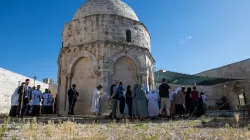
Catholics Ascend to Mount Olives, Site of Jesus’ Ascension, Only Day They Can Use Chapel Currently Under Muslim Control
“I’m excited to have come to pray in the actual place of the Ascension... I want to be closer to God and Jesus,” 14 year-old Joelle Sammour told CNA.

Nigeria’s Makurdi Diocese Orders “immediate” Closure of Catholic School after Attack to “avoid unimaginable disaster”
The Catholic Diocese of Makurdi in Nigeria has ordered the “immediate” closure of Fr. Angus Frazer Memorial High School for the safety of learners and staff after an attack on the institution.
“Barbaric act”, “act of blind hatred”, Catholic Bishops, Pope Francis on Bombing of Mugunga IDP Camp in DR Congo
The bombing of Mugunga camp of Internally Displaced Persons (IDPs) in the outskirts of Goma in the Democratic Republic of Congo (DRC) that resulted in over a dozen deaths and injuries was a “barbaric act”, Catholic Bishops in the Central African nation have said about the attack that Pope Francis has described as an “act of blind hatred”.
Angola’s Political, Civil Leaders “must set an example of service”: Catholic Bishop Emphasizes Patriotism
Angola’s political leaders and civil servants need to take their responsibilities before the people seriously, prioritizing dutiful service, Bishop Maurício Agostinho Camuto of the country’s Catholic Diocese of Caxito has said.