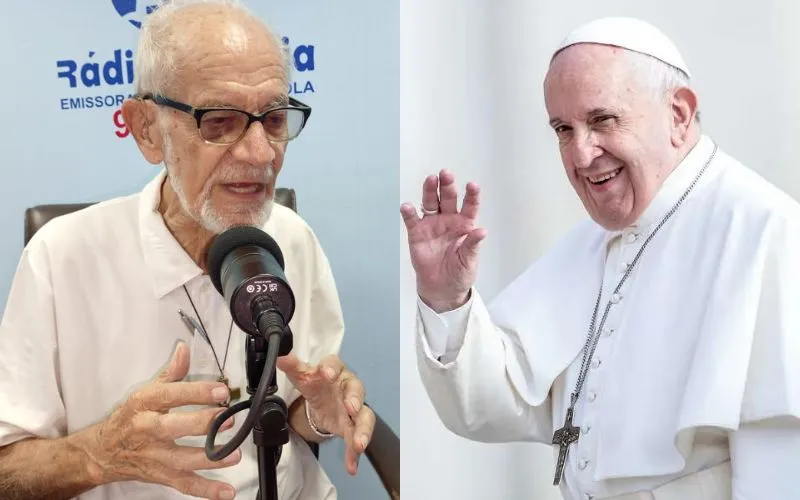
“I saw him grow spiritually, and though I didn’t know he would become Pope, I knew he would have a great impact on the Church because he always sought to be faithful to God and to His principles,” he told ACI Africa.
Fr. Roberto went on to recognize with gratitude Pope Francis’ simplicity and humility as among the most striking aspects of his. He recalled that the late Pontiff “never strayed from his principles, always striving to live the Gospel authentically.”
For the Salesian Catholic Priest, “Pope Francis was a deeply humble man, which is rare in the world today. He was always very close to people. Even as a Cardinal, he was known for his humility and the care he had for the most vulnerable.”
“Pope Francis taught us that the Church must be with the poor, with the marginalized. Pope Francis never cared about the pomp or privileges that often come with the papacy,” Fr. Roberto said.
“He was always more concerned with people’s well-being, especially those living on the margins, and that made all the difference. His choice of the simple name ‘Francis’ was a clear reflection of his identity and mission,” the Argentine SDB Priest in Angola told ACI Africa on May 5.
Fr. Roberto went on to reflect on what for him were the key moments of the late Pope Francis’ Pontificate, saying the late Pontiff “never shied away from going where he was most needed—whether refugee camps or the outskirts of big cities. That touched everyone’s hearts, including mine.”
“Pope Francis had a deep love for the poor, and as missionaries, that’s a lesson we must always carry with us,” the Salesian Priest emphasized.
Asked about the late Pope Francis’ leadership, Fr. Roberto said that the late Pontiff “departed at a very meaningful moment, leaving a legacy that will endure for many years. He taught us to be a Church closer to the people, to practice mercy, and to welcome those who are often forgotten by society. His death is a profound sorrow for all of us.”
The late Pope Francis passed on Easter Monday, April 21. He was laid to rest on April 26 in his “beloved” Papal Basilica of St. Mary Major as he had explained in his testament. The late Pontiff had suffered a stroke that was followed by a coma and an irreversible cardiovascular collapse. He had been struggling with double pneumonia and a respiratory infection.
The April 26 celebration was described as a global farewell to a humble shepherd, who was at the helm of the Catholic Church for a little more than 12 years.