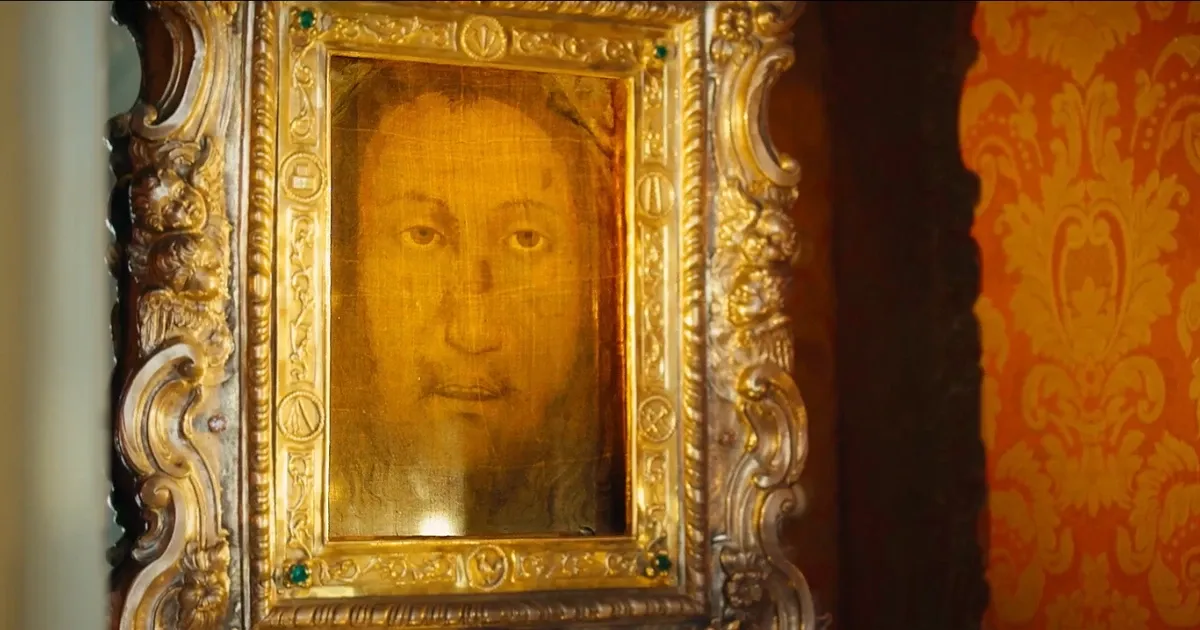
“It’s a beautiful place. You can stand in this small, small church. There are only a few people inside and you … can almost touch the monstrance, which holds this image, and you can look at his face,” he told CNA. “It’s something incredible.”
The least known of the three images, the Veil of Manoppello gained popularity after Pope Benedict XVI’s 2005 visit to the remote village where it is preserved. Also known as the Veil of Veronica, it was discovered in the early 1900s and reveals an image of the face of Jesus, which, according to experts, corresponds to the face in the Shroud of Turin.
Unlike the Shroud of Turin, however, the Veil of Manoppello has no bloodstains and the eyes are open, which, experts suggest, means the cloth shows the face of the risen Lord. Additionally, many believe that the veil is one of the burial cloths seen in the tomb by the disciples Peter and John as told in the Gospels.
Known throughout the world, the Shroud of Turin is an ancient linen cloth that shows the image of what many believe to be the face of Jesus Christ himself. The shroud is kept in the Cathedral of St. John the Baptist in Turin, Italy, and has been the subject of extensive scientific study and public curiosity. The shroud has the imprint of the body of a man wearing a crown of thorns and is covered in bloodstains.
The last time the shroud was publicly displayed was in 2015. While the Vatican does not have an official position on its authenticity, the shroud continues to attract pilgrims from around the world and remains the subject of public interest.
Perhaps more well known than the Shroud of Turin is the Vilnius image of the Divine Mercy, a divinely inspired, hand-painted image based on visions and messages from Jesus to St. Faustina Kowalska.
In 1931, Jesus appeared to St. Faustina in a vision. She saw him clothed in a white garment with his right hand raised as if giving a blessing. His left hand touched his chest, near his heart. From there emanated two large rays, one red and the other white.
Eugeniusz Kazimirowski painted the image under the guidance of St. Faustina and her confessor, Blessed Michael Sopocko. The Divine Mercy image gained popularity in the 1930s thanks to St. Faustina’s writings and in 2000, the Vatican declared the second Sunday of Easter to be Divine Mercy Sunday.
Redziak called the four-year process of making the documentary a “spiritual adventure.”
He explained that the documentary was initially going to be a 20-minute short film that would be shared online only. However, as he traveled, researched, and spoke to more people, it became clear he needed to make it a full-length documentary.