


Advertisement

Catholic Bishop Appeals for Partnerships in Education Initiative in Kenya’s Conflict-ridden Areas

Bishop Cleophas Oseso Tuka of the Catholic Diocese of Nakuru in Kenya is appealing for partnerships to facilitate the realization of formal education among the people of God in conflict-ridden areas of his Episcopal See.

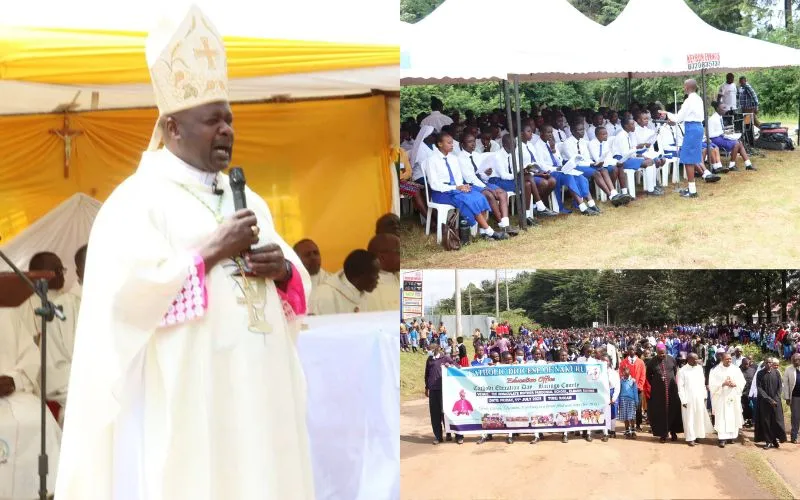
In his homily during the Catholic Education Day in Kenya’s Baringo County, a territory in his Episcopal See characterized with violent conflicts, Bishop Oseso explained that education “is about service” and holistic education offered in Catholic schools is not merely about academic success but about forming God-fearing and disciplined individuals who are committed to service and the common good.

“Catholic education is about service. We are being educated to serve our society, our communities, and our families, to serve all who need help,” he said during the Friday, July 11 event.

He noted the transformative power of education in promoting peace and reconciliation, particularly among communities in conflict such as those in parts of West Pokot, an administrative area his Diocese.

“We often say that people from West Pokot are violent, but what have we done to help them change? If we only complain, nothing will change,” the Kenyan Catholic Bishop said.
Advertisement

To address the conflicts, Bishop Oseso urged the people of God to “make sacrifices to educate them” noting that education “will change their minds and attitudes, and that will be the beginning of transformation in their society.”

“Let education help you to see the needs of others and to respond to them. Let us be kind, generous, and willing to help. Let us help those who have not had access to education,” he appealed.

Members of the Kenya Conference of Catholic Bishops (KCCB) have previously expressed concern over protracted inter-ethnic conflict among members of the Pokot and Turkana communities dwelling at the border of Turkana and West Pokot Counties of the East African nation.

In March 2024, KCCB members emphasized the need to bring to an end the violence in a statement that Bishop Henry Juma Odonya of Kitale Catholic Diocese read out on their behalf during the Kainuk Cross Border Peace Holy Mass.

In the statement, Kenya’s Catholic Bishops urged the government to ensure children in the region have access to education, referring to learners in the affected areas of Turkana and West Pokot Counties.

More in Africa

“Government policy on education is that it is compulsory for all. We are shocked that many children in both counties do not go to school. The government is to make sure all children have access to education and education facilities as a right,” they said.

In his July 11 homily, Bishop Oseso cautioned against ethnic profiling and other forms of discrimination, warning that such practices pose a serious threat to the Kenya’s stability.

“In life, we may divide ourselves into groups, this tribe or that tribe, this side or that side; but if we define ourselves by our tribe, we are lost. Your tribe will not take you anywhere. Discrimination and favouritism destroy even a country,” he said.

The Kenyan Catholic Bishop, who has been at the helm of the Nakuru Diocese since his Episcopal Consecration in May 2023 continued, “We go to school to get rid of such negative thoughts and to see ourselves as children of God. We should not define ourselves by our tribes or regions. We are all Kenyans. That is the purpose of education.”

A good citizen, he said, “is not someone who spreads hatred, lies, or incites violence.”

Advertisement

Bishop Oseso emphasized that even governments invest in education to help citizens “rise above those divisive thoughts” and contribute positively to society.

He urged parents and guardians to take an active interest in their children's education, stating, “We must involve parents because we speak of holistic education.”

For the 57-year-old Catholic Bishop, “Holistic education means everyone plays a role in the life of the child. As a teacher, you may do your best, but if parents fail in their role, it becomes meaningless.”

“In schools where students succeed, there is always strong cooperation between the teacher, the student, and the parent; these three are essential,” he said, adding, “That is why we need to speak to parents, educate them, and make them part of the child’s growth.”

Nicholas Waigwa is a Kenyan multimedia journalist and broadcast technician with a professional background in creating engaging news stories and broadcasting content across multiple media platforms. He is passionate about the media apostolate and Catholic Church communication.