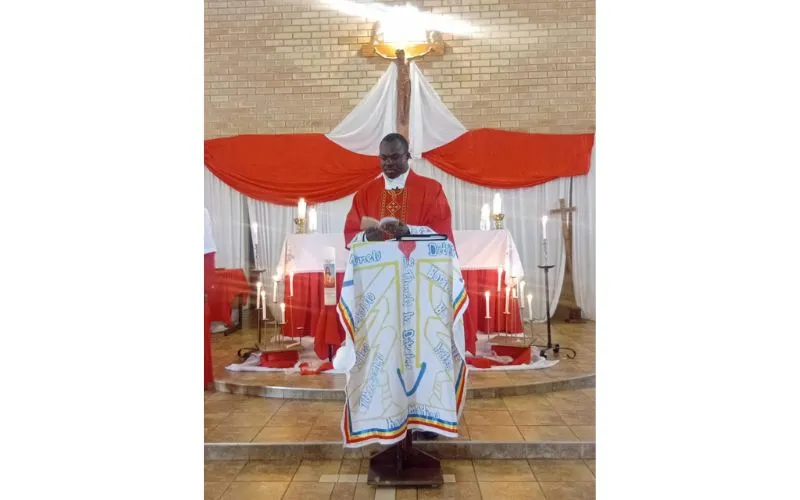
 Fr. Stephen Syambi in South Africa. Credit: Fr. Stephen Syambi
“I was the only Priest available, and so, I took care of all the programs,” he said, and added, “Tuesdays were my office days. I visited the old and the sick on Wednesdays. Thursdays were office and adoration days. Same with Fridays. I did more pastoral work on Saturdays. And on Sundays, I celebrated Mass at the Parish and in our two outstations.”
Asked about how he feels about leaving behind parishioners of St. Ephraim Catholic Parish, the Priest said, “It is a sad situation. It weighs so heavily on me.”
“I left behind a painful situation because two of my parishioners, because of the crime in the country, had been gunned down. And there's a funeral going to happen on Saturday (July 19). And I was supposed to be there as their Parish Priest. People tell me that they are waiting for me to go and baptize their children. But I don't know whether that will ever happen,” he said.
Without a work permit, Fr. Stephen was not at liberty to perform any legal tasks as the Parish Priest.
(Story continues below)
“My hands were tied,” he said, and explained, “Legally, I was not even supposed to be Parish Priest without a work permit. I couldn't sign at the bank for the Parish. And I couldn't append my signature on any Parish projects.”
Fr. Stephen described the Diocese of Klerksdorp as “more or less a growing Diocese.”
“By age, the Diocese of Klerksdorp is old, having been erected in 1978. However, its growth has been slow in terms of numbers, structures and the organization,” he said.
“The parishes there could be compared to the outstations and sub-parishes in most of the Dioceses here in Uganda and in Kenya,” the Ugandan Priest said, and added, “The Diocese is struggling financially. It can’t even pay Priests’ stipends. This is a place where you will find a Bishop without a car.”
Fr. Stephen first went to South Africa in 2017 as a Seminarian to study under the Diocese of Klerksdorp. He left in 2019 to complete his studies in Kenya and went back to South Africa in 2021 to be ordained a Deacon, and a Priest a year later.
For his studies in South Africa, Fr. Stephen was awarded a seven-year study permit in 2017 which was to expire in 2024.
“When I tried to apply to change the permit from study to work, I faced many challenges arising from delays from the authorities concerned,” he said, adding that it would take over a year to get any response from South Africa's department of Home Affairs. And it would always be a rejection.
Fr. Stephen decided to leave South Africa when the intervention of Catholic Bishops in South Africa failed to bear any fruit.
“My Bishop and I agreed that leaving was the only option I had because the anxiety was just getting unbearable for me,” he told ACI Africa referring to Bishop Victor Hlolo Phalana.
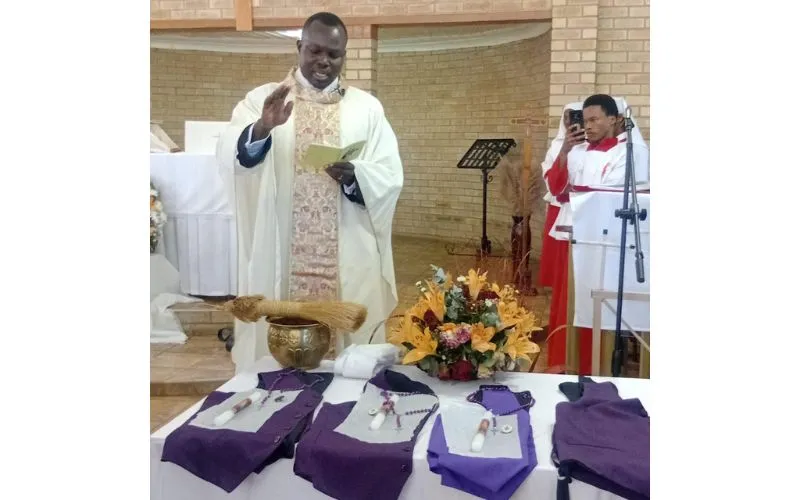 Fr. Stephen Syambi in South Africa. Credit: Fr. Stephen Syambi
“Even after I decided to leave, I still found myself in trouble,” Fr. Stephen said, and added, “Yesterday (July 16) as I was leaving, I encountered authorities who slapped me with a five-year ban, accusing me of being in South Africa illegally. And I tried to explain to them why and how I've been struggling to get hold of my documents, but they still declared me undesirable for the next five years.”
The Priest faulted the lack of proper communication between South Africa’s department of Home Affairs and the Church, saying, “If there was communication, the department would have made things clear for the Church and other entities. We wrote several emails. None was replied to. No phone calls were picked. They share phone numbers which don't work. They basically block all channels of communication with them.”
Sharing a similar experience is , a member of the Clergy of Uganda’s Catholic Diocese of Kiyinda Mityana, who was sent packing from South Africa in May.
Fr. Jude who has been a Priest for 19 years, served as a Fidei Donum Priest in South Africa for nearly a decade.
His first role when he arrived in South Africa in 2016 was in the Catholic Diocese of De Aar at the Cathedral Parish, where he served as the Administrator. He then proceeded to the Eastern Cape to serve in two Parishes while also serving in two other mission stations in the Northern Cape.
“I served in four Parishes at the same time after working at the Cathedral Parish for one year,” Fr. Jude told ACI Africa in an interview on July 17, adding that his two final mission stations were in the De Aar Municipality before authorities sent him packing owing to an expired work permit.
Fr. Jude blames the COVID-19 lockdown, which took away the time he says he would have used to renew his documents, but also authorities in South Africa for further delays.
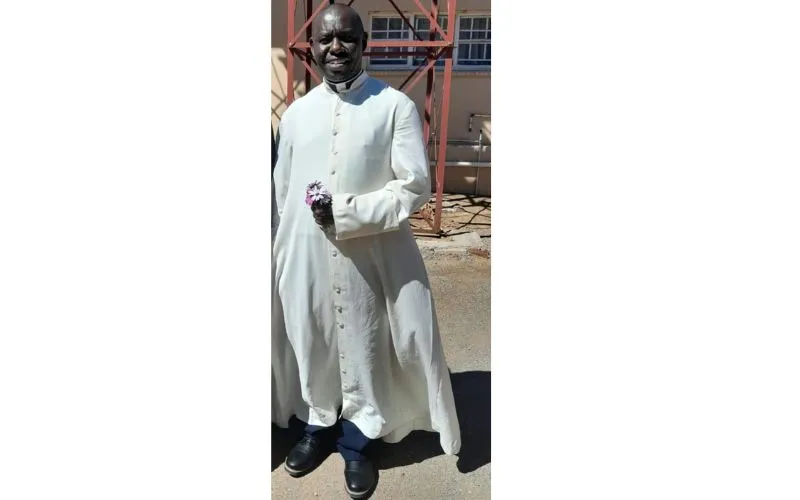 Fr. Jude Thaddeus during pastoral work Credit: Fr. Jude Thaddeus
“If not for COVID-19, my story could be different perhaps,” he said, adding that a lockdown in his native country Uganda, where he had gone to have his passport, driving licence, and other documents renewed, messed up his plans.
Fr. Jude was lucky when he managed to have his fingerprints submitted to the police. “I was asked to pay for the quick delivery of my fingerprints. Months later, I started receiving emails from the police in Pretoria, assuring me that they had received my fingerprints and that everything had been worked on.”
“I waited and waited but the results of my fingerprints did not come,” he said, and added, “I was late for the visa application because of this. I attribute my delay to not receiving the police fingerprints in time, but also the inconvenience that was caused by COVID-19.”
Fr. Jude agrees that deporting Catholic Priests from South Africa hurts the country, where vocations have gone down compared to other African countries.
“Certainly, (there is) a great gap that I created when I left. While in South Africa, I served three Parishes every Sunday, and I also had weekly spiritual exercises. All those had to stop after my departure because there was no other Priest to take over from me,” he said.
“So, there is a lack of spiritual assistance to the people, and the spiritual anger is going to be so high,” Fr. Jude told ACI Africa referring to the people of God in parts of De Aar Diocese.
The Local Ordinary is going to be “the most burdened bishop I think I have ever seen,” he added referring to Bishop Adam Leszek Musiałek, the 68-year-old South African member of the Congregation of the Priests of the Sacred Heart (SCI), who has been at the helm of De Aar Diocese since his Episcopal Consecration in September 2009.
In the interview with ACI Africa, Fr. Stephen appealed for collaboration between the South African government and the Church in the country, noting that “frustrating” foreign missionaries in South Africa is self-sabotaging.
“My appeal is for South Africa to understand that the Church is an important institution in the community. Whether you are a Christian or not, you will realize that the presence of the Church contributes a lot to the cohesion of the community, to the peace of the community, to the growth and formation of young people,” he said.
“If the Church is not helped to grow, we are most likely going to end up with a society where people have no faith, have no sense of hope, end up doing things that are just terrible,” he said, and added, “Crime increases because people have become ungodly.”
Fr. Stephen underlined the need for the South African government to realize that the Church is there to help and be willing to facilitate Priestly ministry, making it easier.
“The government should partner with the Church other than sabotaging the work of the Church. When all is said and done, my frustration is not just my personal frustration. It's the frustration of the Church, of the Diocese of Klerksdorp,” he told ACI Africa on July 17.
Agnes Aineah is a Kenyan journalist with a background in digital and newspaper reporting. She holds a Master of Arts in Digital Journalism from the Aga Khan University, Graduate School of Media and Communications and a Bachelor's Degree in Linguistics, Media and Communications from Kenya's Moi University. Agnes currently serves as a journalist for ACI Africa.





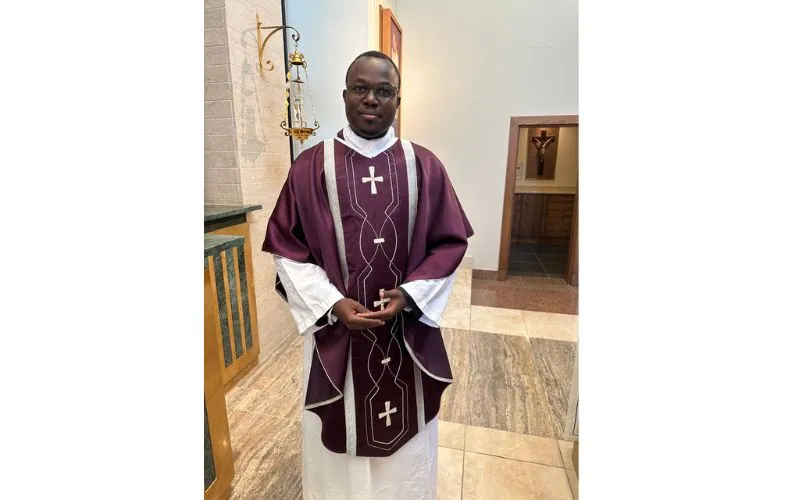 Fr. Stephen Syambi in South Africa. Credit: Fr. Stephen Syambi