

Advertisement

Human Rights Must Shape Future Priests: Catholic Official in Angola Calls for Rethinking Seminary Formation

Credit: Sheila Pires

Future Priests must be shaped by a commitment to human dignity if they are to truly serve the people of God, the Program Coordinator at the Mosaiko – Institute for Citizenship, a human rights institution established by the Dominican missionaries in Angola, has said, proposing that human rights become the pillar of Priestly formation.

In an interview with ACI Africa, Sr. Cecília Prudêncio emphasized that placing human rights at the heart of Priestly formation is vital for preparing pastors who are sensitive, socially conscious, and committed to human dignity.

“Thinking about God and thinking about the human being cannot be separate tasks, since human dignity is central to the Christian faith,” Sr. Prudêncio told ACI Africa on Tuesday, July 22.

She explained, “The Universal Declaration of Human Rights is the key document where the dignity of every human being is recognized, regardless of gender, religion, color, or any other condition. And this must be incorporated into the formation of our seminarians from the very beginning.”

Sr. Prudêncio underscored the need to integrate reflection on human rights into the theological formation of future Priests. 
Advertisement

She stated that such integration is essential “so that they can exercise pastoral leadership that is sensitive, conscious, and truly committed to the dignity of the human person.”

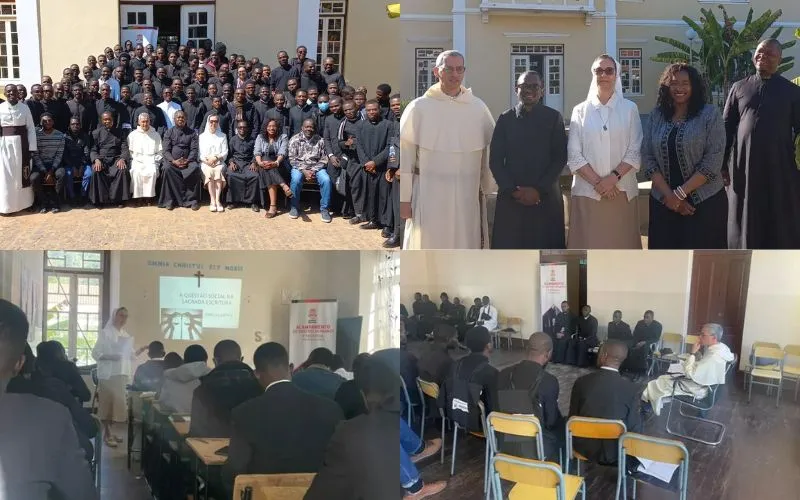
The Peruvian member of the Congregation of the Apostolic Heart of Jesus (ASCJ) who spoke to  ACI Africa following the July 15 to 20 Human Rights and Theology Seminar held at the Father Leonardo Sikufinde Major Seminary, in the Catholic Archdiocese of Lubango in Angola, described the gathering as “a rich and transformative experience.”

“Our goal was to create a space of shared learning where theology and human rights could engage in dialogue, focusing on the human person as a creature of God,” Sr. Prudêncio said.

The six-day event in Angola featured discussions on key themes from the Synod’s final document, such as inclusion, active listening, and fair treatment of religious workers, with special attention to the often-overlooked contributions of religious women.

It brought together over 100 final-year theology Seminarians from the five major seminaries in Angola: Luanda, Huambo, Benguela, Lubango, and Kwanza-Sul.

More in Africa

A key objective, she explained, was to offer future Priests a critical reflection on their pastoral mission in light of human rights. 

“Priests are community leaders with influence both inside and outside the Church. If they lack social awareness, they cannot be true shepherds,” the Catholic nun said.

Sr. Prudêncio also clarified that the event aimed to nurture holistic pastoral awareness—not political activism. 

“We’re not forming activists. We’re cultivating a Christian commitment to life and human dignity, which is essential in priestly formation anywhere in the world,” she said.

The Peruvian Catholic nun lamented the stigma around activism in Angola, where advocacy for the poor is often misinterpreted as political opposition. 

Advertisement

“As a Brazilian Bishop once said, ‘If I give bread to the poor, I’m charitable; if I ask why the poor are hungry, I’m called a communist.’ That mindset must change,” she said.

The seminar featured leading voices from across Africa and beyond. Among them was Sheila Leocádia Pires, Communications Officer of the Southern African Catholic Bishops’ Conference (SACBC) and Secretary of the Synod on Synodality Commission for Information.

Sr. Prudêncio described the experience as “overwhelmingly positive.”

“We celebrated, first of all, the positive response from the five seminaries and the active participation of the theology students. We also celebrated the critical thinking, the questioning, the unease. We didn’t aim to provide all the answers, but rather to provoke reflection—and we succeeded,” she said.

The Catholic nun also praised the collective effort of Mosaiko’s training team, saying, “It was a team effort. We had the support and openness of the leadership at the Lubango Major Seminary, which also contributed greatly to the success of the initiative.”

(Story continues below)

João Vissesse is an Angolan Journalist with a passion and rich experience in Catholic Church Communication and Media Apostolate.