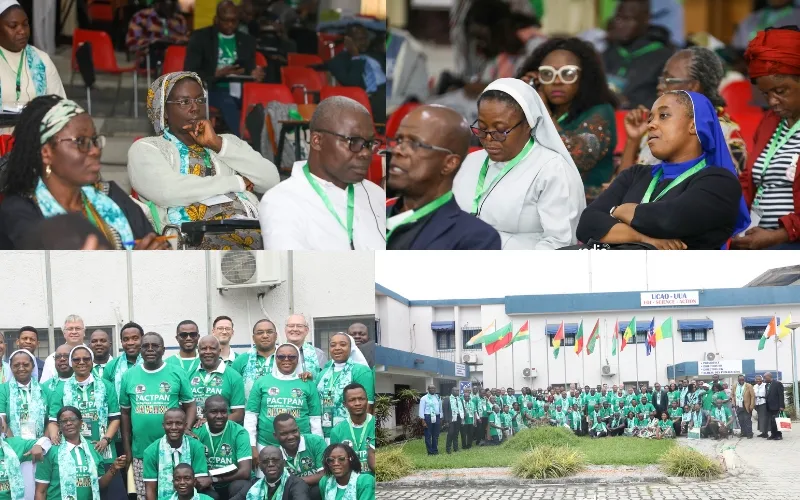
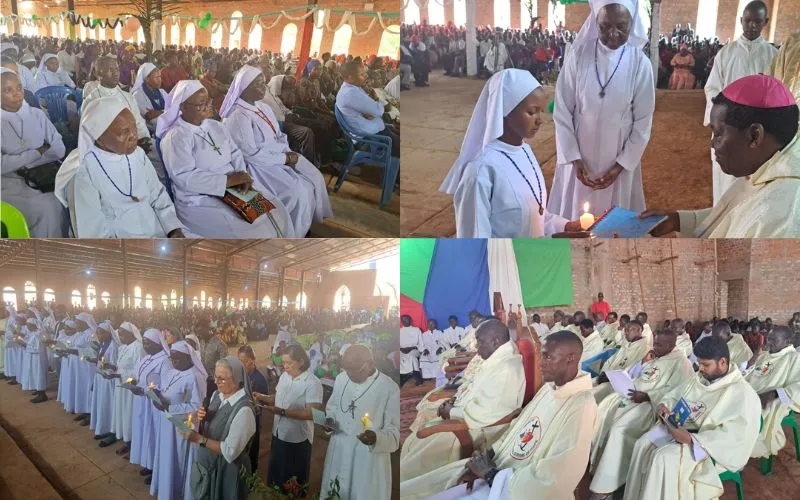
“These missionaries are not beggars or employees but servants of the Gospel,” he said, and explained, “When the Church in Africa sends labourers into the vineyard of the wider world, she must also assume the pastoral and institutional responsibility of sustaining them in their mission, so that they may remain focused on the sacred duties entrusted to them.”
He proposed that Catholic Bishops’ Conferences and Religious Superiors establish dedicated funds and systems of support for Fidei Donum personnel and missionary workers abroad, adding, “Such provision is not merely administrative prudence but an expression of ecclesial communion and spiritual solidarity.”
“Mission is not an exchange of services but a sacrificial offering. It must be protected from the temptations of dependency and reduced expectation,” he said.
“The Church of the Sheaves cannot remain a rhetorical vision,” he said, and explained that the Church in Africa must be embodied through deliberate structures that enable Africa’s sons and daughters to serve with freedom, dignity, and unwavering commitment.
“In this way,” he said, “the missionary presence of Africa will be received not as a request for aid, but as a witness to Christ’s self-giving love and the fruitfulness of the Gospel sown in African soil.”
(Story continues below)
In his presentation, Archbishop Nwachukwu also underscored the need to end what he described as “the crib mentality” within the Church in Africa, and called for a shift in ecclesial consciousness from dependence to maturity.
“Too often, Africa’s voice in the global Church is treated as a cry from the crib: well-meaning but not yet mature, not yet serious,” he said.
According to the Archbishop, Africa’s “baby-syndrome” is sustained by a receiving mentality shaped by decades of foreign aid, subsidies, and subventions from the Churches in the West.
He warned that as long as the Church in Africa presents herself as “a permanent recipient”, her voice will be interpreted as that of one still being fed, not feeding others, a typical “voice of the baby in the crib.”
“The image of the crib should strike us,” he said, and explained, “This crib mentality and its accompanying dependency have tended to become habitual, even when the conditions that necessitated them have long changed.”
He said that a century after the establishment of many local Churches, the Church in Africa must give credible signs of her own maturity. “This does not mean the rejection of help or solidarity. Rather, it means showing initiative, sustainability, and a readiness to stand on her own ecclesial feet,” he clarified, and added, “Maturity is marked not by isolation, but by the capacity to give, sustain, and serve. The Church of the Sheaves cannot remain in the crib.”
Archbishop Nwachukwu challenged Catholic Bishops’ Conferences in Africa to create mission-oriented funds and endowments for supporting missionaries of the local Church, especially those working elsewhere.
“Africa has the capacity. It only needs the will and the structures to harness it,” he said, and added, “Africa cannot continue to plead incapacity while others have planted, watered, and waited.”
“The time of sowing in tears has passed. The sheaves are ready,” Archbishop Nwachukwu said.
Agnes Aineah is a Kenyan journalist with a background in digital and newspaper reporting. She holds a Master of Arts in Digital Journalism from the Aga Khan University, Graduate School of Media and Communications and a Bachelor's Degree in Linguistics, Media and Communications from Kenya's Moi University. Agnes currently serves as a journalist for ACI Africa.