

Advertisement

Align Anti-Trafficking Initiatives with United Nation’s 2030 SDGs, Catholic Nun in Zimbabwe to Church in Africa

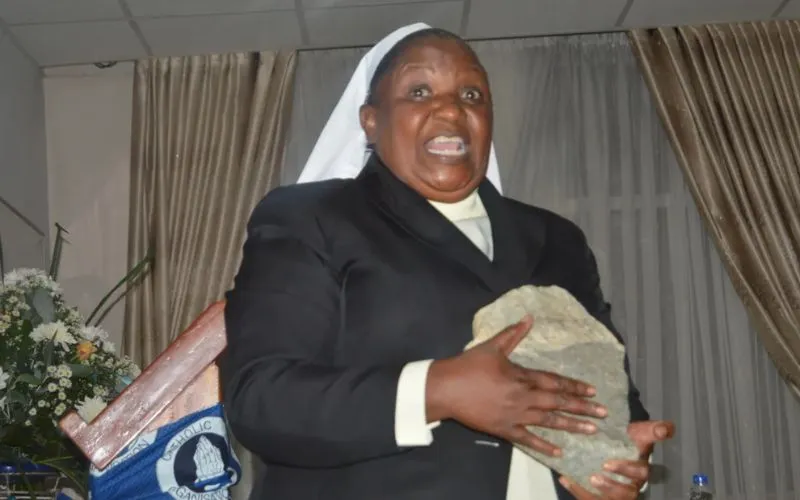
Sr. Diana Kanyere. Credit: Catholic Church News Zimbabwe

Church efforts to end human trafficking in Africa risk being reactive rather than preventive if the underlying socio-economic vulnerabilities that drive the crime are not addressed, the National Coordinator of Zimbabwe’s Talitha Kum Network has warned.

In a presentation on human trafficking shared with ACI Africa on Friday, August 22, Sr. Diana Kanyere has recommended aligning anti-trafficking action with the United Nations (UN) 2030 Sustainable Development Goals (SDGs), which she says provide a “comprehensive framework for addressing the root causes of human trafficking.”

“By aligning anti-trafficking strategies with the United Nations Sustainable Development Goals (SDGs), the Church can build concrete action, replacing exploitation with empowerment, and despair with hope,” Sr. Kanyere says in her five-page document titled, Strengthening the Church's Fight against Human Trafficking: A Vision for Inclusive Global Action.

She emphasizes the need for the Church in Africa to take a distinctive role in fostering this alignment by integrating anti-trafficking goals into national SDG plans and development programs.

SDG 8 on decent work and economic growth, and SDG 16 on peace, justice, and strong institutions, are particularly relevant,” she states, pointing to its target 8.7, which calls for the eradication of forced labour, modern slavery, and human trafficking by 2030.
Advertisement

In her paper, the member of the Congregation of the Little Children of Our Blessed Lady (LCBL) also highlights SDG targets 8.5 and 8.6, which focus on the prevention aspect of human trafficking, including unemployment and the proportion of young people outside education, employment, or training.

Sr. Kanyere says, in an era defined by unprecedented technological advancement and global interconnectivity, “the moral crisis”, particularly “the persistence and expansion of human trafficking”, cannot be ignored.

“This crime is not a relic of the past but a thriving, multi-billion-dollar industry that preys on the most vulnerable. For millions, the promise of opportunity is replaced with the chains of modern slavery,” says the Talitha Kum official.

The Zimbabwean Catholic Nun, who was part of the delegation of 10 Catholic Sisters at the five-day Group of 20 (G20) Interfaith Forum (IF20) that concluded on August 14 emphasizes that “the Church, representing the most influential voices on the global stage, holds not only the power but also the responsibility to change this narrative.”

“By addressing the systemic roots of vulnerability, including poverty, unemployment, inequality, and weak protection systems, the Church can set a course toward a world where exploitation is the exception, not the norm, and where every human being can live in dignity and freedom,” she said.

More in Africa

Sr. Kanyere advocates for “a decisive and coordinated action” to end the cycles of exploitation, particularly among communities already facing entrenched poverty, unemployment, and limited access to education and social protection.

“The year 2030 is not a distant horizon; it is an urgent deadline. If we act decisively today, the Church can build a legacy of courage, compassion, and justice that will resonate for generations to come,” says the Zimbabwean LCBL member.

Nicholas Waigwa is a Kenyan multimedia journalist and broadcast technician with a professional background in creating engaging news stories and broadcasting content across multiple media platforms. He is passionate about the media apostolate and Catholic Church communication.