Advertisement

Church Nigeria’s “last moral voice”: Catholic Bishop Urges Journalists to Defend the Church, Promote Hope amid Crisis

Credit: ACIA Africa

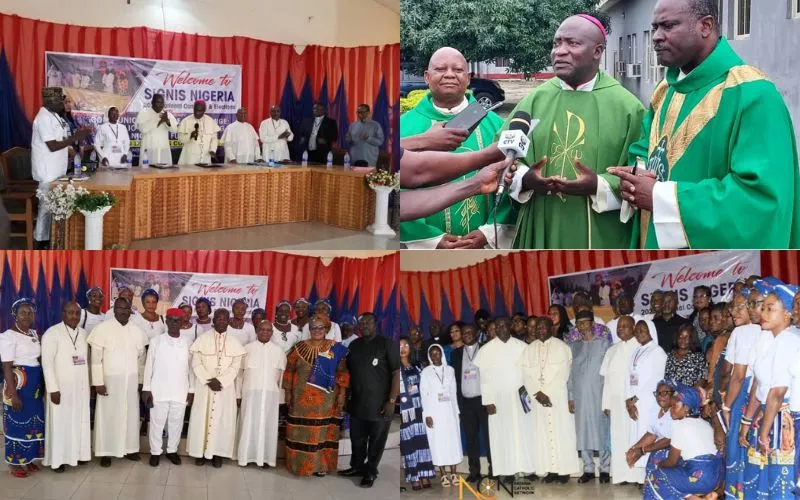
Bishop David Ajang of Nigeria’s Catholic Diocese of Lafia has called on Catholic media practitioners to defend the Catholic Church, arguing that the institution remains the country’s “last moral voice” in a society where morality is in rapid decline.

Speaking to ACI Africa on the sidelines of the 3rd SIGNIS Nigeria National Congress held at the Daughters of Divine Love Retreat and Conference Centre (DRACC) in the Catholic Archdiocese of Abuja, Bishop Ajang said, “Whatever comes against the position of the Catholic Church, we have an obligation as Catholic media practitioners in Nigeria to defend it.”

“Don’t forget that the Catholic Church today is like the last line of defense. Every other pillar has been destroyed,” the Nigerian Catholic Bishop told ACI Africa on September 5.

He acknowledged that critics, including a section of other Christian denominations often attack the Catholic Church, undermining its crucial role in society. Weakening the Church, he warned, would leave the nation without a credible voice to hold leaders accountable.

“Even some Christians who, in error, attack the Catholic Church overlook the fact that by the time this institution is destroyed, then we have no moral voice to listen to,” Bishop Ajang said.

Advertisement

The Local Ordinary of Lafia Diocese since his Episcopal Consecration in June 2021 admitted that Catholics, like all people, fall short of their ideals, and went on to challenge Nigerians to distinguish between human weakness and the Church’s teaching.

“With all our inadequacies, with all our human nature, you have to make a distinction between what the Church stands for and what those who practice the faith preach. Sometimes our humanity, our human nature, takes the better part of us and shows us to be like hypocrites. But overlook that sometimes and look at what the Church stands for,” Bishop Ajang said.

He added that the Church’s service extends beyond its members, especially in education, healthcare, and moral advocacy.

“Even those who are not Catholics, if they know what the Church does for them as an institution, especially those of them who are Christians, then they will be people who support whatever the Church stands for,” Bishop Ajang said.

Reflecting on the theme of the Congress, “Communicating Hope and Change: Catholic Media Roles in Shaping Nigeria’s Future”, Bishop Ajang who chairs the Social Communications Commission of the Catholic Bishops’ Conference of Nigeria (CBCN) challenged Catholic journalists to encourage leaders to inspire hope through concrete action.

More in Africa

“While we encourage them, we must be at the forefront of encouraging those in power to try and see that they make that a reality which people see. Where that happens, then the hope can be kept alive in people,” he said.

Bishop Ajang emphasized that “hopelessness” should never be an option for Catholics.

“The one thing we must never talk about is hopelessness, no matter how bad the situation looks. For the Catholic who really qualifies as a Catholic, hopelessness should not be an option at all,” he reiterated.

He went on to urge Catholic media practitioners to keep hope alive even in the face of insecurity and poor governance. Bishop Ajang said, “The one thing you must never allow to die in you is hope. Once hope is gone, then the whole human person is gone.”

The Local Ordinary of Lafia Diocese called upon Catholic journalists to root their work in humanity, saying, “My message would be, first of all, humanity first. Everything you do, humanity first. And our needs are basically the same—for respect, for justice, for a good life.”

Advertisement

In another interview with ACI Africa on the sidelines of the same event, the 3rd SIGNIS Nigeria National Congress, the National President of the Association of Retired Career Ambassadors of Nigeria (ARCAN), Ambassador Joe Keshi, called on Catholic media practitioners in Nigeria to rise beyond their traditional role of disseminating information and become instruments of evangelization, hope, and social transformation.

“Catholic media is not just owned by the Church, but a missionary instrument, an extension of evangelization. It is all about spreading the Good News, teaching, explaining, and defending the doctrines and teachings of the Catholic Church,” Ambassador Keshi, who was the guest speaker at the September 3-5 SIGNIS Nigeria National congress said.

He challenged Catholic media outlets in Nigeria to follow the example of Vatican Media and EWTN by offering Catholic perspectives on global and national events.

“It must provide Catholic viewpoints on events, shape discussions on ethics, faith, and the digital world, and offer credible information for Catholics,” he said.

Turning to Nigeria’s national crisis, Ambassador Keshi described insecurity, economic stagnation, corruption, unemployment, and deepening ethnic and religious divisions as symptoms of failed leadership.

(Story continues below)

“Nigeria faces an absence of visionary leadership and the absence of elite consensus. Our youth feel disappointed, and this is why we have the japa syndrome, which negatively affects our health and education systems,” he said referring to the slang term for the mass emigration of Nigerians to foreign countries, often in search of better socio-economic opportunities, education, and a higher quality of life.

Catholic media must become a beacon of hope and an engine for change, Ambassador Keshi said, and added, “Communicating hope alone is not enough. Catholic media must campaign vigorously for change and mobilize the people to demand and work for it.”

He urged Clergy and women and men Religious involved in communications to be well-prepared and credible voices. “You must have the knowledge, the capacity, and the competence. Priests and Religious should be well educated, articulate, and grounded in history, social sciences, and philosophy. Their writings and speeches should earn respect, not just for their arguments but for their intellectual depth,” he said.

The diplomat expressed concern about Nigeria’s collapsing value system, and called upon Catholic media to prioritize integrity, justice, and civic education.

“Several people now believe that doing the wrong thing is the right thing. The media must promote values, engage in civic education, and help Nigerians understand their rights and responsibilities,” he said.

For him, Catholic media practitioners must embrace technology, remain courageous, and continue speaking truth to power.

“Being enlightened and strong on the issues enables you to fight the battles of today,” Ambassador Keshi said.

Abah Anthony John is a Nigerian Catholic journalist with passion for Church communication and media apostolate. He holds a bachelor’s degree in mass communication from Benue State University, Makurdi in Benue State Nigeria. He has a background in print, electronic and multi-media production.