

Advertisement

Illegal Mining “cancer in Ghana’s national soul”, Catholic Bishops Lament, Call for State of Emergency in Mining Zones

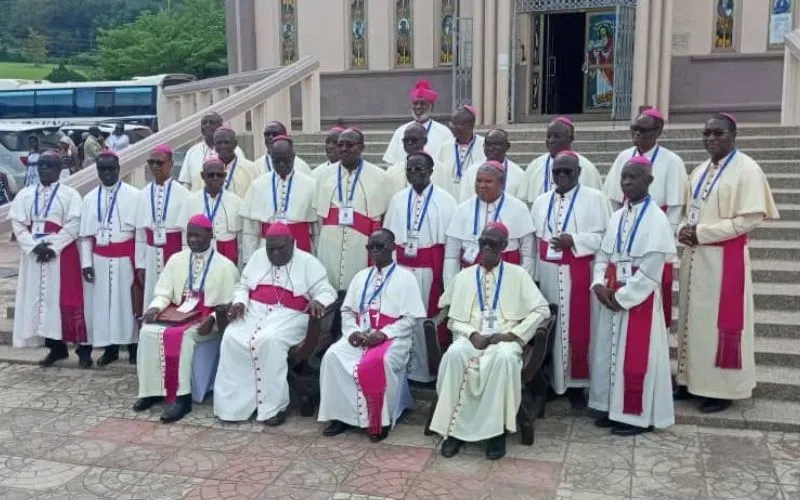
Members of the Ghana Catholic Bishops Conference (GCBC). Credit: GCBC

Ghana’s Catholic Bishops have reiterated their concern about the spread of illegal mining in the country and urged the government to declare a state of emergency in “mining zones” as a step toward addressing the perennial challenge that has attracted condemnation from other Church institutions.

In a Monday, September 15 statement, members of the Ghana Catholic Bishops’ Conference (GCBC) describe the illegal and unregulated mining, commonly known as Galamsey, as “cancer” which they say has currently become one of the gravest afflictions in the West African nation.

Galamsey, the Bishops say, “ravages our rivers and forests, poisons our soil, endangers public health, corrupts governance, erodes our moral fibre, and extinguishes livelihoods.”

“This is not a routine challenge to be managed with half-measures; it is a national emergency requiring decisive, extraordinary response,” GCBC members say, and add, “We therefore urge the President and his government to declare, without hesitation, a state of emergency in the most affected mining zones and around endangered water bodies.”

A declaration of the state of emergency, they continue, “would empower extraordinary interventions: curfews in volatile areas, the securing of devastated lands, the dismantling of entrenched criminal syndicates, and the halting of corrupt administrative complicities. The scale of the crisis justifies nothing less.”
Advertisement

Ghana’s Catholic Bishops recall that God has entrusted human beings with stewardship of the earth and explain that to “desecrate creation through galamsey is not only an offence against neighbour; it is a grave sin against God Himself, the Creator and Owner of all.”

GCBC members warn of dire consequences resulting from desecrating creation as “farmers can no longer trust the land to sustain their families, and our capacity to feed the nation diminishes.”

Ghana’s Water Company strains at great cost to deliver the service and traces of mercury, arsenic, cyanide, and chlorine persist in what is supplied to the people of God, they lament.

Most concerning, GCBC members note, is that children, lured by the illusion of quick wealth, abandon school for dangerous mining pits, with many tragically losing their lives in collapses that could have been prevented.

“The poisons of mining seep silently into our food chain, breeding cancers, skin diseases, kidney failure, and neurological disorders,” they further lament.

More in Africa

For them, “The rot is not only ecological. Galamsey has become a cancer in our national soul.”

They warn that illegal mining corrodes politics, governance, and moral conscience, and note that some politicians, Members of Parliament, Municipal and District Chief Executives, traditional figures, faith leaders, and even security agents have been implicated in the vice.

GCBC members say they find it regrettable that a section of leaders shield illegal operators for personal gain, granting illicit concessions, or remaining silent when duty demands bold speech.

“This betrayal of trust cuts to the very marrow of our national identity. We call such leaders to repent without delay,” they appeal, lamenting that galamsey has matured into a threat to national security.

They find it unfortunate that as the vice enriches criminal cartels, breeds lawlessness, and foments violent conflicts in mining communities, Ghana’s President, John Dramani Mahama, “appears not to grasp the existential scale of the menace.”

Advertisement

Referring to their previous concerns on the vice of illegal mining, Ghana’s Catholic Bishops say that the country’s President has ignored their appeals “with unsatisfactory responses focused narrowly on economic gain.”

They describe President Mahama’s response as “profoundly troubling,” and add, “The hour is late. Delay is betrayal. Now, not tomorrow, not later, is the time to act.”

In the two-page statement that their President, Bishop Matthew Kwasi Gyamfi of Ghana’s Sunyani Catholic Diocese signed, GCBC members say that besides the state of emergency, the country also requires a holistic, integrated national strategy.

“Laws governing mining must be revised, sharpened, and rigorously enforced, with stiffer penalties for offenders,” they say and add that specialized courts should be established to expedite prosecutions.

They also say that “a permanent, well-resourced, and corruption-proof task force must be constituted, comprising security services, environmental experts, and local authorities, to ensure consistent enforcement beyond transient crackdowns.”

(Story continues below)

Emphasizing that justice must be tempered with mercy, they want those driven to galamsey by desperation to be provided with sustainable alternatives, including the establishment of properly regulated small-scale mining zones reinforced with environmental safeguards and technical support.

Displaced farmers, GCBC members say, should be restored with land, credit, and training. They further recommend the launch of a nationwide afforestation and reclamation programme “not only to heal the scars of destruction but also to provide dignified employment, especially for the youth.”

“We appeal to President Mahama to show the courage of leadership,” they say, and add, “His government must prosecute not only the poor but also the powerful; not only the weak but also the well-connected. Without courage, no policy will stand, no law will hold, no declaration will succeed.”

The Catholic Church leaders urge all Ghanaians to resist the lure of quick wealth, which they say leaves their children a desert in place of a homeland.

They urge the chiefs to remember their sacred responsibility as custodians of the land and ask Ghana’s politicians to prioritize the country above personal and partisan advantage.

Ghana’s Catholic Bishops want faith leaders to speak prophetically without fear or favour and the security agencies to act with integrity, be defenders of the people, not accomplices in their betrayal.

Silas Mwale Isenjia is a Kenyan journalist with a great zeal and interest for Catholic Church related communication. He holds a Bachelor’s Degree in Linguistics, Media and Communication from Moi University in Kenya. Silas has vast experience in the Media production industry. He currently works as a Journalist for ACI Africa.