


Advertisement

“Watch the space of young Women” for Africa’s Future, Catholic University Don Urges at International Bible Conference

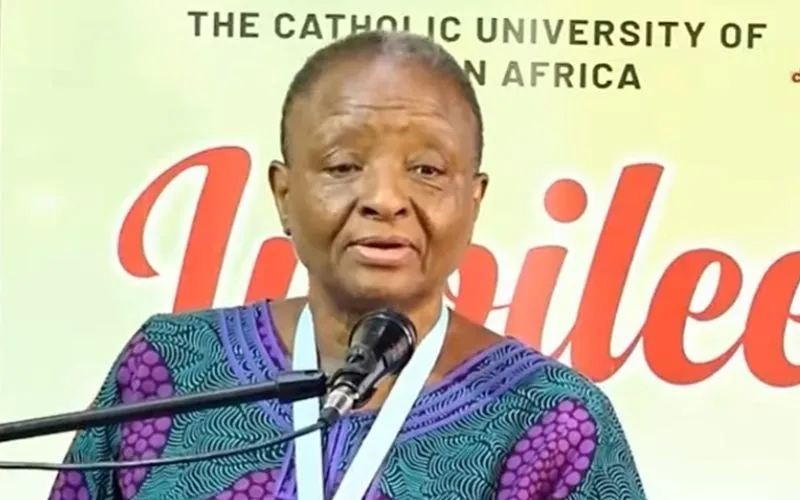
Prof. Mary N. Getui

The space of young women in various sectors and spheres of life needs to be protected and nurtured for the future of the African continent, a lecturer at the Kenya-based Catholic University of Eastern Africa (CUEA) has said.

In her keynote address at the International Conference on the Bible held from October 6–8 under the theme, “Bible, Women, and Societal Issues within Africa,” Prof. Mary N. Getui used the courage of young women in Scripture to emphasize the importance of creating space for women’s participation in all sectors of contemporary society.

“The ideas of women are of benefit to the wider society. The future of Africa, watch the space of youth, watch the space of young women,” Prof. Getui said in her Monday, October 6, presentation titled, “Young Women and Leadership in the Bible: Lessons for Contemporary Africa.”

Scheduled to end on Wednesday, October 8, the three-day event has been organized by CUEA in collaboration with the Catholic Biblical Centre for Africa and Madagascar/Nairobi (CEBAM), and the Institute of Missiology Aachen – Germany.

The event has brought together scholars who are to present on various topics, including “Young Women and Leadership in the Bible: Lessons for Contemporary Africa,” “Women's Stories in Mark (5:21-16:20) Intercultural Narratives, and Biblical Teaching on Women and Marriage.”
Advertisement

Other topics include “The Sage Woman: Reading Proverbs." 31:26-31 in an African context, “His or Her – Story (Gen 27:1-17)? An Afrocentric Appreciation of Women in the Book of Genesis,” and “African Women’s Interpretations of Scripture: A Hermeneutic of Resistance and Hope,” among others.

In her October 6 keynote address, Prof. Getui cited three biblical examples—Miriam from Exodus, the daughters of Zelophehad from Numbers, and the captive young girl from 2 Kings—to illustrate how contemporary society can draw lessons on leadership and courage from these women.

She said that the first lesson to be learned from the three cases is that young women in contemporary society should take the initiative and show creativity.

The women “are present at the critical moment,” she said, and added that Miriam, for example, stands at a safe distance for full view, and she was the first one to talk to Pharaoh's daughter.

“Getting the full view is important, being present at that critical moment. It is also important, as we talk about young women and leadership and the Bible, that it’s important to take the first move,” she said.

More in Africa

From the cases, Prof. Getui said that young women should also prioritize dialogue, especially with those in power.

“Sometimes it is we who have the power to give power, more power than power deserves. I'm just trying to say that each one of us has power, but we cannot help it,” the Professor who lectures at CUEA’s Department of Religious Studies said.

Acknowledging the hierarchies in today’s society, Prof. Getui emphasized that “seeking dialogue with those in power” offers the best solution, as illustrated in the three biblical examples.

In her keynote address, the CUEA lecturer also underlined the need to embrace family as illustrated by the women in the Bible, saying, “We also find that there is a need to be mindful of the family and its welfare.”

Identifying herself with the school of thought recognizing the importance of family, Prof. Getui said that “if we get it right at the family level, then issues of school, of the wider society, of the Church, will actually fall in place.”

Advertisement

The author of the book titled “African Culture in the 21st Century, Persistence, Opportunities, Challenges and Prospects”, among other books, said that another lesson to be learned from the biblical women is that of challenging a culture that sidelines women.

Having existed since time immemorial, Prof. Getui said that a challenging culture cannot remain the same even in contemporary society.

“Unity of purpose is another important aspect that we learn from these young women, as outlined in the Bible. A unity of purpose,” she said in her October 6 presentation, and added, “We don't work alone.”

She explained, “Just to be more specific, the daughters of Zelophehad came together, they put their case clearly and systematically, gave a clear account and articulation of the issue at hand. Miriam stood before Pharaoh's daughter. The approach determined whether she broke or made.”

From the Bible, Prof. Getui said, “We also learn that in all three cases, there is a need to seek counsel— there is a need to consult, including seeking the counsel and intervention of the divine.”

(Story continues below)

As human beings, she said, “we don't have control over many things, and so in leadership, young people, we cannot rule out the place of the divine.”

She also urged those in leadership positions to mentor the young by listening to them, saying, “Age should not be despised. The mouths of babes also have wisdom; status and position do not necessarily determine leadership.”

“Never withhold an idea that could benefit others; instead, cultivate the virtue of listening,” she urged, calling on older women to mentor and support the younger generation. Prof. Getui illustrated this point with the biblical example of Naaman’s wife, who humbled herself to heed the counsel of her servant girl—a gesture that ultimately led to her husband’s healing.

Silas Mwale Isenjia is a Kenyan journalist with a great zeal and interest for Catholic Church related communication. He holds a Bachelor’s Degree in Linguistics, Media and Communication from Moi University in Kenya. Silas has vast experience in the Media production industry. He currently works as a Journalist for ACI Africa.