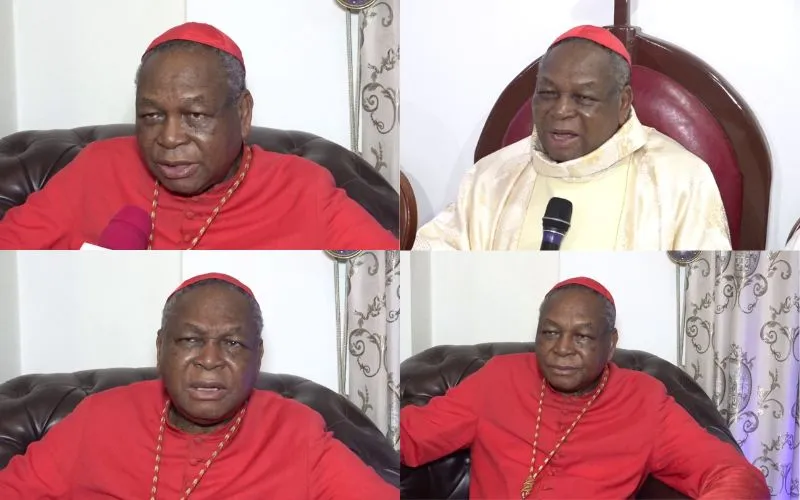
“The day I was ordained, I accepted [that I might have] to be a martyr. Therefore, I must speak the truth,” the archbishop, 66, replied solemnly. “Like Jesus, the way he reacted to injustice in his time, that’s how I act today, before injustices in my country. I do this because I follow Jesus Christ.”
Parish Life
Every Sunday, Archbishop Kleda visits one of the archdiocese’s 88 parishes. On Sept. 28, the destination was Saint Marc de la Cité des Palmiers. The number of faithful has doubled since he took charge in 2009; he has managed the construction of 46 new churches and St. Jerome Catholic University.
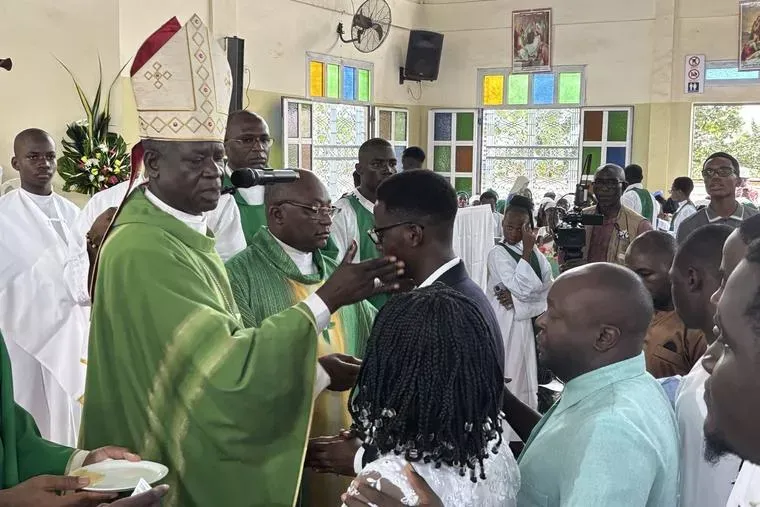
From the moment he unfolded his 6-foot-5 frame from the car at St. Marc’s, the archbishop was surrounded: by dance and incense, babies and seminarians, blessings and songs. The circular nave and balcony overflowed with more than 1,000 parishioners, together to celebrate Mass and witness two sacraments, Holy Communion and confirmation, being bestowed on some 90 youths and adults.
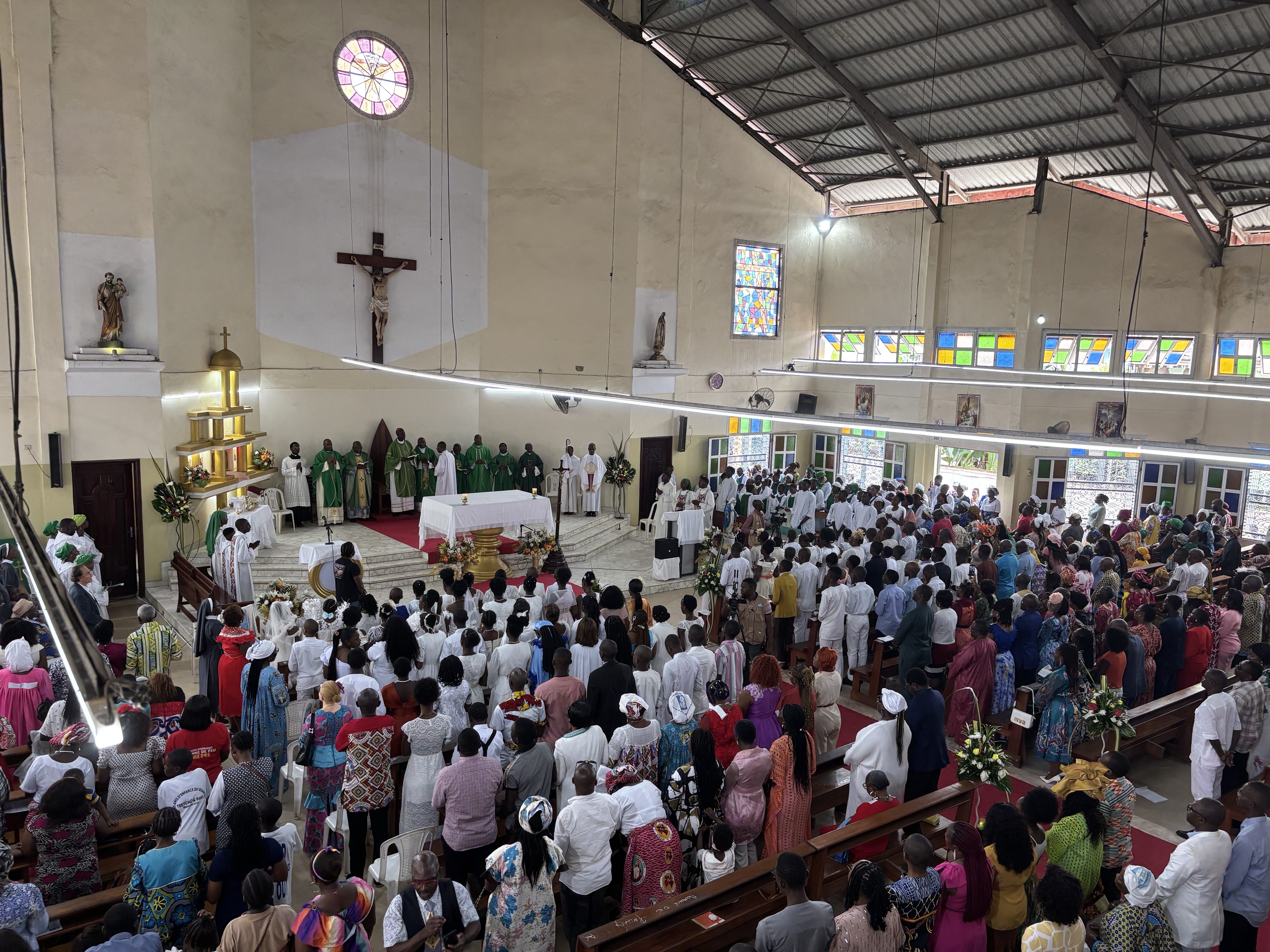 The parish of St. Marc de la Cité des Palmiers, in a Douala neighborhood, hosted Archbishop Samuel Kleda on September 24, 2025. Over 1,000 people attended the Mass, at which youth received Holy Communion and youth and adults received Confirmation. Credit: Victor Gaetan
(Story continues below)
The archbishop’s homily meditated on the parable of Lazarus and the Rich Man, connecting the Gospel reading to Cameroon: “The rich close their hearts — close themselves — because wealth blinds them to reality. This is the situation we live today.”
Throughout the liturgy, worship was gleefully punctuated by a boisterous choir singing in French, English, local dialects and Latin, accompanied by xylophones, drums and shaking gourds.
After Mass, to thank the archbishop for his visit, parishioners and friends danced up the main aisle with a parade of gifts, receiving blessings from the clergy as a brigade of altar servers handled bags of rice, cans of oil, plates piled with pineapples, branches of fresh plantains, chickens, four goats, and a huge pig.
Later, the church secretary explained that goods are brought to the archdiocese, then distributed to seminarians, the elderly, and poor families. It’s a compelling, efficient example of a community sharing its wealth under the stewardship of a trusted leader.
Another communitarian project advanced by the archbishop is his medicinal garden, where ostriches, ducks, hens and a regal peacock flourish among plants with beneficial properties.
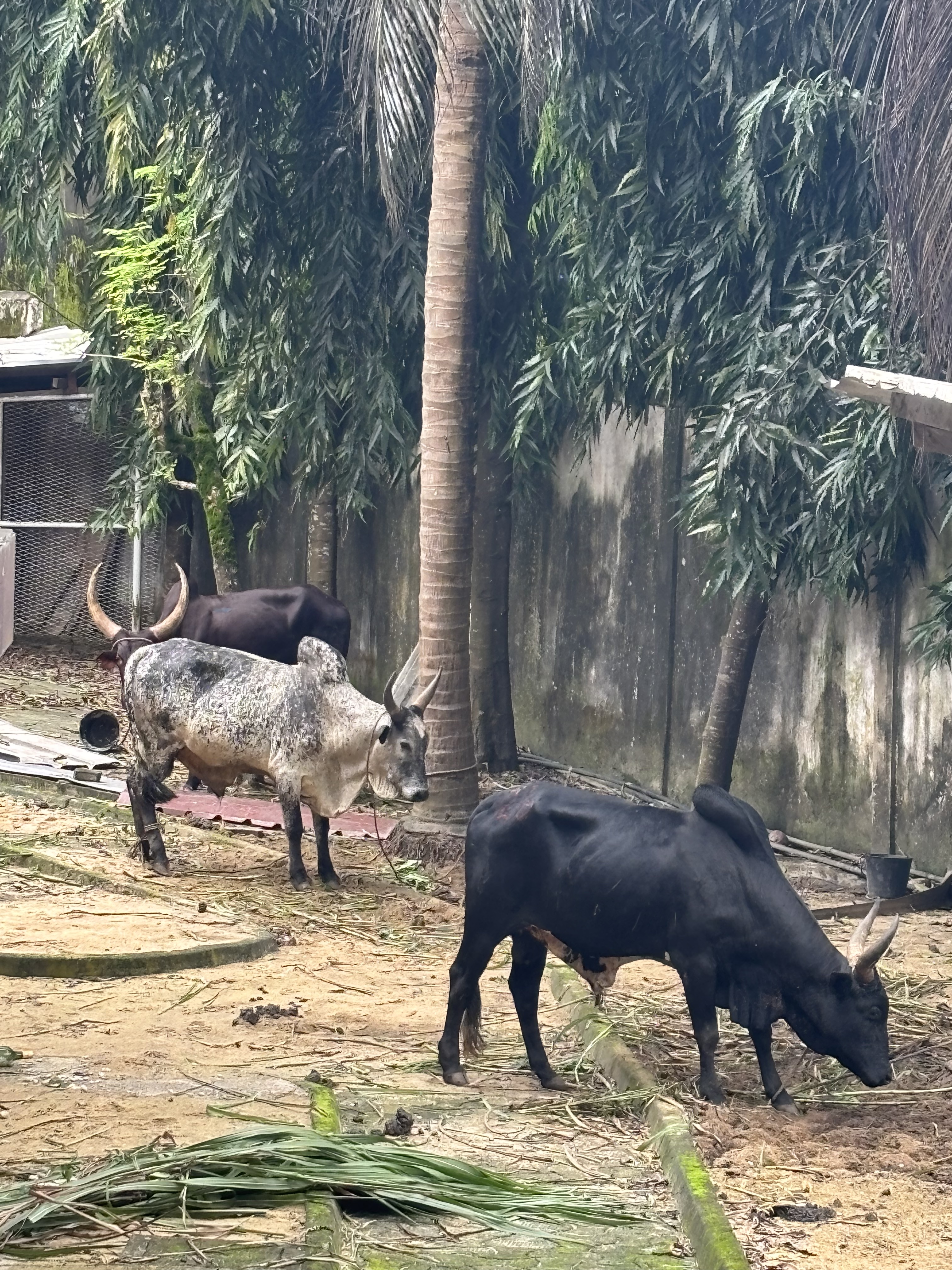 Surrounding the archbishop’s office in Douala’s cathedral complex, are diverse animals and plants, including cattle, ostriches, ducks, and hens—all part of an impressive system of community sharing by which the archdiocese helps support itself as well as seminarians, the elderly, and poor in the area. Credit: Victor Gaetan
“I know how plants work,” he says. “The effect of using plants. The importance of alternative healers cannot be overstated. They are there with the people and they practice healing through different compositions of plants. People sometimes prefer to go to the healers.”
During the COVOD-19 health crisis, Archbishop Kleda made international news with natural medicine he developed to treat symptoms.
Many Charisms
Throughout my week in Douala, I met so many men and women religious, missionaries from historical religious orders, consecrated laypeople, and dedicated youth groups.
Augustinian Sister Honorine, 36, helped catechize the youngsters at St. Marc’s. Her face lit with a giant smile when I asked how she perceived our Augustinian Holy Father: “With immense joy!” she affirmed. “We hope he comes to Cameroon.”
Sister Honorine grew up near the capital of Yaoundé, where she said the Catholic Church is just as strong as in Douala, where she lives in a community of 10 women, including three sisters from the Democratic Republic of Congo. Together they teach Catholic primary school.
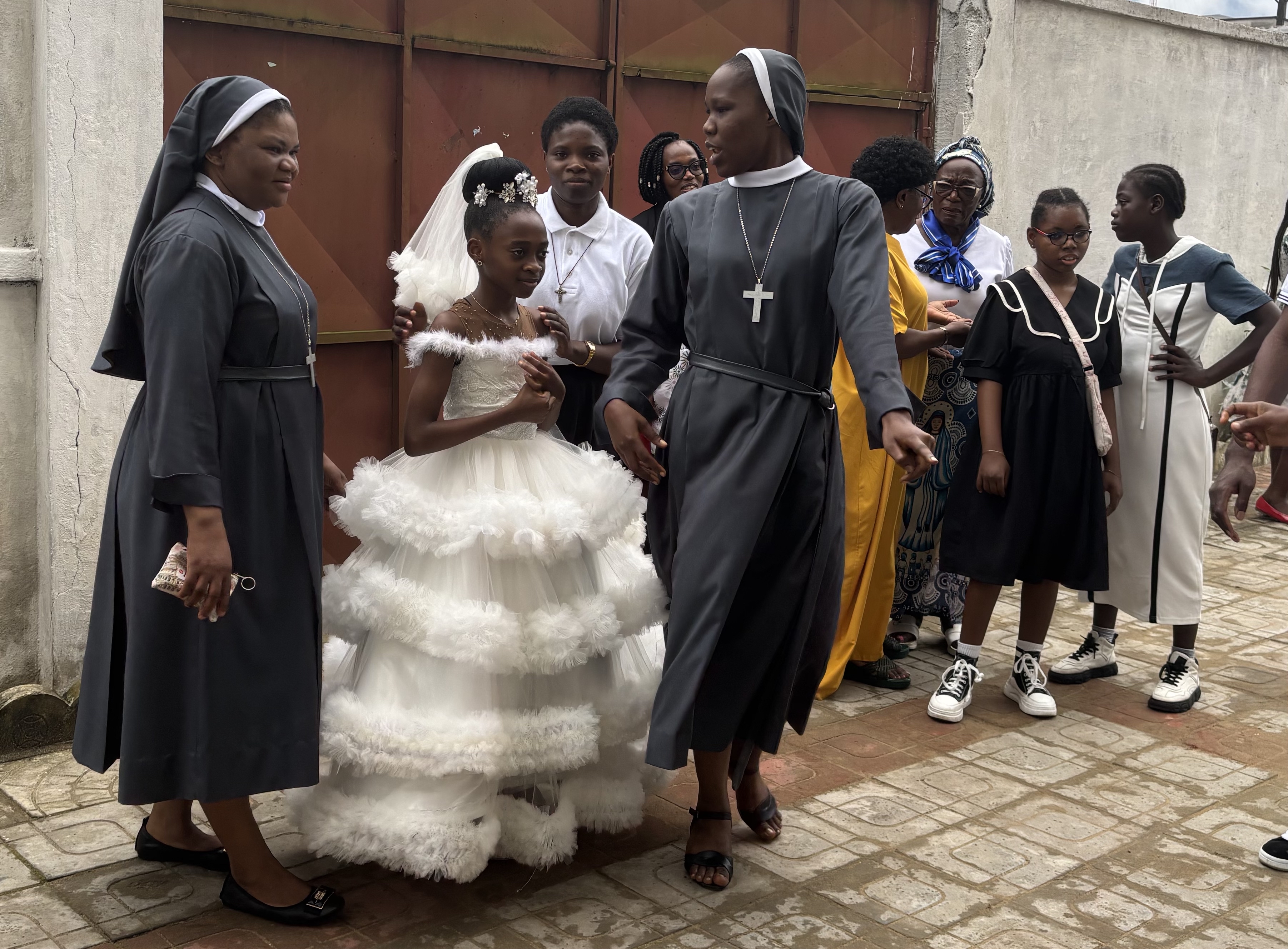 A convent of ten Augustinian sisters run a primary school in Douala and help with catechism at parishes such as St. Marc. Sister Honorine (right) congratulates 10-year-old Divine, who received her first communion at the Sept. 28 Mass. Credit: Victor Gaetan
Playing in the church courtyard, girls wearing matching blue dresses and veils belong to the Cadets of Mary. “We pray the Rosary together every weekend,” explained Patricia, 15. “We try to walk in Mary’s footsteps.”
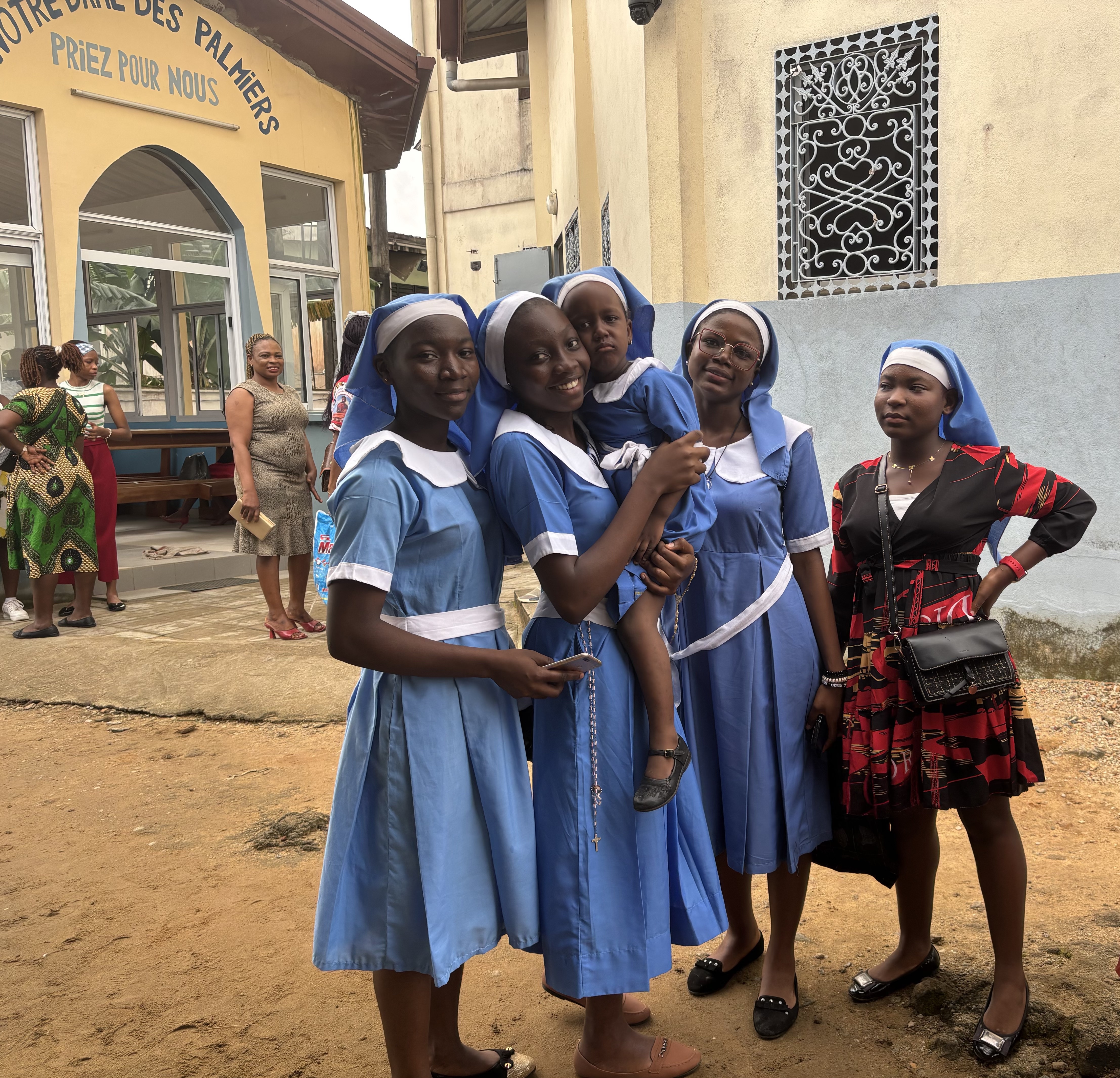 Members of the Cadets of Mary after Mass at St. Marc’s parish in Douala. The cadets are part of the International Association of the Children of Mary, which helps girls emulate the Blessed Mother. Credit: Victor Gaetan
Across town, members of the Congregation of the Holy Spirit members, known as the Spiritans, maintain a chapel and a comfortable guest house. They were among the country’s first missionaries, from France’s Alsace region. Doaula’s first two apostolic vicars were Spiritans who led from 1932 to 1955.
Christianity in Africa
Cameroon suffered colonial exploitation from Germany, France, and Great Britain. (The colonial legacy shows its rot in the Anglophone Crisis, an ongoing armed conflict between the English-speaking northwest and southwest provinces and the Francophone central government).
Although Christianity often came to these lands at the same time as foreign military forces, l'Abbé Serge Eboa, chancellor of the Douala Archdiocese since 2022, provided an excellent account of why faith is not synonymous with colonial oppression.
“African people were people of faith even before evangelization. Priests and bishops brought the Catholic dimension to people who already had faith. So, people were quickly convinced of the importance of the Gospel, of Jesus. African traditional religion and the Catholic Church make sense together. The Catholic message catches.”
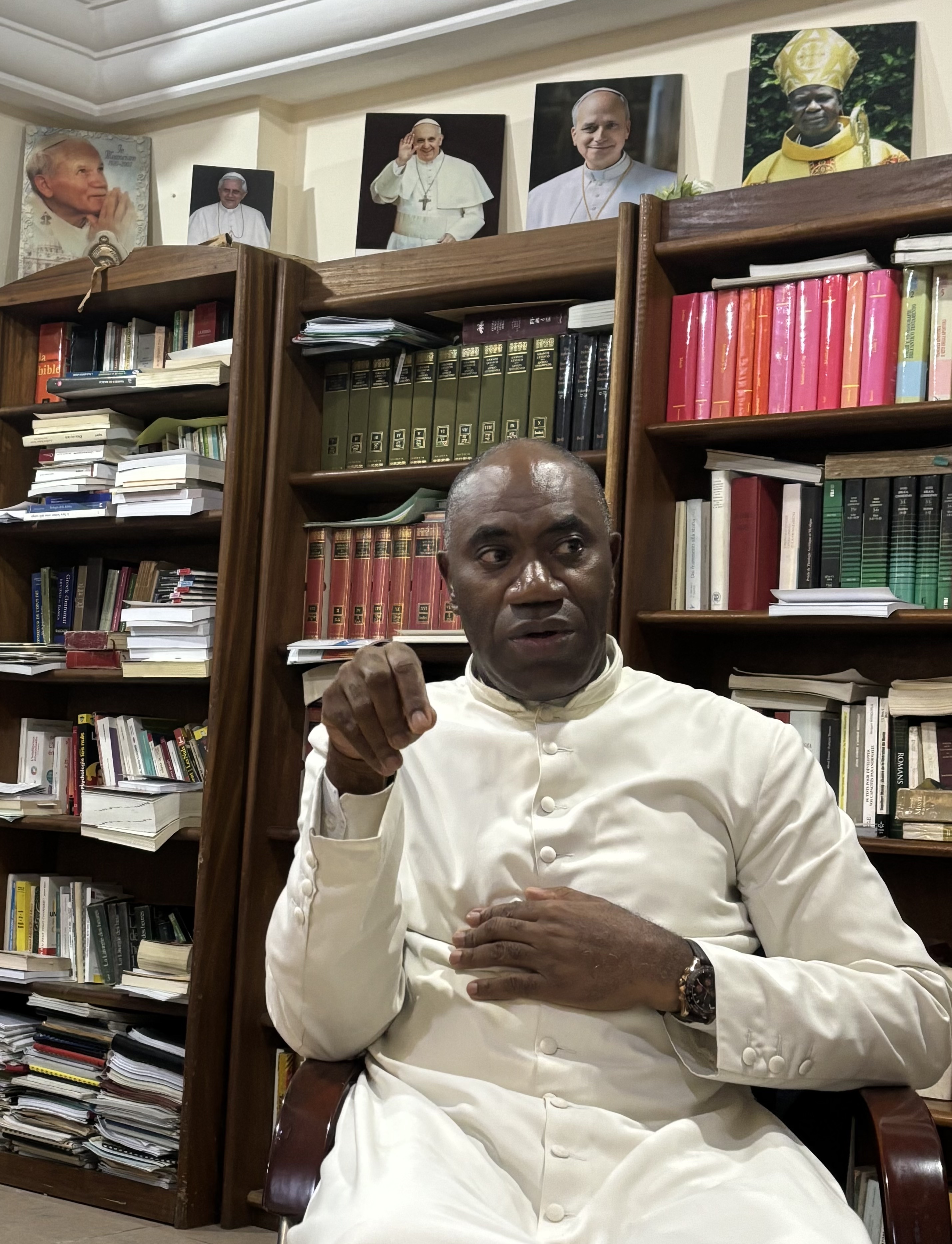 Fr. Serge Eboa serves as the chancellor of the Archdiocese of Douala. He received his doctorate in Biblical theology from the Pontifical University of the Holy Cross in Rome, then spent six months in Chicago. Like his boss, Archbishop Samuel Kleda, he is unusually tall. Credit: Victor Gaetan
He continued, “Today, people are looking in particular for the Catholic approach because we give knowledge and Christian values, which transform a society that is going adrift. People come. You see, at whatever Mass, 12:30 p.m. on a weekday, the cathedral is full. People understand the importance of Church.”
“African traditional religions are disappearing a bit,” the priest observed.
However, “dechristianization comes to us from the West. There are some intellectuals who come from the United States and other Western countries who say we must return to traditional sources,” Father Eboa explained. They claim the Christian religion “cheated them” and replaced indigenous traditions so Christianity should be rejected, “but this is perverse,” reported Father Eboa.
“Jesus Christ is important in our life. We need him everywhere we are, regardless of traditions. If the Church is destroyed, the world is in a state of eternal damnation,” he said.
Leaving the chancellor’s office, I noticed a portrait of St. Josemaría Escrivá high on the wall. Is the Opus Dei active in Cameroon? Yes, it has study centers in Douala and Yaoundé as well as a program helping prepare people for work in the hospitality sector.
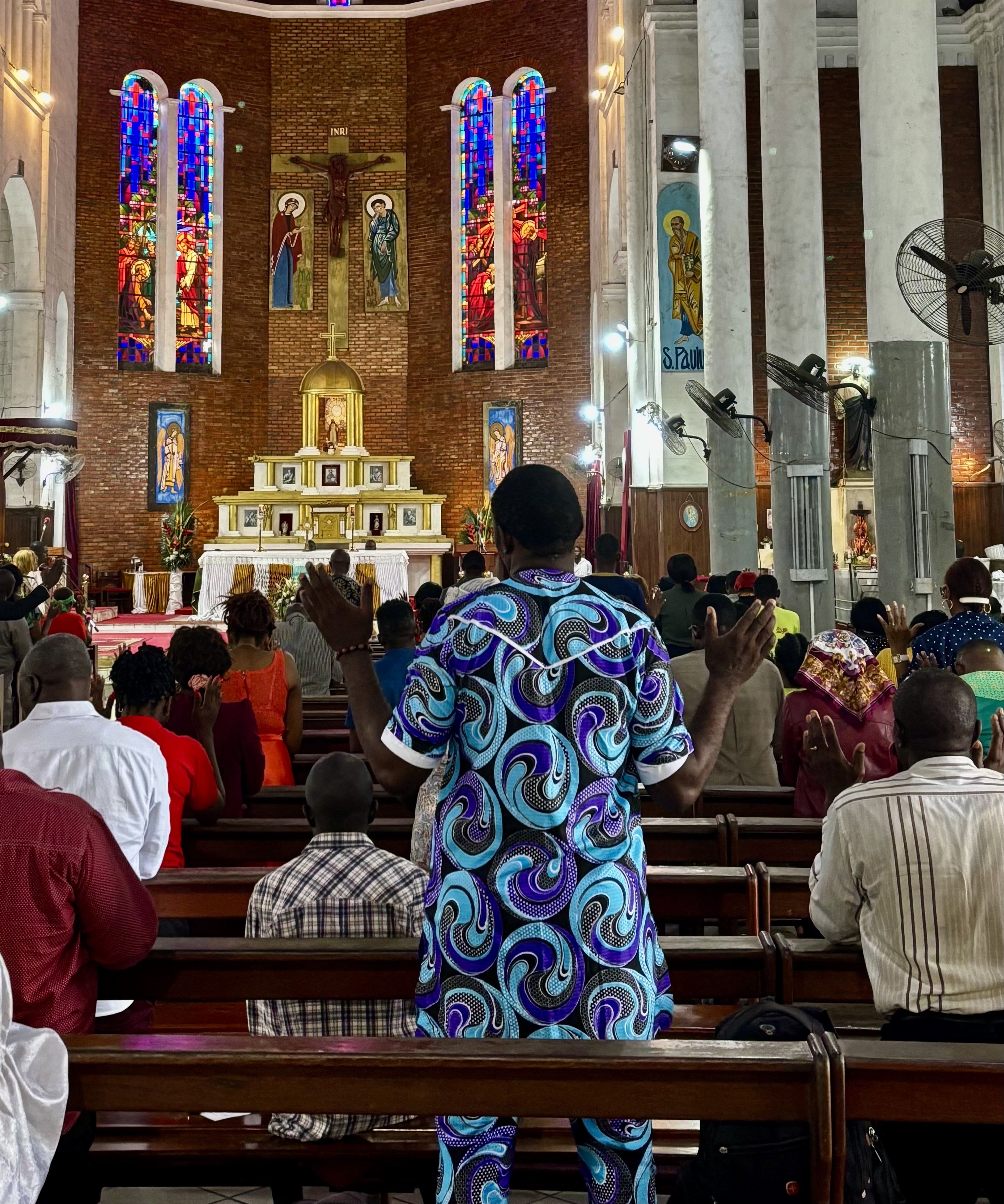 Over 100 people worshipped at a Wednesday, 12:30 pm Mass in Douala, Cameroon at the Cathedral of Saints Peter and Paul, built in 1936 by French members of the Congregation of the Holy Spirit—Spiritan fathers—on the site of the city’s first Catholic church. Over 38 percent of the country’s 30 million people are Catholic, the largest religious groups. Douala is Cameroon’s largest city and its economic hub, with Central Africa’s busiest port on the Atlantic Ocean. Credit: Victor Gaetan
Father Eboa met the work of Opus Dei in Douala 24 years ago. He obtained a doctorate in biblical theology in Rome at the prelature’s Pontifical University of the Holy Cross. “Opus Dei has helped me a lot. Its spirituality is very strong — sanctifying work. It has helped me be a better diocesan priest,” he reflected.
Election This Sunday
President Biya made his first public appearance of the campaign on Oct. 7 at a rally in the country’s far north where some 20% of the voters live. It’s also a Muslim-majority region.
The two leading candidates gaining ground are both Muslims from this region. They were presidential allies — government ministers — until last June when they resigned to run.
Archbishop Kleda said, “My wish and the wish of the Church is that the election be conducted without fraud and with transparency. Our prayer is for peace.”
“And we want a better future,” he added. “Something much better.”
This story was first published by the National Catholic Register (NCR), ACI Africa's partner




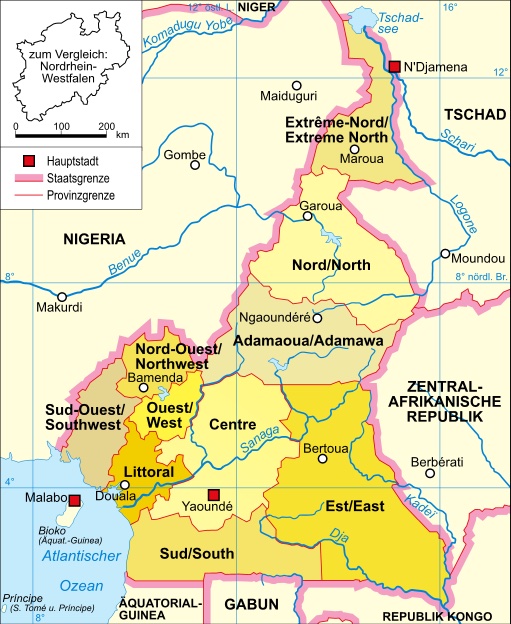 Map of Cameroon Credit: Victor Gaetan