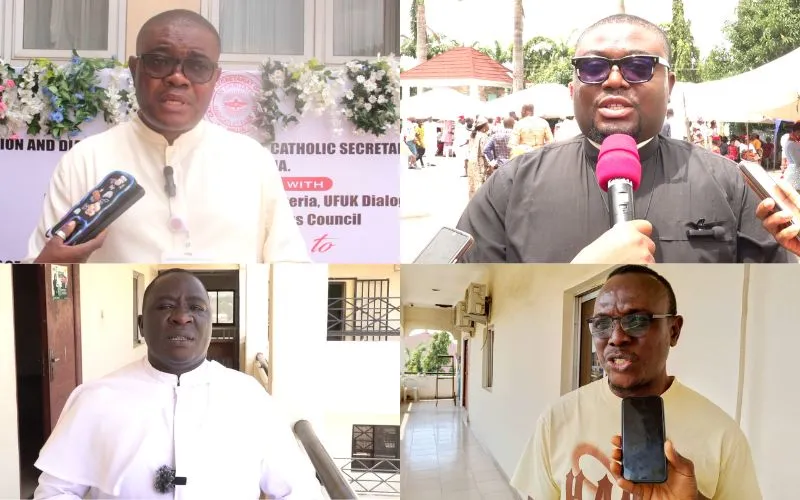
“I’m not sure from which time to which time he started his research. But we know that since the Boko Haram insurgency began about 15 or 16 years ago, many people—both Christians and Muslims—have been killed. At the beginning, most of the affected communities were Christian-populated areas,” he said.
He, however, acknowledged that the situation has somewhat improved in recent years, saying, “Today, we can say there is improvement. People are still being killed, but not like before. His statement would have made more sense if it had come earlier, when persecution was really taking place. Though there are still cases of insecurity in different parts of the country, we can say the situation has improved to some extent.”
On his part, a Nigerian civil engineer and filmmaker, Leo Okwesi, agreed that the U.S. senator’s call is a wake-up call for Nigeria’s leaders.
“Ordinarily, as a Nigerian, one would say, what’s the meaning of that? But the reality is that we can’t handle our security risks in this country,” Mr. Okwesi said, adding, “Government is supposed to protect lives and citizens. That’s part of their duty apart from stealing money.”
He added, “I think we should be listed even more than once. Maybe when that listing begins to affect government officials’ ability to travel abroad, they will start to rethink. Right now, everyone in power does what is good in his own sight. They need a check, and I think this is a check.”
(Story continues below)
Mr. Okwesi called for decisive international pressure, saying, “Heads must roll for things to get better. If my generation has lost it, then my children should have a better country.”
“The government should sit up, or the international community should impose sanctions, so that we will look inwards. Maybe when there’s a restriction to this mass exodus abroad, we’ll be forced to fix things here,” he told ACI Africa.
In a divergent opinion, the National Director of Mission and Dialogue at the Catholic Secretariat of Nigeria (CSN) questioned the timing of Sen. Ted Cruz's latest proposal, saying that “the situation today is not as widespread or as dangerous as it used to be.”
Fr. Emehel observed that the earlier removal of Nigeria from the CPC was wrong, especially when the killings were at their peak.
“Christians were actually persecuted and suffered grave injustices in some parts of the country. Removing Nigeria from the list at that time was wrong because that was when the killing of Christians was at its peak,” Fr. Lawrence Emehel said.
“If this question had come eight or ten years ago, I would have agreed. But now, things have changed. There are still pockets of violence, but not widespread persecution as it is being portrayed,” he noted.
The member of the Clergy of Nigeria’s Sokoto Diocese cautioned against interpreting all violent attacks as religiously motivated, citing the recent killings in Yelewata, Benue State, and other parts of the Middle Belt as examples of “pure criminality” rather than faith-based aggression.
“Many of those involved are hired criminals with no religious agenda. We must be careful not to give these incidents a religious coloration because it makes resolution more difficult,” Fr. Emehel said.
He also faulted government efforts to address insecurity, saying authorities “speak like politicians” and fail to admit their shortcomings.
“The killings show that their efforts have failed. Nigerian lives no longer matter. People are now just statistics,” Fr. Emehel said.
Abah Anthony John is a Nigerian Catholic journalist with passion for Church communication and media apostolate. He holds a bachelor’s degree in mass communication from Benue State University, Makurdi in Benue State Nigeria. He has a background in print, electronic and multi-media production.