


Advertisement

Cardinal in Cape Verde Urges “wisdom of the heart” to Guide Ethical Use of Artificial Intelligence

The Bishop of Cape Verde’s Catholic Diocese of Santiago has called for what he described as the “wisdom of the heart” to guide humanity in the ethical use of Artificial Intelligence (AI), emphasizing that technological progress must always serve the good of the human person.

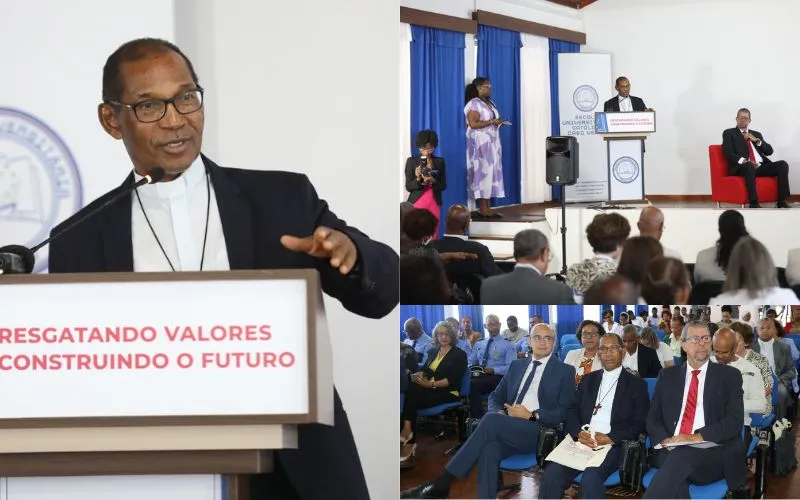
In his address during the opening ceremony of the 3rd Symposium of the Catholic University of Cape Verde (EU Católica), Arlindo Cardinal Gomes Furtado reflected on the growing influence of AI in daily life, cautioning that while innovation can advance human welfare, it also poses serious ethical and social challenges, including the sidelining of human values.

“The rapid evolution of new technologies must not come at the expense of the human person. Our task is to ensure that philosophy, ethics, and the wisdom of the heart remain central to every human decision,” Cardinal Furtado said during the Thursday, October 16 event.

He went on to advocate for a “wisdom of the heart” in the use of AI and to underscore the need to “harmonize reason, ethics, emotion, and spirituality in decision-making.”

For Cardinal Furtado, this wisdom “ensures that artificial intelligence serves human dignity.”
Advertisement

“The wisdom of the heart is the active capacity—what we traditionally call virtue—that allows us to integrate each part into the whole so that the parts and the whole do not contradict one another,” he explained.

With the wisdom, the Local Ordinary of Santiago continued, “we will be better prepared to use artificial intelligence, which is a fruit of human reason and can take us even further—but always in obedience to the wisdom of the heart.”

Cardinal Furtado also pointed out the limits of AI, stressing that no matter how advanced it becomes, it can never replicate the fullness of human experience.

AI, he said, “does not make use of corporeality or our sensory experiences. It cannot look at a sunset and feel the inspiration of a poem. It cannot appreciate poetry—but we can.”

The Catholic Church leader noted that while AI can indeed be a valuable tool, “all other intelligences must remain at the service of the human person, who is master of all things.”

More in Africa

“Humanity, with its emotional and spiritual intelligence, must remain at the center of every technological decision,” Cardinal Furtado said.

October 16-18 event, which brought together scholars, clergy, and policymakers to reflect on the moral dimensions of scientific progress was realized under the theme “Philosophy and Bioethics: Ethical Challenges in Medicine and Scientific Research in the 21st Century.”

In his October 16 address, Cardinal Furtado said he hoped the symposium would provide “a space for reflection and meaning-making, fostering dialogue among disciplines and a renewed commitment to the common good.”

“May this symposium generate the capacity and experience of seeing the parts and uniting them, so that all knowledge serves the human being and artificial intelligence is well used—without humanity ever being lost,” he said.

Cardinal Furtado added, “We must use these things for the happiness of the human person.”

Advertisement

As Grand Chancellor of EU Católica, Cardinal Furtado reaffirmed the institution’s mission to “complement and deepen” areas of knowledge often overlooked in national education.

“Our goal is not to compete with other universities,” he said. The goal, he said, is “to enrich academic life by focusing on what is most fundamental to human growth and formation.”

He warned against an increasing “fragmentation of knowledge,” where specialists and ideological groups operate in isolation, without genuine dialogue or critical reflection.

“Among technology users, there are influencers and ideologues—and then there are many others who follow them uncritically,” the 75-year-old Cape Verdean Cardinal said on October 16.

João Vissesse is an Angolan Journalist with a passion and rich experience in Catholic Church Communication and Media Apostolate.