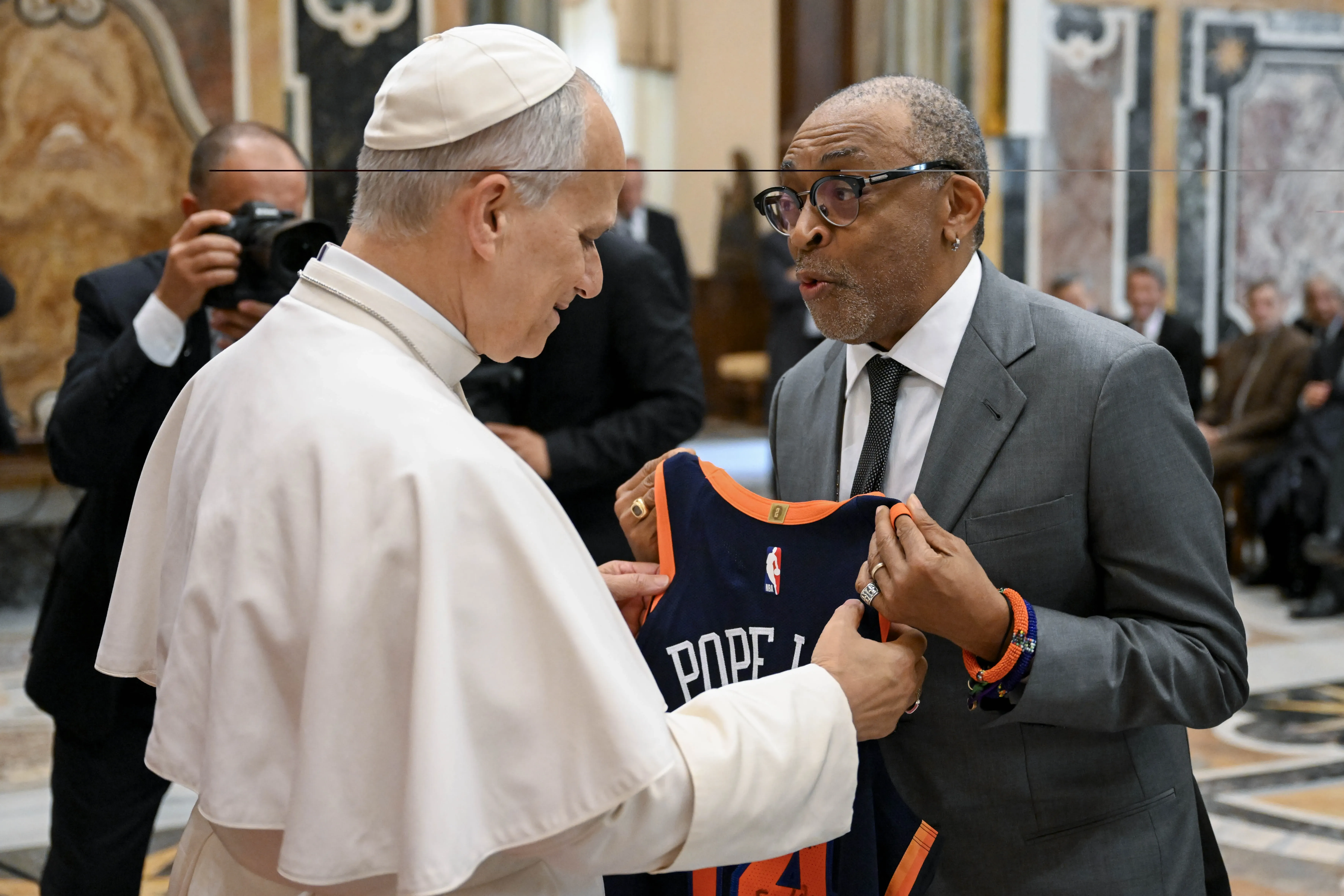
One of cinema’s most valuable contributions, he said, is “helping audiences consider their own lives, look at the complexity of their experiences with new eyes and examine the world as if for the first time,” thus rediscovering “a portion of the hope that is essential for humanity to live to the fullest.” He added, “I find comfort in the thought that cinema is not just moving pictures; it sets hope in motion!”
The cinema as the heart of community life
“Entering a cinema is like crossing a threshold,” the pope said. “In the darkness and silence, vision becomes sharper, the heart opens up and the mind becomes receptive to things not yet imagined.” Through their work, filmmakers “connect with people who are looking for entertainment, as well as those who carry within their hearts a sense of restlessness and are looking for meaning, justice and beauty.”
“We live in an age where digital screens are always on,” he continued. “There is a constant flow of information. However, cinema is much more than just a screen; it is an intersection of desires, memories and questions. It is a sensory journey in which light pierces the darkness and words meet silence. As the plot unfolds, our mind is educated, our imagination broadens and even pain can find new meaning.”
He stressed that cultural institutions such as cinemas and theaters are “the beating hearts of our communities because they contribute to making them more human,” adding: “If a city is alive, it is thanks in part to its cultural spaces. We must inhabit these spaces and build relationships within them, day after day.”
Nonetheless, he warned that “cinemas are experiencing a troubling decline, with many being removed from cities and neighborhoods,” and noted that “more than a few people are saying that the art of cinema and the cinematic experience are in danger.” He urged institutions “not to give up, but to cooperate in affirming the social and cultural value of this activity.”
Resisting the ‘algorithmic logic’ of the digital age
“The logic of algorithms tends to repeat what ‘works,’ but art opens up what is possible,” he said. “Not everything has to be immediate or predictable. Defend slowness when it serves a purpose, silence when it speaks and difference when evocative. Beauty is not just a means of escape; it is above all an invocation.”
“When cinema is authentic, it does not merely console, but challenges,” he continued. “It articulates the questions that dwell within us, and sometimes, even provokes tears that we did not know we needed to express.”
In the Jubilee Year, he told them, the Church invites everyone “to journey towards hope,” saying their presence was “a shining example” of that. He described filmmakers as “pilgrims of the imagination, seekers of meaning, narrators of hope and heralds of humanity,” whose journey is measured not in distance but in “images, words, emotions, shared memories and collective desires.”