


Advertisement

Members of Mariannhill, Precious Blood Urged to Press On with Beatification of Founder Celebrated for African Legacy

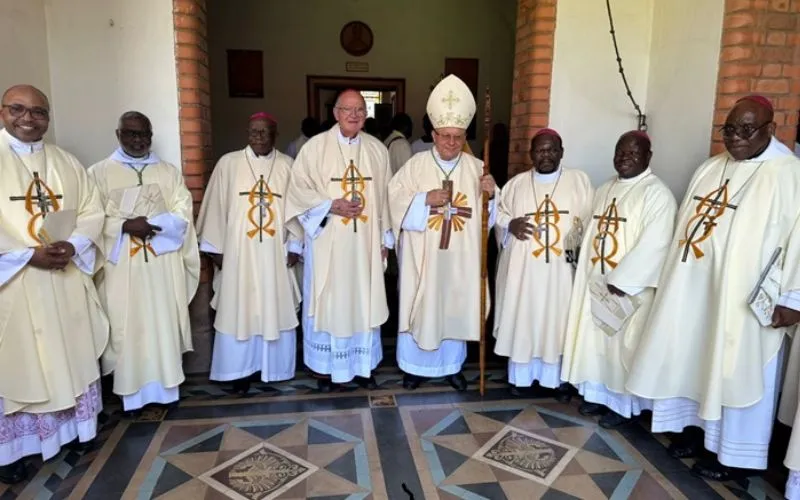
Credit: SACBC

Members of the Congregation of the Missionaries of Mariannhill (CMM) and the Missionary Sisters of the Precious Blood (CPS) have been urged to press on with the Beatification process of their founder, Abbot Franz Pfanner, who left a lasting legacy in Southern Africa.

In his reflection on the occasion of the 200th celebration of the birth of Abbot Pfanner, Stephen Cardinal Brislin, the President of the Southern African Catholic Bishops’ Conference (SACBC) where the Abbot served for many years during his stay in Africa, acknowledged the hurdles that sometimes characterize sainthood causes, and told the CMM and CPS members not to despair along their founder’s cause.

Cardinal Brislin said in the reflection on Monday, December 8 that the Servant of God was “certainly a pilgrim of hope”, adding, “Despite the many hardships, opposition and humiliations he experienced, he did not give up, he did not despair, and he did not abandon his vocation.”

“We, too, must not be the type of people who shrink back or give up,” the SACBC official said, and added, “In this regard, I would appeal most sincerely to the Mariannhill Missionaries and the Sisters of the Precious Blood, please do not give up on the Beatification Process (of Abbot Pfanner).”

“There are always hurdles to be overcome, doubts, questions, and accusations raised. The going may seem tough and slow, but you owe it to him (Abbot Pfanner), to the Congregation, and to South Africa to proceed with this. You have the responsibility of seeing it through,” Cardinal Brislin said.

Advertisement

He assured the two Religious orders started by Abbot Pfanner of the Church’s solidarity, saying, “You have our support, our encouragement, and our good wishes.”

Born on 20 September 1825 in Austria, Abbot Pfaner in Dunbrody, South Africa in 1880 and in1882, he established Mariannhill Monastery in Durban.

Three years later, he was appointed Abbot of the Mariannhill Monastery. He goes down in history as the first missionary Abbot in South Africa.

Cardinal Brislin said Abbot Pfanner’s “founding vision”, his struggles against “many uphill battles”, and his determination to  respond to the needs of the time are still evident in the work and ministry of the Fathers and Brothers of  the Mariannhill Missionaries and the Sisters of the Precious Blood, who themselves have celebrated  140 years of the founding of their Order. 

“Abbot Pfanner was certainly a determined person who fought against many odds, but he was also, clearly, a flexible person, the Cardinal said, and added, “Although a contemplative and a Trappist, he responded to the needs of the time in this country and suspended some of the Trappist rules in order to free monks – and even novices – to evangelise the un-evangelised in the surrounding areas of KwaZulu-Natal.”

More in Africa

He said that Mariannhill Missionaries, currently in 15 countries, are “reaping vocations in the rich fields” of countries such as Rwanda, DRC, Kenya, and Uganda, thanks to the founding vision of Abbot Pfanner. 

According to the SACBC official, South Africa has a lot to learn from Cardinal Pfanner’s inclusiveness.

“We can learn much today from Abbot Pfanner,” he said, and explained, “Many societies in Southern Africa and globally are marked by a gradual escalation in ethnocentrism and nationalism.”

“Abbot Francis has shown us that differences of language and the colour of our skin are mere accidents, and we are all sons and daughters of God. On several occasions, he spoke openly and prophetically about a racially divided  South Africa,” he said. 

Cardinal Brislin noted that the Servant of God spoke out against racial segregation with the question, “Will the time finally dawn in South Africa when people will renounce this deeply ingrained and radically evil prejudice?” adding, “As long as people are not willing to  do this, they will indeed tame the black man but not convert him.”

Advertisement

The Cardinal said that Abbot Pfanner’s sentiments “must speak and chide us today when we witness so many xenophobic attacks, and many people wish to enclose themselves in the laagers of nationalism and ethnicity.”

“Abbot Francis has left us a legacy of non-racialism and shown us a way to promote respectful intercultural living by teaching our young people how to live together,” he said.

Cardinal Brislin added, “In the context of the challenges  we face as the Church in Southern Africa and globally with the temptations of focusing on our cultural,  national, or ideological differences, Abbot Francis’ legacy of non-racialism and respect for every  human being should be a constant reminder to all of us and to our consciences that there is indeed  ‘neither Jew nor Greek, there is neither slave nor free, there is neither male nor female; for we are all  one in Christ Jesus (Galatians 3:28).’”

Agnes Aineah is a Kenyan journalist with a background in digital and newspaper reporting. She holds a Master of Arts in Digital Journalism from the Aga Khan University, Graduate School of Media and Communications and a Bachelor's Degree in Linguistics, Media and Communications from Kenya's Moi University. Agnes currently serves as a journalist for ACI Africa.