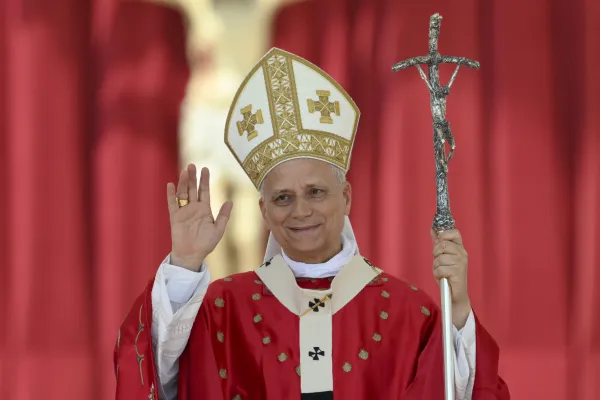
According to the pontiff, archaeology not only provides historical data but also allows theology to remain rooted in the concrete reality of the people of God. Thus, he affirmed that a theology that “embraces archaeology ... listens to the body of the Church, assesses its wounds, reads its signs, and is touched by its history.”
In his reflection, Leo XIV highlighted the human and pastoral dimension of archaeological work. He described it as an essentially “hands-on” profession in which researchers “are the first to handle buried material that conserves its vitality even after centuries.”
But the contribution of the Christian archaeologist, Leo XIV added, goes beyond material recovery: “They study not only the artifacts but also the hands that forged them, the minds that conceived them, and the hearts that loved them.”
God has truly entered history, and faith is not a philosophy
The pope recalled that from its origins, the Christian faith was transmitted through the memory of places and signs. “Christian communities safeguarded not only Jesus’ words but also the places, objects, and signs of his presence,” he stated.
(Story continues below)
Places such as the empty tomb, Peter’s house in Capernaum, and the Roman catacombs not only served as historical testimony but also “all testify that God has truly entered history and that faith is not a mere philosophy but a tangible path within the reality of the world,” the Holy Father wrote.
The pope affirmed that the Church needs to “search for a profound wisdom capable of preserving and passing on to future generations what is truly essential” and emphasized that archaeology has “an essential role in understanding Christianity and, consequently, its application within catechetical and theological formation.”
Citing Pope Francis’ apostolic constitution Veritatis Gaudium, Leo recalled that archaeology is part of the fundamental disciplines of theological formation, because “it does not merely tell us about artifacts but about people: their homes, tombs, churches, and prayers” and about “how faith shaped their spaces, cities, landscapes, and mentalities.”
The pope also emphasized that archaeology “is not just a specialized discipline reserved to a few experts” but rather a path accessible “to anyone who wishes to understand how faith is embodied in time, place, and culture.”
Archaeology as a ‘school of hope’
In his view, studying and narrating history helps to keep “the flame of collective conscience” alive. Otherwise, he warned, “all that remains is the personal memory of facts bound to our own interests or sensibilities, with no real connection to the human and ecclesial community in which we live.”
Leo XIV recalled that the Pontifical Institute of Christian Archaeology was established by Pius XI’s motu proprio Primitivi Cemeteri (“Primitive Cemeteries”) of Dec. 11, 1925, with the task “of directing studies on the monuments of ancient Christianity with the utmost scientific rigor” in order to “reconstruct the lives of the early communities.”
The institute has participated in crucial excavations, such as that of the tomb of the apostle Peter beneath the Altar of the Confession in St. Peter’s Basilica, and in recent investigations at St. Paul Outside the Walls.
The pope asked: “How fruitful can the role of Christian archaeology still be for society and the Church in an age marked by artificial intelligence and by the exploration of the innumerable galaxies of the universe?”
He himself offered the answer: Contemporary methods “enable us to glean new information from findings once considered insignificant,” reminding us that “nothing is truly useless or lost.” Even the marginal, he affirmed, can “reveal profound meaning in the light of new questions and methods. In this respect, archaeology is also a school of hope.”
This story was first published by ACI Prensa, CNA’s Spanish-language news partner. It has been translated and adapted by CNA.
As a journalist, Victoria Cardiel has specialized in social and religious news. Since 2013, she has covered the Vatican for various media outlets, including Europa Press and Alfa and Omega, the weekly newspaper of the Archdiocese of Madrid.