


Advertisement

Late South African Catholic Bishop Eulogized for Personifying God’s Mercy

Credit: SACBC

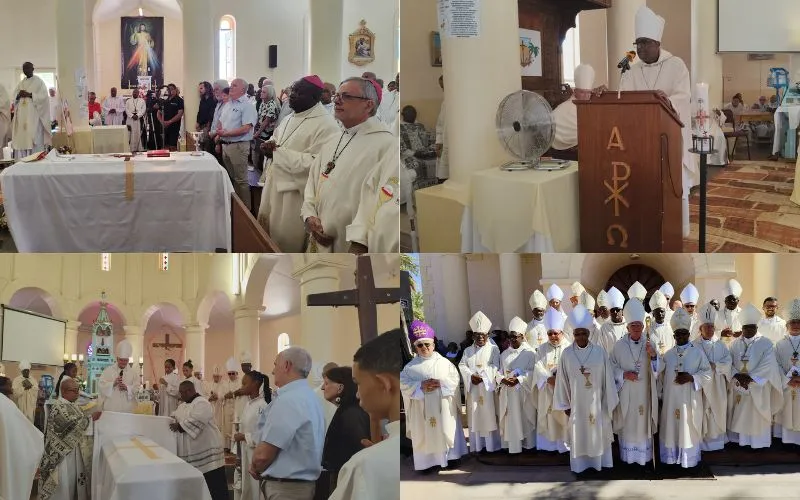
Bishop Edward Gabriel Risi of South Africa’s  Keimoes-Upington Catholic Diocese, who passed on December 4 at the age of 76, has been eulogized for personifying the mercy of God as exemplified by Jesus while on the cross.

In his homily on Thursday, December 18, during the Funeral Mass of the member of the Oblates of Mary Immaculate (OMI), the Auxiliary Bishop of South Africa’s Cape Town Archdiocese reflected on Jesus’ words of forgiveness while on the cross.

“The first word spoken from the cross was this: Father, forgive them, for they know not what they do. How much those words of mercy must have meant to this bishop, who himself became the personification of God's mercy!” Bishop Sylvester David said.

Bishop David said that the late Bishop Risi was brilliant in the “field of mercy” to the extent that “he brought God's healing to the fragmented and brokenhearted.”

Reflecting on the late Bishop’s early years and vocation, he said Bishop Risi was full of zeal and, even in those days, had a deep yearning for authentic liturgy.
Advertisement

He further reflected on his encounter with the late Bishop, saying, “I am grateful to the Lord that I enjoyed his personality. I enjoyed witnessing his goodness to faith, his hope, and his charity.”

Bishop David explained that the late Bishop had an Oblate cross, a distinctive one. 

“The cross is the fire of our life. The cross was the fire of his own life. He saw the cross as the source of all life,” Bishop David said, adding that spiritually, as an Oblate, the cross was a firm and inseparable part of Bishop Risi’s life.

According to the Auxiliary Bishop, Oblates are called to look at the world through the eyes of the crucified Christ.

“Yes indeed, the cross is not only about our difficult experiences as missionaries. It is the focal point of the Church’s confrontation. In fact, that is how the Oblate mode of communication was born,” he said.

More in Africa

He reflected further that there were seven words spoken to the cross and seven words spoken from the cross, noting that in Bishop Risi’s contemplation of the cross, disobedience would have wounded them all.

“At the foot of the cross, there were others casting lots for the clothing of Jesus. Looking into that crowd, Jesus would have seen a fickle group of people. Ten days earlier, they were shouting Hosanna,” Bishop David said.

He added that Bishop Risi’s mission as an Oblate and as a Bishop, particularly about the liturgy, was to turn people’s eyes to the truth. “Near the cross, there was an unnamed disciple who looked orphaned,” he reflected.

“For us who contemplate the cross, it is only when we hear those words, not with the physical ears, but with the ears of faith, that we will know our contemplation has been real,” he said in reference to the late Bishop known for the liturgical reform that has put the Southern African Catholic Bishops Conference (SACBC) among the “most up-to-date” Conferences in liturgical matters.

Bishop David expressed confidence that the late Bishop had heard those words. “That is why we are confident that he is with Christ. In the Gospel text, we hear Jesus say, It is finished. The original actually means, It has been accomplished,” he explained.

Advertisement

“It also means that now that it has been accomplished, it could never be unaccomplished. The marks of the crucifixion are valid for all times. The effects of the crucifixion are valid for all times, in and through Jesus Christ,” Bishop David said.

Born on 6 January 1949, Bishop Risi entered the Congregation of OMI in 1967 and made his profession the following year.

He was ordained a Priest on 12 July 1974, beginning a ministry marked by missionary dedication, pastoral gentleness, and a profound love for the Church’s liturgical life.

In July 2000, St. John Paul II appointed him Bishop of Keimoes-Upington, a Diocese he would shepherd faithfully for twenty-five years. He was ordained Bishop on 14 October 2000, becoming one of the most active and respected contributors to the life of the SACBC. 

Silas Mwale Isenjia is a Kenyan journalist with a great zeal and interest for Catholic Church related communication. He holds a Bachelor’s Degree in Linguistics, Media and Communication from Moi University in Kenya. Silas has vast experience in the Media production industry. He currently works as a Journalist for ACI Africa.