Music is in his blood, the Guinean cardinal said, adding that he had learned from his parents and from French missionaries who evangelized his village that different types of music belong in different places and that liturgical music is set apart for the worship of God and “hence it is rightly called ‘sacred.’” He also pointed out that as an African, music used in the liturgy does not have to be “exactly the same as the music of my own culture” and that it does not even have to be in one’s own language. He learned the meaning of chants and sang them devoutly “because of the wider Catholic tradition into which they immersed us.”
His community “received” the liturgical music they sang, the cardinal said, adding that those who composed sacred music did so having “first received and come to know and live in, and from, the tradition itself.”
Sacred music “has an objectivity to it,” he said, and that objectivity is rooted in the liturgical tradition of the Church. “That is to say, what is sung in the liturgy can truly be said to be ‘The Song of the Lamb,’ praising and giving glory to Almighty God and supplicating him for the needs of his people.”
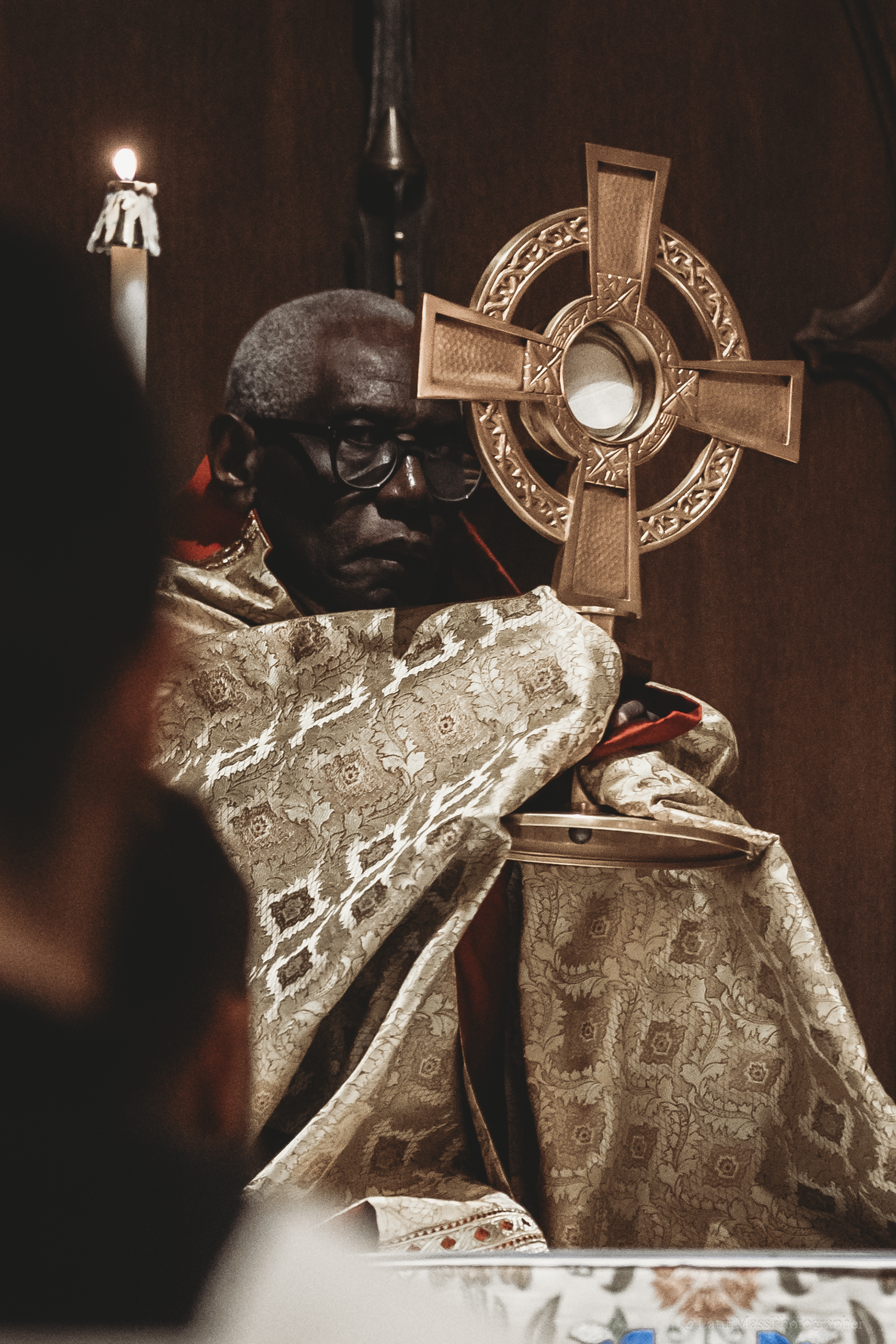 Cardinal Robert Sarah lifts the Eucharist aloft after Mass at Princeton University in November 2025.(Photo: Allison Girone/LatinMassPhotographer.com)GPhotographyandFilms
“I think that if the music we sing in the sacred liturgy conforms to this criterion, we can truly call it ‘sacred’ and, in conformity with the relevant stipulations of the liturgical books, with Gregorian chant always having pride of place.”
The cardinal concluded by encouraging those who prepare and celebrate the sacred liturgy, sometimes in the face of opposition, and urging them to form others in the Church’s liturgical and musical tradition. Sacred music, he said, “is not a ‘nice’ addition to the liturgy; it is an essential component of it.”
“We are created to sing the praises of Almighty God for all eternity,” Cardinal Sarah said. “In doing so as well and as beautifully as we possibly can in the sacred liturgy in this life, we prepare ourselves and others for eternity — indeed, by doing so we are able all the more faithfully to live our supernatural vocation in the daily circumstances of our particular vocation here and now.”
Christ’s Kingship and True Peace
In a homily at Princeton University Chapel on Nov. 23, 2025, the Solemnity of Christ the King in the new rite, Cardinal Sarah continued on this theme of sacred music’s role in the liturgy, explaining how it “lifts our hearts and minds up to Almighty God in worship of him.” He added that sacred music “enlarges and opens our hearts so that he may enter them anew, purifying us, healing us and strengthening us for his service through the grace he offers us through the sacred liturgy and through the sacraments the liturgy celebrates.”
Going on to note that “Christ is the King of peace amongst nations in the world,” he stressed that “without him, and without submitting to his truth, to his law of self-sacrificing love,” there can be “little hope of peace that shall last” in private affairs or in politics.
Christ’s suffering on the cross showed that his peace and his kingdom were not of this world, Cardinal Sarah said, adding that the peace he came to bring “transcends even the worst of the suffering that this world can inflict.”
He explained that the nature of Christ’s peace is found in humility and in the prayer of St. Dismas, the thief crucified alongside Christ, who asked Jesus to remember him when he came into his kingdom. Jesus responded, “Today you will be with me in paradise.” He doesn’t rescue him from his earthly fate, but it shows that no matter the extent of personal suffering, each person should make the same prayer “in all humility.”
“For it is in accepting our sufferings and in seeking the kingdom of God above all (see Matthew 6:33) that Our Lord will open for us the pathway to paradise,” Cardinal Sarah said. Christ’s kingdom is not of this world, he added, and “the peace he came to bring is not fundamentally political.”
While he stressed the importance of praying for peace in the world, that peace is always fragile and cannot last, the cardinal said, and so it is necessary to work for true peace, which comes through individuals, groups and states submitting to the “saving rule of our Savior, Jesus Christ, King of the Universe.”
Be Watchful and Prudent
These themes carried over in Cardinal Sarah’s homily for a traditional Latin Mass celebrated on the 2025 Solemnity of Christ the King at St. John the Baptist Parish in Allentown, New Jersey. During the homily, he urged the faithful not to become discouraged by the state of the Church today and the “many complaints” about it that are “not without foundation.”
“Rejoice in the grace God gives us,” he said, most especially in the sacred liturgy, which, he added, purifies and strengthens each soul in his or her particular vocation.
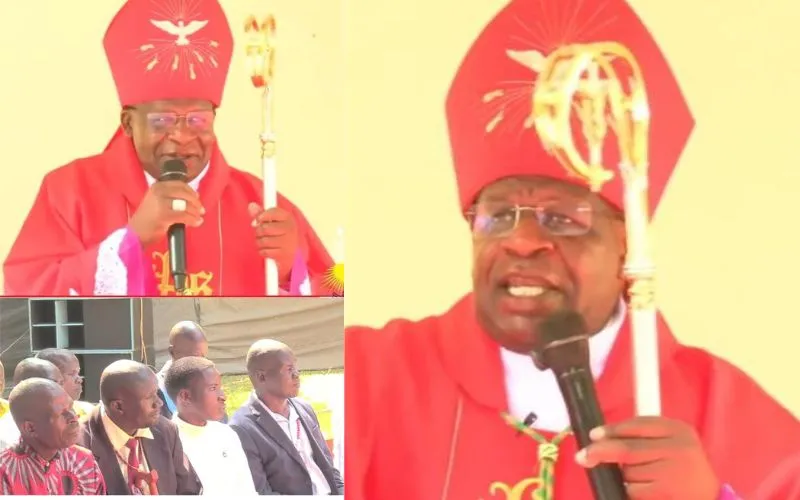
 Cardinal Robert Sarah delivers his homily at Mass on Nov. 23, 2025, at St. John the Baptist Parish in Allentown, New Jersey.(Photo: Allison Girone/LatinMassPhotographer.com)GPhotographyandFilms
He said that at the end of the liturgical year, the Church, “like a wise mother […] rightly calls our attention to the Four Last Things — death, judgement, heaven and hell,” as these “are realities, and we ignore them, or pretend that they do not exist, to our peril.”
Cardinal Sarah urged the faithful present not to get carried away by a “trick of the devil” regarding talk of the end times. It can lead to paranoia and obsession that renders some souls incapable of fruitfully fulfilling their vocations. If one is alive when the world ends, “God will give us the necessary grace of clarity of understanding we need at the time, provided we remain faithful to him,” he said.
The cardinal recalled the Lord’s demand of watchfulness from his disciples as the correct response. That is not obsession or paranoia, he said, but “it is prudence, and it is wisdom.” Just as it is prudent to prepare well for a journey, so, too, is prudence needed in respect of the Four Last Things, he said. “Too many people live as if the day of their death will never arrive,” he noted, adding: “This is the most insidious trick of the devil,” for it conveys that “we cannot prepare for it and for the judgment we shall each face at the moment of our death.”
“We must be prudent and prepare to give account of our lives — and, where necessary, if we have gone astray, we must repent and seek God’s mercy and forgiveness and do penance whilst we can,” Cardinal Sarah exhorted. God is merciful, he added, to those who repent and turn their lives to him, and he will equally “respect our free rejection of him.”
He stressed that in this context it was important to be as confident as St. Paul was in his prayer in his Letter to the Colossians: to lead a life worthy of the Lord, fully pleasing to him, bearing fruit in every good work, while also prudent and watchful amidst the world’s tribulations. “For if we are faithful to Christ and to the teaching of His Church,” Cardinal Sarah said, “we have nothing to fear. Indeed, we have the promise of eternal life!”





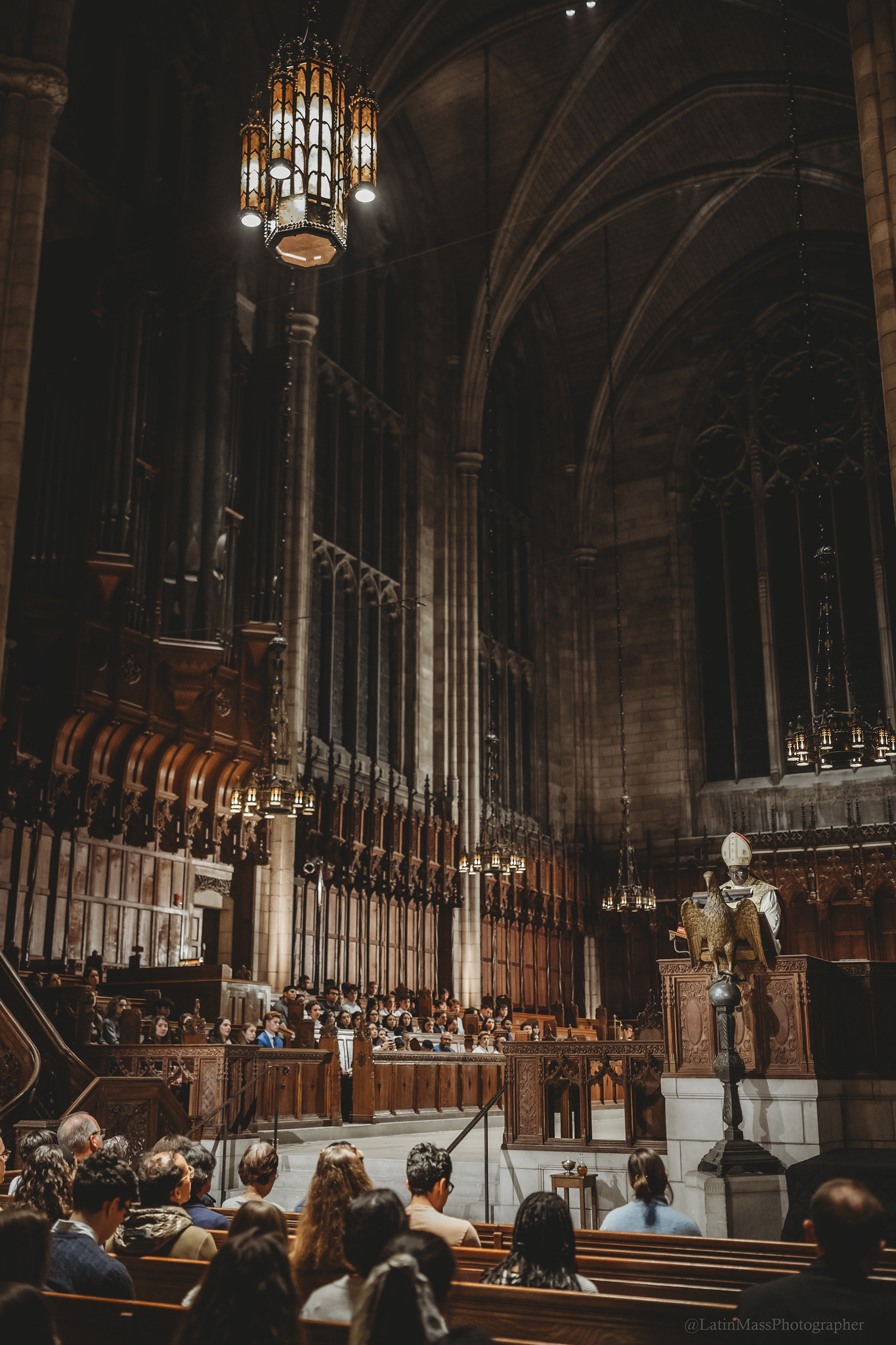 Cardinal Robert Sarah gives the homily at Mass at Princeton University Chapel, November 2025(Photo: Allison Girone/LatinMassPhotographer.com)GPhotographyandFilms