


Advertisement

Man, 20, Arrested After Profanation of Sacred Hosts at Catholic Parish in Angola’s Malanje Archdiocese

Credit: Jornal Borges

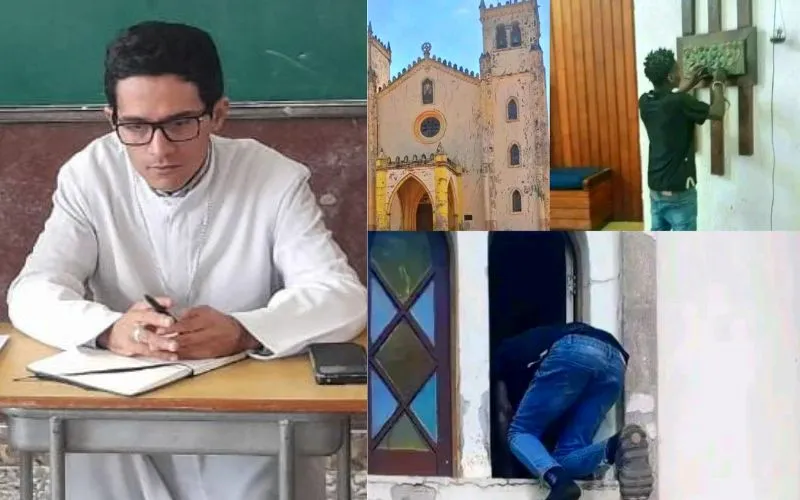
A 20-year-old man has been arrested by Angolan authorities in connection with profaning consecrated hosts and vandalizing at St. Michael the Archangel Parish of the Catholic Archdiocese of Malanje.

The incident occurred in the early hours of January 1 at the Parish, located in the Missão neighborhood, when the suspect, identified as Paulino João Kuenda, taking advantage of the cover of night, entered the Church and stole the ciborium containing consecrated hosts from the tabernacle.

In a statement issued on January 3, the Director of Angola’s Criminal Investigation Service (SIC) said the ciborium had been recovered, though the hosts were “no longer present.”

“The suspect remains in custody and is expected to be presented to the Public Prosecutor’s Office for further legal proceedings,” Manuel Halaiwa further said in the statement.

In a Monday, January 5, interview with ACI Africa, the Parish Priest, Fr. João Paulo Machado Freitas, said he and parishioners were stunned by the desecration of the church and its sacred objects.
Advertisement

“This situation was a shock. It is one of those things we never expect, and it becomes difficult to digest and draw conclusions immediately,” Fr. Freitas said. 

He added that the days following the incident have been “emotionally heavy”, noting that both he and the parish community “remain discouraged and deeply affected.”

The Portuguese-born member of the Congregation of the Holy Spirit (Spiritans/Holy Ghost Fathers) said the pain was heightened by the fact that religious spaces had traditionally been respected even during Angola’s years of civil war. 

“We hear of such abuses in other countries, but I never thought it would happen here. Even in times of war, the Church was respected. Today, it seems the sense of the sacred is being completely lost,” Fr. Freitas said.

Fr. Freitas recounted that the parish had begun the New Year’s Day Mass as usual. 

More in Africa

“The bell rang, the Catechist opened the doors, the altar servers prepared everything, and we began Mass normally,” he said. 

The shock came at the moment of Holy Communion. 

“When I opened the tabernacle, I found it empty,” he recalled, adding that he was “momentarily paralyzed,” unsure of what had happened.

The situation became even more disturbing when, later that day, a Catechist found a consecrated host lying on the main road. 

“That is when we fully realized it was an act of vandalism and profanation,” the Spiritan Priest said.

Advertisement

Fr. Freitas said he was further saddened upon learning that the suspect allegedly distributed and consumed the consecrated hosts with avocado “as if it were ordinary bread.”

He described the act as “barbaric” and deeply offensive to the faith. 

“A young man of 20 committing such an act shows how respect for the sacred is being lost,” the Parish Priest said, questioning what social or moral factors may be contributing to such behavior.

Fr. Freitas said that while incidents of break-ins, vandalism, and theft from churches are not uncommon in Angola, this was the first time he had personally experienced such a violation in his 11 years of ministry in the country. 

“We have heard of similar cases, but living through it is very different. It has been extremely difficult for me, and the Christians feel traumatized,” he said.

(Story continues below)

He explained that Church authorities and civil officials were immediately informed. In line with Catholic norms, the parish church has been closed since January 1, with all Masses and acts of adoration suspended until a formal act of reparation is carried out. 

“We are now waiting for Archbishop Luzizila Kiala to indicate when he can come to preside over the reparation ceremony,” Fr. Freitas said.

He said, “Now our task is to strengthen the faithful and help them understand the seriousness of what has happened.”

João Vissesse is an Angolan Journalist with a passion and rich experience in Catholic Church Communication and Media Apostolate.