

Advertisement

Leaders Cannot Evade Responsibility to Provide: Participants in Synodality Course at South African Seminary Told

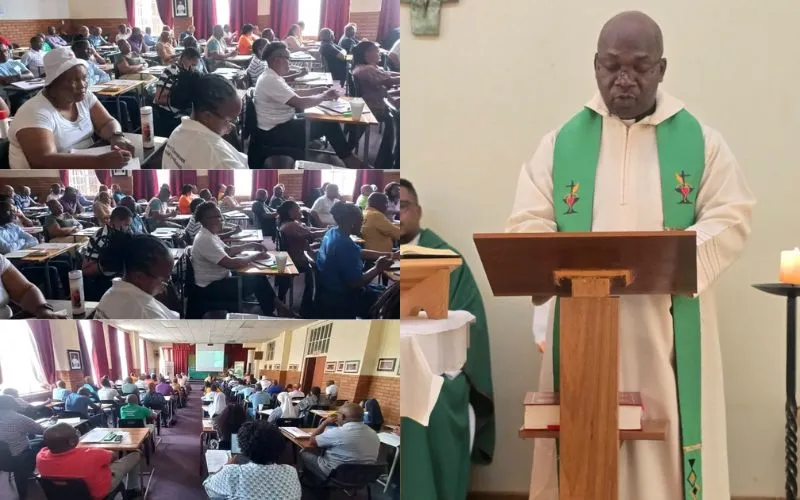
Fr. Nhlanhla Mchunu, the Coordinating Secretary of the Southern African Catholic Bishops’ Conference (SACBC) Department for the Laity. Credit: Catholic Diocese of Kroonstad/Facebook page/SACBC

Participants in a short course on synodality underway at St. John Vianney Seminary in Pretoria, South Africa, have been challenged to embrace leadership that takes responsibility for others, drawing inspiration from Jesus’ feeding of the multitudes.

In his homily during Holy Mass on Tuesday, January 6, Fr. Nhlanhla Mchunu, the Coordinating Secretary of the Southern African Catholic Bishops’ Conference (SACBC) Department for the Laity, reflected on the Gospel of St. Matthew in which Jesus fed 5000 people, and noted that authentic leadership involves providing for those entrusted to one’s care.

Rather than dismissing the people to nearby villages to find food for themselves, Fr. Mchunu noted, Jesus places the responsibility squarely on His disciples.

“Jesus commands his disciples to give the crowd something to eat,” he said, and added, “Leaders must provide. This is what Jesus is challenging us,” Fr. Mchunu said, adding that leaders cannot evade their duties. “We cannot shirk the responsibility. We must provide as leaders.”

Fr. Mchunu explained that the miracle of the feeding of the five thousand using five loaves of bread and two fish points beyond itself to the Eucharist, which he described as the new manna.
Advertisement

Unlike the manna in the desert that sustained the Israelites only for a day, he said, the Eucharist nourishes God’s adopted children for eternal life.

Held from January 5 to 10 at St. John Vianney Seminary in Pretoria, the week-long program that has attracted over 60 participants provides an opportunity for reflection, learning, and formation on synodality.

The course brings together lay leaders from sodalities and lay associations, members of parish pastoral and finance councils, diocesan synod coordinators, Priests, Religious Sisters, and even representatives from other Christian denominations.

In an interview on the sidelines of the program, the academic Dean and Director of the short course at the Seminary, Fr. Sbongiseni Msomi, explained that the course seeks to explore key themes of synodality while addressing common misconceptions that have emerged among the faithful.

“The purpose of this course was to reflect on what synodality is about, emanating from the synod that Pope Francis called,” Fr. Sbongiseni Msomi said in the Tuesday, January 6 interview with the SACBC Communications Officer, Sheila Leocádia Pires.

More in Africa

Fr. Msomi highlighted several misconceptions that the course aims to address, including the tendency to equate synodality with democracy, as well as misunderstandings surrounding clericalism, which, according to him, the people of God often fail to fully grasp and mistakenly associate with synodality.

In his January 6 homily, Fr. Mchunu invited participants to see synodal leadership not as a position of privilege, but as a call to compassionate service rooted in trust in Christ, who continues to feed and guide His people.

He further reflected on the deeper meaning of the Gospel miracle of feeding 5000 people, noting that while the old manna sustained God’s people in the wilderness for only a day, the new manna, the Eucharist, nourishes believers not temporarily, but for eternal life.

He explained that the feeding of the multitude is not merely a story about bread and fish, but a call to trust in the person of Jesus Christ.

Fr. Mchunu said that many people often focus on their limitations, telling themselves that they do not have enough time, strength, patience, or resources, or that they are less blessed than others.

Advertisement

According to Fr. Mchunu, Jesus invites believers to bring these perceived inadequacies to Him in trust. When people surrender their limitations in faith, he said, Christ blesses what is offered, multiplies it, and uses it to nourish others, even when it seems insufficient for oneself.

He also highlighted Jesus’ deep compassion for the crowd, pointing out that before attending to their physical hunger, He first taught them, responding to their spiritual needs. This, Fr. Mchunu said, reflects the very heart of the proclamation of the Gospel, which seeks the holistic care of the human person.

Fr. Mchunu reminded participants at the short course program that Christ is the light of all nations. Just as the bread was broken and shared, he said, so too is Christ’s love meant to be shared with others.

Silas Mwale Isenjia is a Kenyan journalist with a great zeal and interest for Catholic Church related communication. He holds a Bachelor’s Degree in Linguistics, Media and Communication from Moi University in Kenya. Silas has vast experience in the Media production industry. He currently works as a Journalist for ACI Africa.