In recent months the situation in Nigeria has been back in the spotlight after U.S. President Donald Trump threatened to go “guns a-blazing” into the country and subsequently launched strikes on militants linked to the Islamic State group in the northwest of the country.
While both the U.S. and Nigerian governments cooperated on the strikes, Trump has accused the Nigerian government of failing to protect Christians from jihadist attacks, with some allies and campaign figures describing the situation as a “ genocide.”
The Nigerian government is reluctant to address the religious aspect for fear of being designated a “country of particular concern,” which could “enable the Trump administration and other international governments to take measures including an embargo,” according to John Samuel, an expert on sub-Saharan Africa for Open Doors.
Asked how the U.K. government should respond to the situation, the U.K.’s special envoy for freedom of religion or belief, David Smith, told EWTN News: “We need to be critical friends. We need to be able to speak to our Nigerian counterparts, encouraging and enable them to speak truth. It’s a multilayered conflict in central Nigeria, with many causes, including religious persecution.”
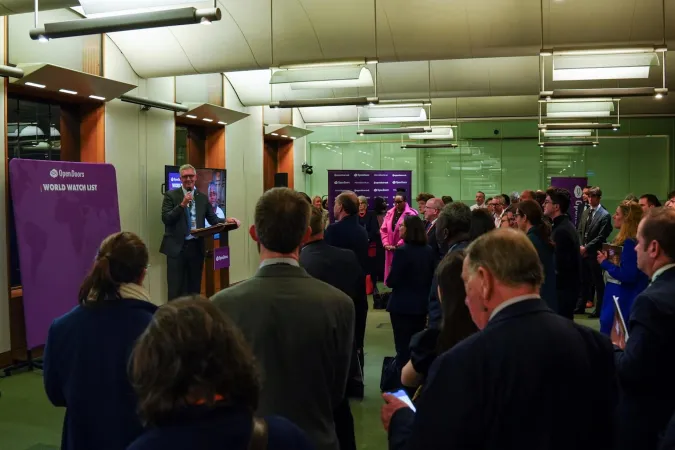
Speaking at Portcullis House, London, he told the room of 110 members of Parliament: “We have to be that voice that speaks on these horrendous stories. No one should live in fear because of their faith or belief. The minimum we can do is speak up, and I urge you to that.”
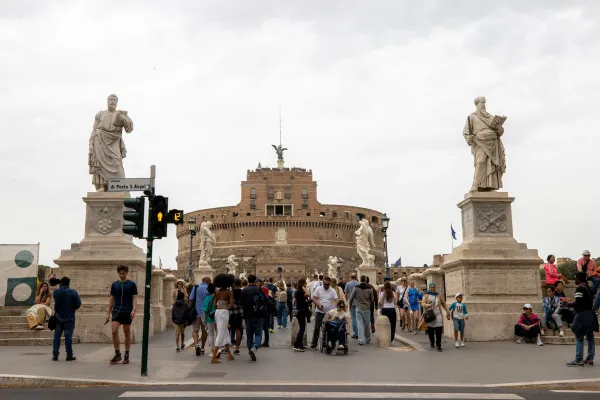
Pope Leo XIV addressed the Nigeria crisis in November 2025, acknowledging that “Christians and Muslims have been slaughtered” in the country. He told journalists at Castel Gandolfo that “many Christians have died” and called on the government to “promote authentic religious freedom.” The pope’s comments came after Trump designated Nigeria a country of particular concern for religious freedom violations.
The reasons for persecution in Nigeria are multifaceted and vary between regions. Ethnic Fulani herders have moved from the north to Nigeria’s middle belt, where they “are causing a massive problem,” according to John Samuel.
“They are moving to the area where they can find more resources for their cattle, like grazing land, and that naturally could cause a conflict between the predominantly Christian farming community and the herders who are predominantly ethnic Fulanis and Muslims.”
However, he warned “the least reported and the wrongly reported violence, but causing a massive problem, is the violence in the Middle Belt or north central of Nigeria by Fulani militants. That is the oversimplified one always,” he said, adding that “now there is an emergence of an Islamic militant Fulani.”
Christians are 2.7 times more likely to be targeted and killed in attacks from the Fulani than Muslims, according to the Netherlands-based Observatory for Religious Freedom in Africa. Some have suggested this is because Christian faith leaders can fetch higher ransoms if they are kidnapped.