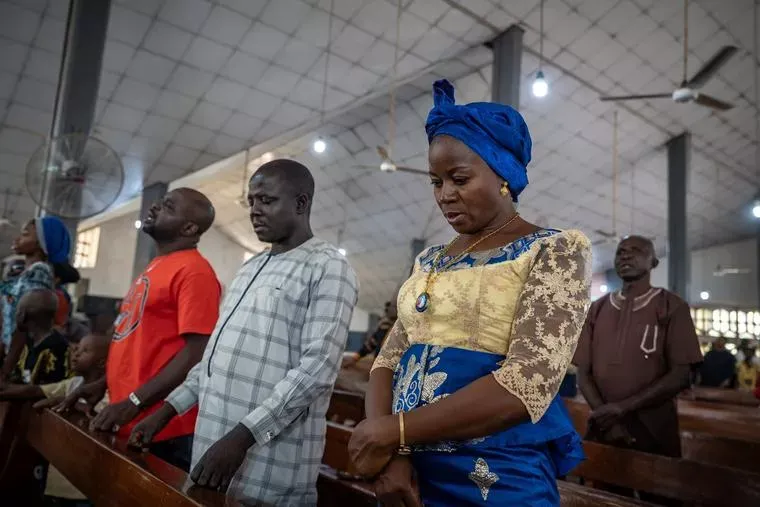
The “root causes” of the situation, he said, are “the continued dysfunction and non-performance of our political class,” he said.
“What you have at base is a country that consists of a political class that’s not performing its basic functions as a government, which is to take care of its people, to secure its borders, to ensure the safety of its people inside its borders. All these other things that are happening are symptoms of a long-running moral failure of the political class.”
Airstrikes Send ‘Message’ to Terrorists
Father George Ehusani, of Nigeria’s Lokoja Diocese, and executive director of the Lux Terra Leadership Foundation, told the Register that the U.S. action sends an important message to those who would continue to carry out attacks on Christians in Nigeria.
“The airstrikes cannot solve all the problems, but they have achieved something: These all-powerful terrorist groups now know that there is an international conspiracy against this terror,” Father Ehusani said.
(Story continues below)
“One of the significant fallouts of the airstrikes is that there is no place to hide. That will at least put some fear into them that there could be serious consequences to their continued terrorizing of the Nigerian people,” he said, noting that he is told there is still a lot of “drone surveillance all over the place.”
Nigerian Christians Massacred by Tens of Thousands
Since 2009, more than 52,000 Christians have been killed in Nigeria, according to a report published by the International Society for Civil Liberties and Rule of Law, a Nigerian-based research group monitoring religious persecution. Militant Islamists have gone from village to village, killing Christian farmers and their families and forcing many to flee. Catholic clergy have also been targeted: In the past 10 years, the pontifical foundation Aid to the Church in Need reports, 212 priests were kidnapped in Nigeria, 12 were murdered, and three later died from injuries sustained in captivity.
These attacks on Christian villages have largely been carried out by militant Islamist members of the Fulani, a semi-nomadic herding community operating in northwest Nigeria, according to the 2025 annual report from the U.S. Commission on International Religious Freedom.
Father Remigius Ihyula, a priest from the Diocese of Makurdi, in Benue State, one of the areas most impacted by terrorism, told the Register that the joint operation follows many years of inaction by the Nigerian government. The U.S., he said, should continue to put pressure on the government to ensure the well-being and safety of Christians in the country.
“We have seen our people displaced. We have seen our people decimated, and we have seen them killed and butchered like animals,” said Father Ihyula, who has dedicated most of his ministry to Christians in internally-displaced-persons camps.
“I’ve had to look for food and beg organizations around the world to give me money to feed people. When they give me money, I had to prioritize because sometimes it’s just a drop in the ocean,” he said.
Father Ihyula commended the Trump administration for adding a requirement to its new aid package that it be distributed through Christian agencies and organizations.
“I want to appeal that, going forward, if America is giving money to Nigeria, they should be very specific,” he said, explaining the aid should delineate precisely where the money should go, such as the for reconstruction of displaced peoples’ villages. “In Nigeria, we see billions for development aid, but you never really see any impact.”
Father Ehusani also emphasized to the Register that for this operation to be considered a success, the Nigerian government would need to act.
“Our hope is that with the pressure being put on our government by Donald Trump, some of the people can be prosecuted for sponsoring terrorism,” he said.
Could U.S. Involvement Backfire?
While commending the efforts of the Trump administration, Father Ehusani said there is concern that the recent joint U.S.-Nigerian attacks on terrorist sites could simply shift the threat of violence to other parts of the country.
“There is a bit of fear down south that those who have been displaced by this American strike may begin to terrorize people elsewhere. However, what it does is put our military on alert so that some of those people can be apprehended,” Father Ehusani said, noting that 38 terrorists fleeing the Sokoto area were recently arrested in Ondo State in the south.
Indeed, Bayo Onanuga, special adviser to President Bola Ahmed Tinubu, said on Jan. 4 that the post-Christmas attack had been carried out by “terrorists suspected to be fleeing from Sokoto and Zamfara following the United States’ airstrike on Christmas Eve,” The New York Times reported.
“We are not yet safe because these terrorist groups had spread across the country. We could hardly say that any part of the country is safe. So one strike in one location does not solve our problem,” Father Ehusani told the Register.
Nevertheless, the U.S. airstrikes give Catholics in Nigeria a reason for hope, he said.
“We feel optimistic, first of all, that there is international attention to what we are facing, that there is some support from the international community, and, therefore, there is hope that if our government is not serious enough to crush this, that we are getting support from the international community. That gives some optimism, some hope.”
Zelda Caldwell is News Editor at Catholic News Agency based in Washington, DC. She previously worked for Aleteia, as News and Culture editor.