When the sexual revolution made sex "recreational and not procreative, what it produced above all is a love deficit,” Eberstadt said.
At the same time, secularization produced “troubled, disconnected souls drifting through society without gravity, shattering the ability to answer ‘Who am I?’”
“The Church is the answer to the love deficit because Church teachings about who we are and what we’re here for are true,” she said.
She concluded with a final note on hope, saying “it is easy to feel embattled, but we must never lose sight of the faces of the sexual revolution’s victims,” she said, “who are sending up primal screams for a world more ordered than many of today’s people now know; more ordered to mercy, to community and redemption.”
The Church’s teachings were ’truly beautiful’ but 'very, very hard to live'
(Story continues below)
Erika Bachiochi, a legal scholar and fellow at the Ethics and Public Policy Center who has taught a class for the graduate program, shared her experience as a mother of seven who tried to live according to the Church’s “difficult” teachings.
As her children began to arrive at “a breakneck pace” and each pregnancy was “a bit of a crucible,” Bachiochi said being a mother was “very hard” for her, partly due to wounds from her youth (among other troubles, her own mother had been married and divorced three times), and partly because of a lack of community.
Echoing Eberstadt’s “arithmetic” problem, Bachiochi described having very few examples of Catholic family life and a very small support system.
Bachiochi said she believes God heals us from our wounds through our “particular vocations,” however.
Of motherhood, she said: “I think God really healed me through being faithful to teachings that I found quite hard, but truly beautiful. I was intellectually convinced by them and found them spiritually beautiful, but found them to be very, very hard to live.”
“Motherhood has served to heal me profoundly," she said, encouraging young mothers to have faith that though it might be difficult now, there is an “amazing future” awaiting them.
“It’s really an incredible gift that Church has given me ... the gift of obedience,” she said.
She also said by God’s grace, she was given an “excellent husband” and has found that “just as the Church promises, that leaning into motherhood, into the little things, the daily needs, the constant requests for my attention, has truly been a school of virtue.”
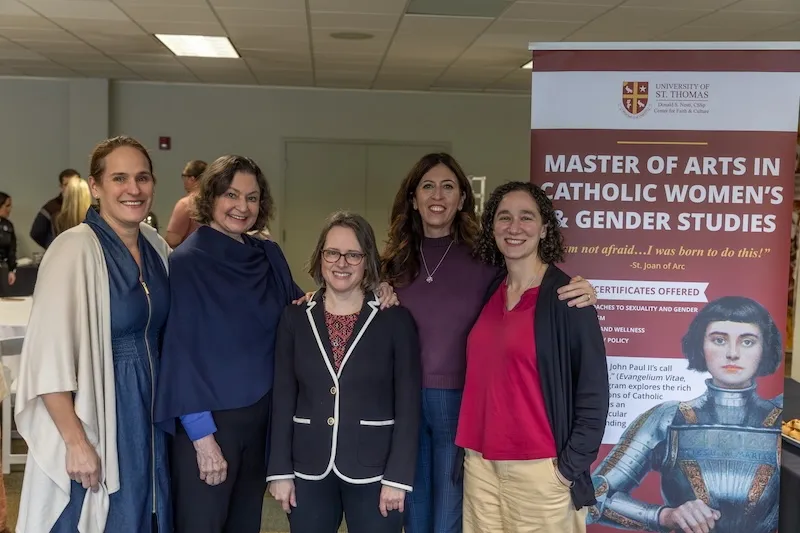
The Catholic Women’s and Gender Studies Program is a new part of the Nesti Center for Faith and Culture at the University of St. Thomas, a recognized Catholic cultural center of the Vatican’s Dicastery for Culture and Education.