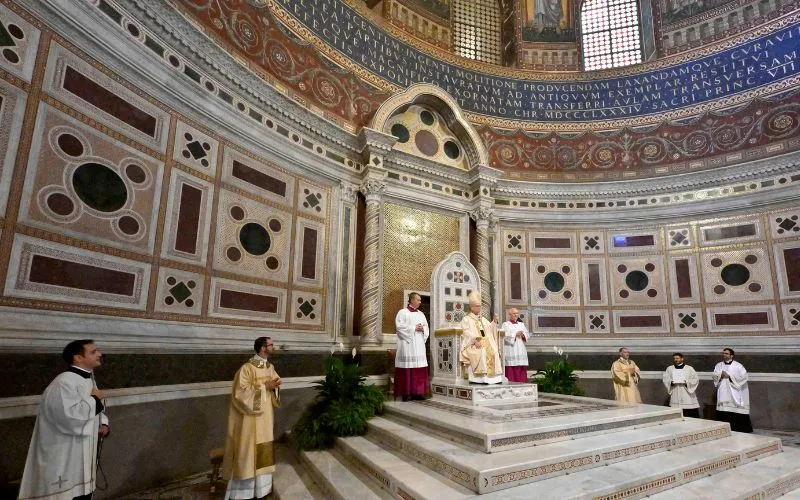
He noted that the Gospel of John is the only one to transmit the episode, accompanied by a catechesis that makes it a symbol of fraternal love and of the “new commandment,” concretizing love in reciprocal service.
For that reason, he said, “already in the early Church, the washing of the feet was considered a relevant sign for recognizing the authentic disciples of the Lord.”
Falbo added that the rite has varied over the centuries. The Council of Toledo in 694 regarded the washing of feet performed by a bishop for his collaborators as a semi-liturgical and obligatory rite. The Ordo Romanus XII even describes a second mandatum in which, after offering lunch to 13 poor people in a hall of the papal palace, the pope washed, dried, and kissed their feet.
In the 15th century, the chronicles of Giovanni Burcardo — papal master of ceremonies from Innocent VIII to Julius II, including under Alexander VI — systematically mention the pope washing the feet of 13 poor people in one of the halls of the Apostolic Palace in the Vatican.
Falbo also recalled that before the definitive move to the Vatican after the return from Avignon in 1378, popes lived for nearly 1,000 years near the Lateran cathedral, from the pontificate of St. Miltiades (d. 314) to Clement V (1305–1314).
(Story continues below)
Although the washing of feet is a rite proper to Holy Thursday, Falbo noted that at least since the pontificate of Innocent I in 416, three separate Masses were celebrated that day: a morning Mass for the reconciliation of penitents; another for the blessing of the holy oils, especially the chrism; and a third evening Mass as a memorial of the Lord’s Supper.
For that reason, he said, the foot-washing was not originally joined to the Holy Thursday Mass, even though the Gospel proclaimed at the Eucharist in Coena Domini refers precisely to Jesus’ gesture.
Falbo also pointed to the profound reform of the Sacred Triduum carried out by Pope Pius XII in 1955, which took effect the following year, with the goal of restoring greater historical fidelity in the celebrations.
Since then, he said, the practice of the bishop of Rome — conditioned by no longer residing near his cathedral — has been to divide the Triduum liturgies between St. John Lateran and St. Peter’s, reserving to the lateran the evening Holy Thursday celebration with the foot-washing rite, after the chrism Mass celebrated in the morning at the Vatican basilica.
This story was first published by ACI Prensa, the Spanish-language sister service of EWTN News. It has been translated and adapted by EWTN News English.
As a journalist, Victoria Cardiel has specialized in social and religious news. Since 2013, she has covered the Vatican for various media outlets, including Europa Press and Alfa and Omega, the weekly newspaper of the Archdiocese of Madrid.