“There are too many rivalries surrounding our leaders. The birth of many new communities is the result of multiple divergences in their leadership. The history of our Church bears the mark of great divisions whenever Christians have turned their gaze away from what is essential,” he said.
Archbishop Ahiwa denounced the trivialization of values and the promotion of anti-values in Ivorian society, urging a living faith expressed through concrete actions for the common good.
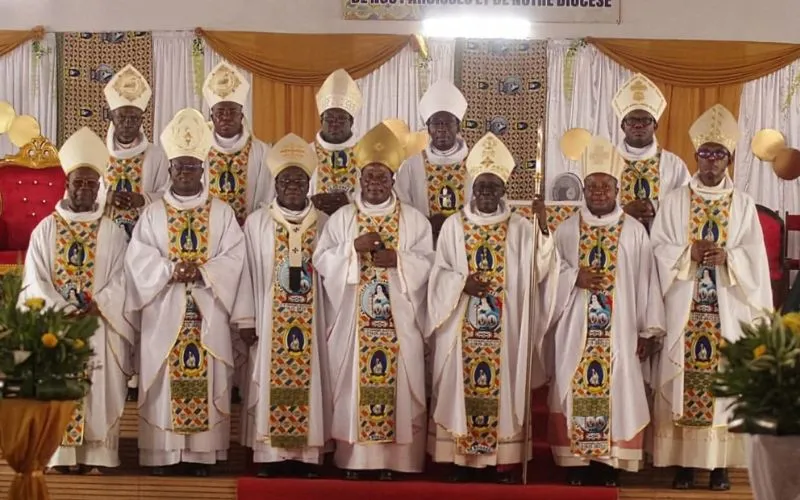
In their final communique that Bishop Joseph Kacou Aka of Ivory Coast’s Catholic Diocese of Yamoussoukro, read, CECCI members urged Ivorians to rise above divisions.
They called for “authentic reconciliation, without cheating or exclusion,” describing it as an indispensable condition for “a sustainable peace.”
CECCI members exhorted “all political, social and religious actors to prioritize truth, justice, dialogue and respect for human dignity, the only solid foundation of national cohesion.”
The Assembly also gave “special attention” to the project of creating a Catholic University in Ivory Coast, described as “a priority and structuring project from the resolutions of 2024 and 2025.”
According to the Catholic Bishops, the Catholic University of Ivory Coast (UCASSI) aims at “the integral training of the person, namely intellectual, human, ethical and spiritual,” and is intended to become “a pole of academic excellence, ethical and technological, in the service of integral human development.”
They praised “the quality and strategic coherence of the orientation document presented by the Catholic Academy of Ivory Coast in UCASSI” and recommended “the resolute transition to the operational phase,” including legal formalization, authorization requests, transparent application processes, and the use of specialized expertise.
On Catholic education, CECCI members acknowledged “major difficulties affecting the functioning of the National Association of Catholic Education of Ivory Coast,” citing financial tensions related to school fees, court disputes, delays in state payments, and challenges linked to social contributions.
They reaffirmed their commitment to accompany reforms “in a spirit of dialogue and responsibility,” while encouraging stronger professionalization and improved accounting and financial management.