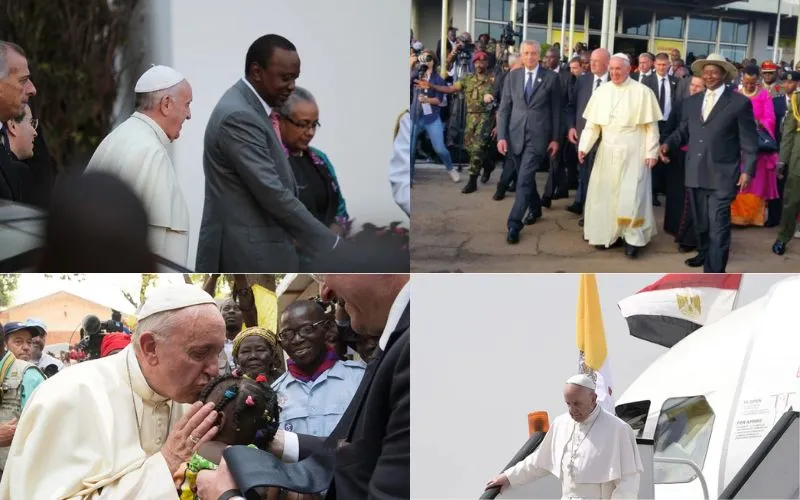
Central African Republic (29-30 November 2015)
Amidst the violent conflicts in the Central African Republic (CAR), the late Pope Francis brought a message of peace and reconciliation to the country. He opened the Holy Door of Mercy in the Metropolitan See of Bangui, a historic gesture that symbolized hope and healing.
“Bangui is today the spiritual capital of the world. We open this door as a sign of God's boundless mercy, calling all people to lay down weapons and embrace peace,” the late Pontiff said on 29 November 2015.
He made an appeal to “all those who make unjust use of the weapons of this world” to “lay down these instruments of death!”
“Arm yourselves instead with righteousness, with love and mercy, the authentic guarantors of peace,” the late Pope Francis emphasized in his appeal in CAR, where he underscored the urgency of interreligious harmony and an end to violence.
(Story continues below)
In CAR, the late Pontiff visited the Mosque of Koudoukou in the country’s capital city, Bangui, where he addressed both Muslim and Christian leaders. He appealed for unity in the diversity of faith practices.
“Christians, Muslims and members of the traditional religions have lived together in peace for many years. We are well aware that the recent events and acts of violence which have shaken your country were not grounded in properly religious motives,” the late Pontiff said on 30 November 2015.
He added, “Christians and Muslims are brothers and sisters. We must therefore consider ourselves and conduct ourselves as such. Together, we must say no to hatred, to revenge and to violence, particularly that violence which is perpetrated in the name of a religion or of God himself. God is peace, salaam.”
Egypt (28-29 April 2017)
The late Pope Francis visited Egypt to strengthen Christian-Muslim relations. At Al-Azhar University, he condemned religious extremism and called for peaceful coexistence.
“We have an obligation to denounce violations of human dignity and human rights, to expose attempts to justify every form of hatred in the name of religion, and to condemn these attempts as idolatrous caricatures of God,” the late Pontiff said on 28 April 2017.
He added, “To counter effectively the barbarity of those who foment hatred and violence, we need to accompany young people, helping them on the path to maturity and teaching them to respond to the incendiary logic of evil by patiently working for the growth of goodness.”
During the Holy Eucharist with Egypt’s Catholic community that he presided over, the late Pope Francis reinforced the message of unity amid challenges that Christians in the region face.
“Do not be afraid to open your hearts to the light of the Risen Lord and let him transform your uncertainty into a positive force for yourselves and for others. Do not be afraid to love everyone, friends and enemies alike, because the strength and treasure of the believer lies in a life of love!” the late Pontiff said on 29 April 2017.
Morocco (30-31 March 2019)
In Morocco, the late Pope Francis focused on interfaith dialogue, particularly between Christians and Muslims; he urged cooperation between different faiths to build bridges of peace and fraternity.
“Freedom of conscience and religious freedom – which is not limited to freedom of worship alone, but allows all to live in accordance with their religious convictions – are inseparably linked to human dignity,” the late Pontiff said in his first meeting in Rabat on 30 March 2019.
Authentic dialogue brings awareness of the importance of religion “for building bridges between people,” he said, adding that it is faith in God, which leads people “to acknowledge the eminent dignity of each human being, as well as his or her inalienable rights.”
The late Pontiff also met with migrants for whom he advocated for humane treatment and the protection of rights. “You are not the marginalized; you are at the center of the Church's heart. The Church is aware of the sufferings that accompany your journey, and she suffers with you,” the late Pope Francis said.
At Holy Mass, in the Prince Moulay Abdellah Stadium in Rabat on 31 March 2019, the late Pope Francis called upon the Moroccan people to “let the culture of mercy grow.”
Mozambique (4-6 September 2019)
Arriving in Mozambique after the devastation of Cyclone Idai, the late Pope Francis encouraged national reconciliation and post-war reconstruction efforts.
In his address to authorities, civil society, and the diplomatic corps on 5 September 2019 at the Palácio da Ponta Vermelha in Maputo, the late Pontiff challenged the notion that peace is the absence of war.
He said, “Peace is not merely absence of war but a tireless commitment – especially on the part of those of us charged with greater responsibility – to recognize, protect and concretely restore the dignity, so often overlooked or ignored, of our brothers and sisters, so that they can see themselves as the principal protagonists of the destiny of their nation.”
The late Pontiff called for a “culture of encounter.”. For him, he said, “it is essential to cherish memory as a path opening up towards the future, as a journey leading to the attainment of common goals, shared values and ideas that can help to overcome narrow corporative or partisan interests. In this way, the true wealth of your nation can be found in the service of others, especially the poor.”
The late Pontiff urged Catholic Church leaders in Mozambique to avoid being part of conflicts and divisions but to go out of their way to visit others and to encourage dialogue and solutions.
“The Church in Mozambique is invited to be the Church of the Visitation,” the late Pope Francis told Mozambican Bishops, Priests, Seminarians, women and men Religious, and Catechists in Maputo on 5 September 2019.
To young people in the Southern African nation, the late Pope Francis cautioned against despair; he encouraged youths to confront their country’s challenges with hope.
Madagascar (6-8 September 2019)
Pope Francis addressed deforestation and economic inequality in Madagascar. In his address to the civil authorities of Madagascar on 7 September 2019, Pope Francis urged them to embrace the “soul” of their country and to work toward an “integral development” that will not forget the poor and those most in need.
“In the Preamble of the Constitution of your Republic, you wished to enshrine one of the fundamental values of Madagascan culture: fihavanana, a word that evokes the spirit of sharing, mutual help, and solidarity. It also evokes the importance of family, friendship, and goodwill between people and with nature,” the late Pontiff said.
He urged the government to combat corruption which he said fosters “conditions of inhumane poverty” and encouraged them to work toward a society with a “better division of income and an integral development of all, particularly those most poor.”
Mauritius (9 September 2019)
In Mauritius, the late Pope Francis urged Catholics to avoid worldly securities, to increase their zeal for evangelization, and to invite youths to be an active part of the Church.
The late Pontiff made a particular reference to Blessed Jacques-Désiré Laval, the French missionary Priest and member of the Congregation of the Holy Spirit (CSSp./Spiritans/Holy Ghost Fathers) known as the “Apostle of Mauritius” because of his great evangelization work on the Indian Ocean Island nation, particularly his attention to the poor, the sick, and ex-slaves.
“Through his missionary outreach and his love, Father Laval gave to the Mauritian Church a new youth, a new life, that today we are asked to carry forward,” the late Pope Francis said outside the Monument of Mary Queen of Peace in Port Louis on 9 September 2019.
He called on young people to reject materialism and embrace service to society.
Democratic Republic of Congo (DRC) (January 31-February 3, 2023)
During his visit to the DRC, the late Pope Francis denounced violence and exploitation, particularly in the mineral-rich Eastern region.
In his first speech in the Central African nation, the late Pontiff urged the international community to give the country its autonomy and desist from exploitation and violence.
“This country and this continent deserve to be respected and listened to; they deserve to find space and receive attention. Hands off the Democratic Republic of the Congo! Hands off Africa! Stop choking Africa: Africa is not a mine to be stripped or a terrain to be plundered,” the late Pontiff said on 31 January 2023 in the garden of the Palais de la Nation in Kinshasa.
“May Africa be the protagonist of its own destiny!” the late Pope Francis said, and appealed, “May the world acknowledge the catastrophic things that were done over the centuries to the detriment of the local peoples and not forget this country and this continent.”
He called for an end to bloodshed and economic injustice, urging leaders to prioritize the common good. “We cannot grow accustomed to the bloodshed that has marked this country for decades, causing millions of deaths that remain mostly unknown elsewhere,” the late Pontiff said.
South Sudan (3-5 February 2023)
In a historic Ecumenical Visit, which Pope Francis undertook alongside the then Archbishop of Canterbury, Justin Welby, and the Moderator of the Church of Scotland, Iain Greenshields, the late Pontiff pleaded for an end to tribal conflicts and encouraged political leaders to work together for stability and development.
In his encounter with Internally Displaced Persons (IDPs) in South Sudan on 4 February 2023, Pope Francis urged respect for and protection of women. “If mothers and women receive the proper opportunities, through their industriousness and their natural gift of protecting life, they will have the ability to change the face of South Sudan, to give it a peaceful and cohesive development!” the late Pope Francis said.
He begged the leaders of South Sudan to work together to put an end to bloody conflict and violence in their country.
“In the name of God, of the God to whom we prayed together in Rome, of the God who is gentle and humble in heart, the God in whom so many people of this beloved country believe, now is the time to say ‘No more of this,’ we say no more, without ‘ifs’ or ‘buts,’” the late Pope Francis said on 3 February 2019 in his address to South Sudan’s President and Vice Presidents in the garden of the presidential residence in Juba.
ACI Africa was founded in 2019. We provide free, up-to-the-minute news affecting the Catholic Church in Africa, giving particular emphasis to the words of the Holy Father and happenings of the Holy See, to any person with access to the internet. ACI Africa is proud to offer free access to its news items to Catholic dioceses, parishes, and websites, in order to increase awareness of the activities of the universal Church and to foster a sense of Catholic thought and culture in the life of every Catholic.