Advertisement

SECAM Joins Other Faith Leaders, European Civil Societies to Urge “justice in Africa–Europe Agricultural Relations”

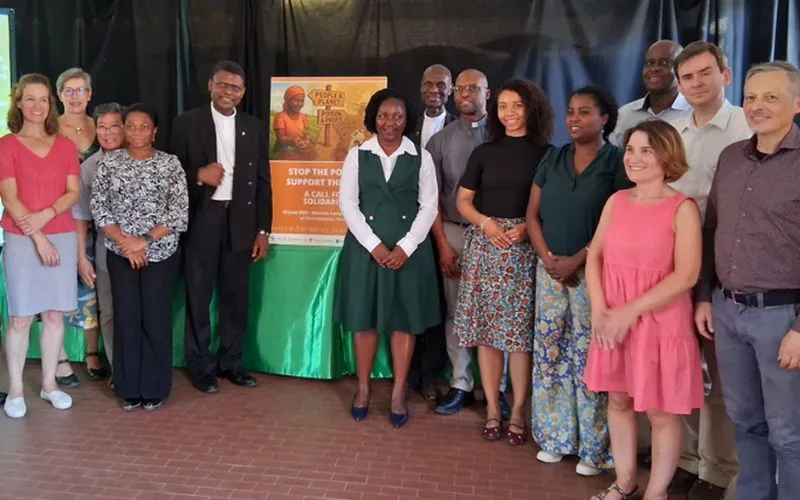
Some of the Delegates at the Circo Massimo Farmers Market in RomeJune 26 conference in Rome. Credit: CIDSE

Member of the Symposium of Episcopal Conferences of Africa and Madagascar (SECAM) have joined other faith leaders from across the globe, and civil society organizations from Europe to advocate for “justice in Africa-Europe agricultural relations”.

In a press statement shared with ACI Africa on Tuesday, July 1, participants in the June 26 convention that  SECAM co-organised with the Alliance for Food Sovereignty in Africa (AFSA), Eastern and Southern Africa Small-Scale Farmers Forum (ESAFF) and European Civil society partners urge the European Union (EU) and the African Union (AU) to end “toxic trade practices.”

The civil societies from Europe that co-organised the conference with SECAM include the International Cooperation for Development Solidarity (CIDSE), the relief organization of Germany’s Catholic Bishops, Misereor, CCFD-Terre SolidaireBroederlijk Delen, DKA-Austria, and Focsiv.

In the July 1 Press Statement titled “Stop the poison, support the seed: A call for solidarity”, the faith leaders and farmers from Africa say they “joined forces with European allies to demand urgent action in protecting farmer-managed seed systems and halting the export of banned pesticides from Europe to Africa.”

“Participants issued a united call to the African Union, European Union, and national governments to put an end to toxic trade practices and enshrine the rights of farmers to control their seeds and food systems,” the leaders say.
Advertisement

The delegates at the conference held at Circo Massimo Farmers Market in Rome complained about the International Union for the Protection of New Varieties of Plants (UPOV) style, which they claimed threatens the African food system.

They said that the UPOV style “seed laws promoted across Africa, often with donor support, threaten to criminalize the saving, exchange, and improvement of traditional seeds — the very foundation of African food systems.”

The one-day conference sought to “identify ways forward in strengthening ongoing efforts to protect and enhance farmer-managed seed systems, given ongoing AU efforts and in the context of recent Comprehensive Africa Agriculture Development Programme (CAADP) processes.”

It also sought to “identify steps that can be pursued by both the European Union and the African Union, and at national levels in addressing the risk posed by highly hazardous pesticides that continue to be exported to Africa even though these are already banned in Europe.”

According to the July 1 press statement shared with ACI Africa, the participants at the convention “exposed the hypocrisy of the European Union,” faulting the union of 27 countries for exporting highly hazardous pesticides to Africa and the rest of the world.

More in Africa

“Europe is exporting poison that it doesn’t want to use on its fields. But Europe imports food grown with it, so the residues end up on European consumers’ plates. This is a double standard that must end,” Suzy Serneels of Broederlijk Delen has been quoted as saying.

On the other hand, Medius Bihunirwa of PELUM Association emphasized that pesticide use “has doubled across Africa over the past 15 years — often without farmers being trained or having access to protective equipment.”

Bihunirwa further lamented about “revealed banned pesticide residues in food, drinking water, and even human urine samples" and explained, “These toxins are in our food, water, and bodies. And the most vulnerable are women and children, who suffer most.”

Faith leaders at the conference, which was also organized in partnership with Fondazione Campagna Amica, condemned these practices as immoral and incompatible with the values of justice and stewardship.

“If these pesticides are too dangerous for Europeans, they are too dangerous for Africans. Our governments have a sacred duty to protect life, not to sell it off to chemical companies,” Fr. Richard Rwiza, Professor at the Catholic University of Eastern Africa (CUEA), is quoted as saying.

Advertisement

As a way forward, Faith leaders, farmers, and civil society organizations at the June 26 conference called on EU to “immediately ban the export of all pesticides prohibited within the EU.”

They also want the EU to ensure that food imports from its region are not produced with substances banned in Europe, and to support “agro ecological transitions in Africa with public finance and just trade policies.”

To the AU member States, the faith leaders, farmers, and civil society organizations have called for the finalization and implementation of “the continental policy framework on farmer-managed seed systems.”

They also want AU member States to “reform restrictive seed laws” to recognize and support traditional seed saving, exchange, and improvement, and to ban the import and use of highly hazardous pesticides by implementing the Bamako Convention.

Additionally, the delegates at the Rome convention have recommended that AU member States consider investing in “agro ecological alternatives, farmer-led research, and community seed banks.”

(Story continues below)

Silas Mwale Isenjia is a Kenyan journalist with a great zeal and interest for Catholic Church related communication. He holds a Bachelor’s Degree in Linguistics, Media and Communication from Moi University in Kenya. Silas has vast experience in the Media production industry. He currently works as a Journalist for ACI Africa.