Advertisement

Angola’s Governance System “kills private initiatives, stifles creativity”: Catholic Bishops Lament Restricted Freedoms

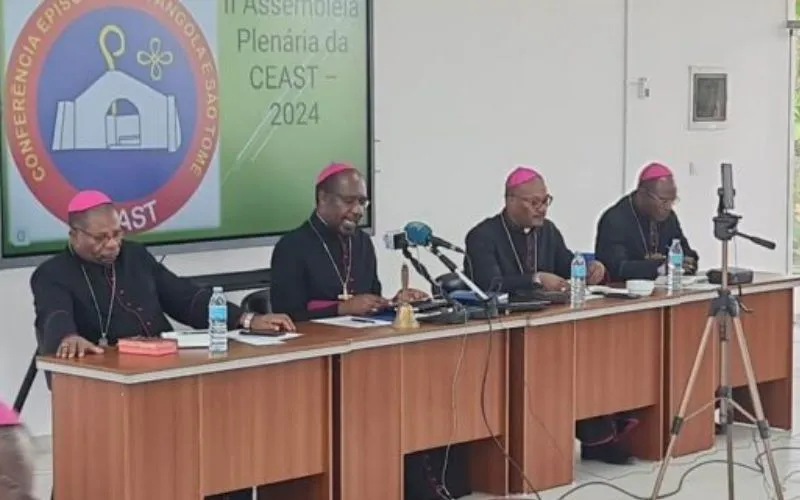
Members of the Permanent Council of the Bishops' Conference of Angola and São Tomé and Príncipe (CEAST). Credit: Radio Ecclesia

There is a decline in ethical standards and growing social injustices in Angola, members of the Bishops' Conference of Angola and São Tomé and Príncipe (CEAST) have noted with concern.

In a statement issued following their July 16-17 Permanent Council meeting in Angola’s capital city, Luanda, CEAST members fault the country’s governance system and call for urgent reforms and a renewed commitment to ethical governance and inclusive decision-making processes.

“The values of freedom are being eroded by restrictions on freedom of expression and the instrumentalization of public media, which suppress plurality and silence dissenting voices,” they lament in their Friday, July 18 statement, which they issued ahead of the 50th anniversary of Angola’s independence scheduled for November.

The Catholic Church leaders are concerned about “systematic and deliberate exclusion of Angolans from decision-making processes,” which they say weakens democracy.

They decry Angola’s centralized, autocratic, and welfare-based system of governance as it “kills private initiatives, stifles creativity and proactivity essential for progress.”
Advertisement

“The unchecked pursuit of capital without ethical criteria undermines national dignity and threatens social cohesion,” CEAST members say, warning of “external influences bearing poisoned gifts,” which they say “erode sovereignty and distort national development.”

In their statement, members of the two-nation Conference denounce persistent divisions stemming from historical conflicts that, they say, “continue to fuel animosities among citizens.”

They condemn the “shocking inequalities” that violate human dignity and insist that “no one should have unnecessary excess” while others lack the bare minimum.

Against this backdrop, CEAST members call for a renewed civic spirit, noting that “the nation-state is built through honest work, solidarity, and love of country.”

They encourage citizens in all sectors—from family to academia, public service to business—to uphold integrity.

More in Africa

“We urge young people to become active participants in national life despite the current challenges. Their balanced formation and creative leadership are the seeds of boldness that can break cycles of despair and open promising paths forward,” the Catholic Bishops say.

They call for the realization of institutions that promote “human rights, transparent governance, judicial independence, free media, and functional education and healthcare systems.”

Without these, they warn, “individual efforts will fail, and the future will remain uncertain.”

Reflecting on the 50th anniversary of Angola’s independence, CEAST members acknowledge the sacrifices of many who contributed to the Southern African nation’s liberation.

“As a Church, we recognize and are grateful for the testimony of faith and national dedication of countless brothers and sisters. We pray for them and offer them our apostolic blessing,” they say.

Advertisement

In their July 18 statement, CEAST members have expressed concern about the government's current commemorative practices.

While the late Agostinho Neto of Angola’s ruling party, the Popular Movement for the Liberation of Angola (MPLA), has been posthumously honored, other key nationalist leaders, Holden Roberto of the National Front for the Liberation of Angola (FNLA) and Jonas Savimbi of the largest opposition party, the National Union for the Total Independence of Angola (UNITA), have been ignored.

“For a true national reconciliation, it is indispensable to recognize all founding fathers of the nation—Holden Roberto, Agostinho Neto, and Jonas Savimbi—without diminishing any of them,” they say, and add, “True unity requires that all of Angola be welcomed into the ideal space of collective memory and forgiveness.”

For them, such reconciliation must be anchored in ethical conversion, especially from the country’s leaders.

“It is urgent to root out corruption,” CEAST members emphasize, adding that the transformation Angola needs will only be possible through “a moral turning point that restores respect for public resources, for fellow citizens, and the common good.”

(Story continues below)

The Catholic Church leaders remain confident in Angola’s potential for renewal. “These are still times of hope. Every upright human action contributes to history and matters in the eyes of God,” CEAST members say in their July 18 statement.

João Vissesse is an Angolan Journalist with a passion and rich experience in Catholic Church Communication and Media Apostolate.