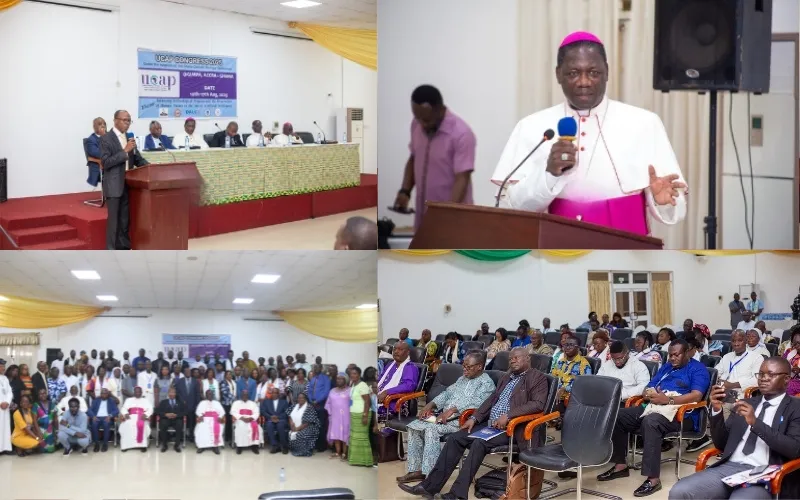
Deliberating on a broad range of issues, participants are to come up with recommendations to guide governments, media organizations, and society at large. Outcomes from the Congress are to shape UCAP’s future training programs and professional guidelines.
Also speaking during the August 11 event, the President of the Ghana Catholic Bishops Conference (GCBC) called on Catholic media professionals in Africa to resist misinformation and disinformation with “steadfast integrity, humility, and transparency.”
Bishop Matthew Kwasi Gyamfi warned that the abuse of media power is a “moral and cultural crisis” that undermines truth and social cohesion.
“It is a privilege for Ghana to host the African Catholic Union of the Press Congress at a time when the world is navigating the complex intersection of technological advancement and the perennial truths of our shared humanity,” Bishop Gymfi said.
Recalling the Church’s teaching since the Vatican II’s Inter Mirifica, Bishop Gyamfi affirmed that “social communications are not merely instruments of information exchange, but powerful means by which truth, beauty, and the dignity of the human person are either upheld or undermined.”
(Story continues below)
He said: “The means of social communication are marvelous technical inventions which God’s providence has placed in human hands. They are, therefore, moral as well as technical realities to be used in service of the common good.”
“This erosion of trust is not merely a professional challenge. It is a moral and cultural crisis,” the Bishop of the Catholic Diocese of Sunyani said, adding, “The abuse of media power corrodes the bonds of social cohesion and undermines the very capacity of truth to illuminate public life.”
Bishop Gyamfi said the theme of the UCAP congress “resonates profoundly with the Church’s anthropology and moral vision.”
“While technological progress and, in our day, artificial intelligence, in particular, opens new horizons for human ingenuity, it also poses significant questions about the integrity of truth, the safeguarding of freedom, and the sanctity of life,” he said.
The President of GCBC further noted, “The Catholic tradition affirms that human dignity flows not from what we do, nor from the data we generate, but from what we are, persons created in the image and likeness of God, endowed with reason, conscience, and the capacity.”
On his part, UCAP President, Charles Ayetan, called for “strengthening the capacities of media professionals with the aim of educating the public on the need to promote and preserve human values in a world strongly impacted by technological progress, particularly with the advent of Artificial Intelligence.”
Mr. Ayetan described UCAP Congress as “our Union’s largest event, a continuing education forum that offers participants a wealth of information through conferences, debates, and discussions with experts.”
He explained that topics of UCAP Congresses are “carefully chosen” to help media practitioners “develop a more positive approach to covering local and global events, in the spirit of spreading universal human values.”
The native of Togo, who serves as the Communications Officer of the Ghana-based Symposium of Episcopal Conferences of Africa and Madagascar (SECAM) wished participants “a fruitful Congress” that will contribute to the mission of Catholic media in upholding human dignity in the face of rapid technological changes.
Jude Atemanke is a Cameroonian journalist with a passion for Catholic Church communication. He holds a Bachelor’s Degree in Journalism and Mass Communication from the University of Buea in Cameroon. Currently, Jude serves as a journalist for ACI Africa.