Advertisement

Catholic Sisters at Recent G20 Interfaith Forum in South Africa Thankful for Opportunity to Contribute to Global Issues

Credit: SACBC

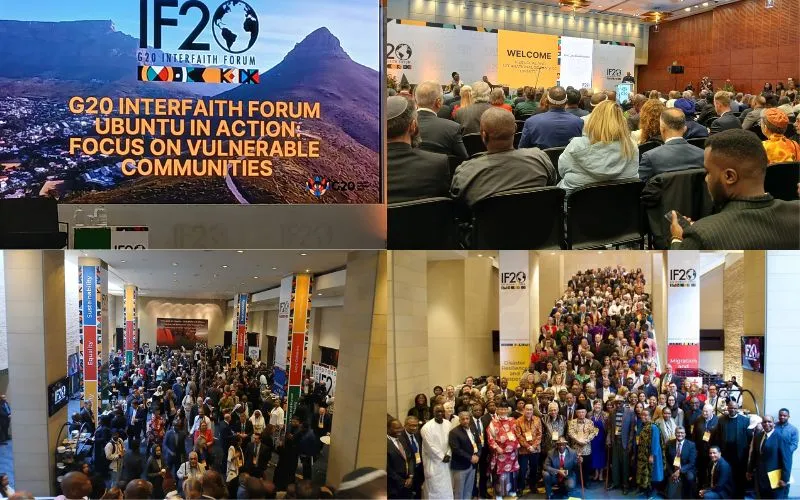
Catholic Sisters, who participated in the Group of 20 (G20) Interfaith Forum (IF20) in South Africa that concluded on August 14 have recognized with appreciation the opportunity to contribute to a gathering that brought together faith leaders to address global challenges.

Two of the 10 Catholic Sisters, who spoke to ACI Africa after the five-day event in Cape Town, South Africa, said it was fulfilling to join other faith leaders to discuss global concerns such as displacement, hunger, poverty, education, and health care among other issues.

“I feel this is the best way that we could have done it – involving the religious leaders in fighting hunger and poverty because the religious leaders are found where the people are. Even in the so-called hard to reach areas, there are always religious leaders there with the people,” Sr. Christabel Juunza Mwangani said.

She said she was happy to share her experiences from initiatives undertaken in her home country and expressed satisfaction that these efforts were contributing to the fight against hunger.

“I work with eight Congregations of Religious Sisters in Zambia to bring about food security to female-headed households among women farmers,” the Zambian-born member of the Religious Sisters of the Holy Spirit said, alluding to an initiative she oversees in her home country in partnership with the Hilton Foundation.
Advertisement

She emphasized that when efforts to address poverty and hunger are entrusted to religious leaders, those interventions are more likely to reach the people directly and have a meaningful impact.

“When you want to measure food security or insecurity in a community, you go directly to households. Then you will know what food insecurity looks like. That's where dignity is restored,” said Sr. Mwangani.

She told ACI Africa that she expects the G20 leadership to explore “practical solutions” that would contribute to transforming agriculture in Africa to a “more productive engagement and food security more meaningful.”

“We propose that provision of water is prioritized because productivity in agriculture can't happen where there's no water,” she said, advocating for a sustainable irrigation system that can support food production throughout the year.

On her part, the Director of Talithakum Zambia (TAKUZA), a network of Catholic Sisters seeking to address the issue of human trafficking, told ACI Africa that she found the convergence of the different faiths and their common focus on the dignity of the human person striking.

More in Africa

“What struck me was that whenever I listened to people of different faiths speaking about the human person, the focus was always on dignity. To me, this shows that across our diverse traditions, we share a common recognition of the value and significance of every individual,” said Sr. Kayula Lesa on her experience at the IF20 summit.

She added that the “link between these values and policy” as different stakeholders discussed issues of climate change, human trafficking, migration, refugees and internally displaced persons, and food security was also “quite striking” for her.

“It was also important to just be in that environment with people from different faith backgrounds ... I haven't had such an interaction with them at that level. That just gave me that sense of being on holy ground,” said the member of the Religious Sisters of Charity.

In the August 16 interview, Sr. Lesa also weighed in on the contribution of the Vatican’s Secretary of the Dicastery for the Promotion of Integral Human Development (PIHD) at the IF20 forum.

She recalled that Sr. Alessandra Smerilli began by sharing the late Pope Francis’ first apostolic journey to Lampedusa, emphasizing that the late Holy Father chose the island for his first apostolic visit “because of his commitment to migration.”

Advertisement

“This is a place where over 20,000 people from Africa and other parts of the world lost their lives in an attempt to reach Europe. That struck me so strongly because it was the Pope putting in practice what he believed that is the care for the migrants.

“This is a place where over 20,000 people from Africa and other parts of the world have lost their lives in an attempt to reach Europe. That struck me so strongly because it showed the Pope putting into practice what he believed, namely, the care for migrants,” said Sr. Lesa

To address the challenge of migration, she urged the leadership of the G20 nations as they prepare for their summit to lead the way and encourage other developed nations to forgive debts owed to them, especially by the least developed nations.

“At this point, we're talking about debt forgiveness and that would be significant,” said the Talithakum Zambian-born official urging them to consider embracing fair trade and lifting unnecessary migration restrictions.

She added, “Fair trade contributes to making life better for countries so that people can put their resources into education, employment, and social services. Beyond that, for me, really, it is also just making migration easier.”

(Story continues below)

“These restrictions put people into situations where they resort to migrating irregularly. Why don't we just make it easier for people to move regularly, so that they are less vulnerable to issues of smuggling, and issues of human trafficking?” she asked, posing a challenge to the G20 leaders, who will be participating in their 2025 Summit scheduled for November in South Africa.

Nicholas Waigwa is a Kenyan multimedia journalist and broadcast technician with a professional background in creating engaging news stories and broadcasting content across multiple media platforms. He is passionate about the media apostolate and Catholic Church communication.