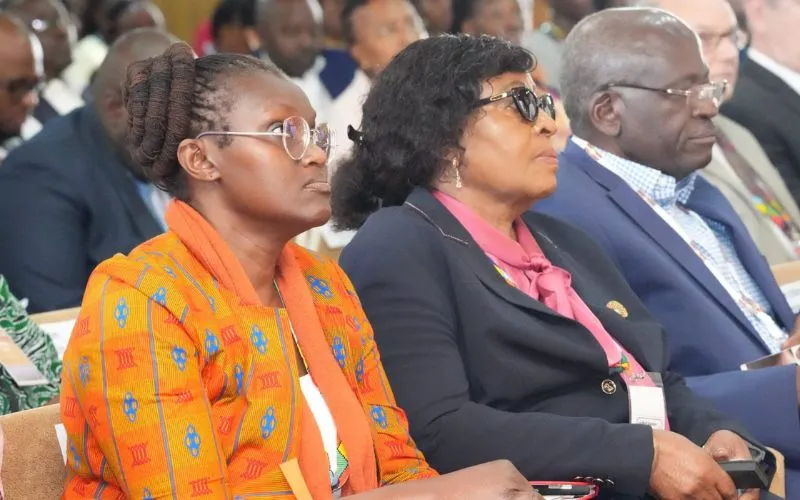
“I have been working in my business school for 15 years, and this conference was an opportunity for me to rethink what we have been doing,” Marie who works at MDE (Management et Developpement d’Entreprise) said.
She added, “I was a panelist in one of the sessions where we talked about the public and private sectors and what could be done to improve the efficiency of the public sector.”
“One of the ideas that I came up with was the need to train government officials. This is difficult because they don't like training, and they don't like thinking about ethics and morals, doing good, and integrity, but we as academia should find a way to teach these values,” she said, and added, “I was happy to get ideas from the audience on how to go about this.”
Also central at the conference was the readiness of Africa to embrace a kind of development where African countries do not rely anymore on traditional funding models.
Weighing in on the possibility of African countries being self-reliant, away from paternalism, Marie said, “Do we believe that Africa can make a leap? Yes. Do we have the people to steer this thought? Not yet. Why is that? I don't know.”
(Story continues below)
“Our leaders are very educated people but it looks like we are not doing something right,” she said, and added, “We have most of the resources the world has to offer. We have many people on the continent. But we are the poorest. Of course Africa can be sustainable. We know how to, theoretically. But practically we are not yet there.”
Marie said that simple things, such as managing our elections in African countries show that the continent has a long way to go in terms of sustainability.
“Elections are like disasters in African countries,” she said, and posed, “How can we be sustainable if a simple election brings about so many issues, struggles and deaths? I won't be pessimistic but we need to change how we think about Africa. It should be about the common good.”
“It is going to be very difficult to train young people so that they get these ideas in the head, but it can be done,” Marie said.
From Nigeria, Jess Castellote who founded Yemisi Shyllon Museum of Art, one of the few such museums across the continent described the conference as having been “in many ways, an eye opener.”
“This conference has been a way of contacting people who are also trying to do something that is impactful, that serves Africa, that serves the community,” Castellote, who has lived in the West African country for over two decades, said.
At the conference, Castellote attempted to convince participants that art is not only for the privileged, for the wealthy.
“Art is not a luxury,” he said, and explained, “Art in Africa can play an important role in creating narratives, in bringing ideas, in helping people explore issues. Art has the capacity to engage. It engages emotions. You can feel moved by an art show, by a dance.”
Lauding the organizers of the conference, he said, “This event has been excellent. Discovering Strathmore University has been a great thing. What this university is doing is a model for other universities in Africa.”
Agnes Aineah is a Kenyan journalist with a background in digital and newspaper reporting. She holds a Master of Arts in Digital Journalism from the Aga Khan University, Graduate School of Media and Communications and a Bachelor's Degree in Linguistics, Media and Communications from Kenya's Moi University. Agnes currently serves as a journalist for ACI Africa.