The fake statement falsely claimed to convey messages from the Dar-es-Salaam-based Catholic Bishops’ Conference ahead of the country’s October 29 General Elections. It urged Tanzanians to uphold peace and unity during the polls and purported to offer what appeared to be guidance from TEC members on civic and moral responsibilities.
Published under five subheadings, including “recognition of the right to vote and democracy, ecclesial and spiritual perspective, call to safeguard peace, appeal to elected leaders, and appeal to all Tanzanians, the falsified document appealed to citizens to exercise their constitutional right to vote responsibly and to promote peace, justice, and respect for human dignity throughout the electoral process.
The fake statement also alleged that the Catholic Church was providing moral and spiritual direction on the elections, calling on political leaders and the general public to avoid violence, hate speech, and political intolerance.
It additionally appeared to instruct members of the Clergy, men and women Religious, and Parish leaders to foster harmony and discourage the spread of incitement or misinformation, particularly on social media platforms – a message crafted to mimic the Church’s usual tone of pastoral guidance, but which TEC members have now firmly denounced as fabricated.
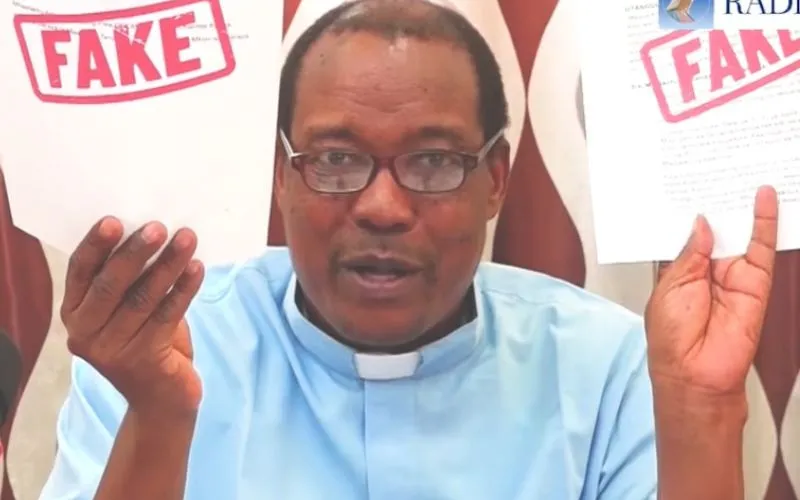
In his October 13 press conference, TEC Secretary General condemned the use of a falsified signature of the Catholic Bishops’ Conference President to authenticate a message that he said “did not originate” from TEC members.
“This is a serious misconduct involving the misuse of the Bishops’ institution and even the falsification of the signature of the President of the Tanzania Episcopal Conference to endorse a message that did not originate from the Conference,” Fr. Kitima said in the video recording, which Radio Maria Tanzania published on October 13.
Fr. Kitima reminded the people of God in Tanzania that Catholic Bishops follow well-established procedures when issuing official communications such as statements, pastoral letters, or messages, each with its own meaning and process.
“If someone has concerns, opinions, or wishes to have something addressed by the Church, he or she is encouraged to follow the proper channels,” the Tanzanian-born Catholic Priest said.
He went on to explain that in the Catholic Church’s structure, individuals begin at the family level, move to the Small Christian Community (SCC) and then to the Parish Priest. “From there, the Priest can refer the matter to the Bishop, who may take it to the President of the Episcopal Conference,” he said.
The TEC Secretary General emphasized the importance of adhering to these procedures when conveying information to or on behalf of the Church. “Therefore, even if you have something to communicate, go through those procedures so that your message, ideas, or suggestions can reach the appropriate Church authorities,” he advised.