Advertisement

Let’s Recognize Migrants as “rights-bearing individuals”: Director of Mozambique Catholic Bishops’ Secretariat

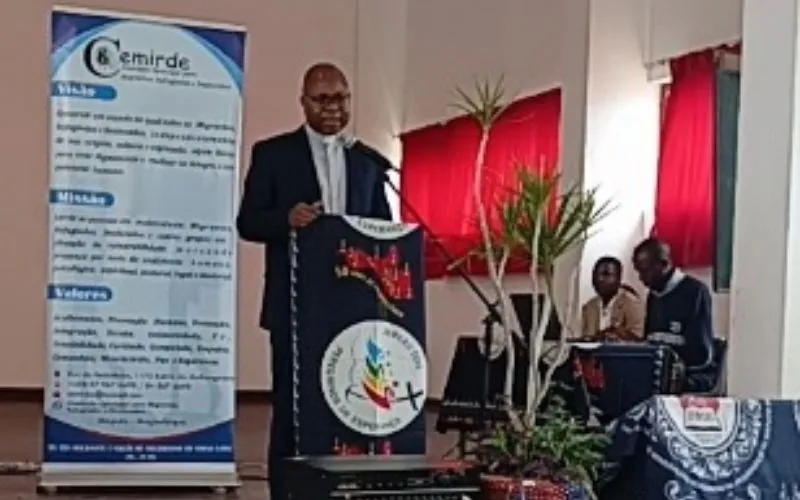
Fr. Francisco Valente Fumo. Credit: CEM

The Director of the Secretariat of the Episcopal Conference of Mozambique (CEM) has urged both the Church and society to recognize the dignity of migrants and underscored the need for a renewed social commitment to justice, human solidarity, and inclusion.

In his presentation during a Symposium on Migration, Fr. Francisco Fumo Valente said that Mozambique must rethink how it approaches migration.

“The integration of migrants cannot be understood as passive absorption — it is mutual adaptation,” Fr. Fumo said during the Friday, October 17 event that was held at St. Pius X Interdiocesan Major Seminary in the Catholic Archdiocese of Maputo.

He emphasized that migrants and members of the host community “must learn and change.”

In his presentation titled “Integration and Human Mobility in Mozambique”, Fr. Fumo explained that understanding human mobility as both a civic challenge and a Christian mission requires the Church and society to reinvent their structures.
Advertisement

“We cannot treat the migrant as a statistic or a labor force — he is a person, a bearer of culture and dreams,” he emphasized.

The Director of CEM Secretariat noted that the assimilationist model demands that migrants abandon their cultural identities to fit in, while the multiculturalist model embraces diversity but risks isolating communities into cultural enclaves.

For Mozambique, Fr. Fumo proposed a “model of cultural encounter” – the one that fosters integration through shared values and respect for individual identities.

“The State must not impose cultural conditions on migrants’ acceptance. Migrants should be recognized as rights-bearing individuals, and civil society must promote dialogue between native and newcomer communities,” the Mozambican Catholic Priest emphasized.

He faulted the assimilationist model as “unjust” and “for erasing identities,” and the unstructured multiculturalism as one that “tends to segregate.”

More in Africa

Fr. Fumo called on Mozambicans to overcome fear of the other and build a shared sense of belonging.

Addressing integration challenges in the Southern African nation, particularly in legal and labor areas, Director of CEM Secretariat noted that migrants face administrative irregularities “not by choice, but because of bureaucracy, institutional inefficiency, and corruption.”

He urged the government to simplify legal processes, ensure transparency, and allow long-term residents to regularize their status or apply for citizenship.

“Employers must respect migrants’ rights and avoid exploitation,” he appealed, calling on both the State and employers’ organizations to partner in ensuring decent working conditions.

The CEM official also encouraged migrants to invest in skills and education but noted that “individual effort is not enough without social openness.”

Advertisement

Fr. Fumo identified family reunification, neighborhood coexistence, and decent housing as essential pillars for social integration.

“Family reunification provides emotional stability and reduces isolation,” he said, adding that everyday social interactions between locals and migrants “can be decisive in breaking cultural barriers.”

He encouraged local authorities and community organizations to create public spaces that bring migrants and residents together.

On the cultural level, Fr. Fumo underscored the importance of learning local languages, respecting regional customs, and fostering cultural exchange through music, dance, cuisine, and liturgy.

He noted that “some migrants assimilate local African languages faster than Portuguese,” which demonstrates genuine integration pathways.

(Story continues below)

Fr. Fumo said Parishes must become “safe spaces for migrants, where they find listening, pastoral support, and a sense of belonging.”

He called upon the people of God to play an active role in legal assistance, pastoral accompaniment, and civic education.

“The ideal is that Parishes be welcoming, capable of hosting diverse cultural expressions within one community of faith and life,” Fr. Fumo said.

He urged the Church, the State, and society at large to “rethink paradigms, dismantle prejudices, reform policies, and foster a genuine culture of hospitality.”

“Mozambique can cease to be merely a place of passage and become a home that respects human dignity and celebrates the richness of diversity,” Fr. Fumo said during his October 17 presentation.

João Vissesse is an Angolan Journalist with a passion and rich experience in Catholic Church Communication and Media Apostolate.