Advertisement

Cameroon’s Catholic Bishops Acknowledge Peaceful Voting, Decry Post-Election Irregularities

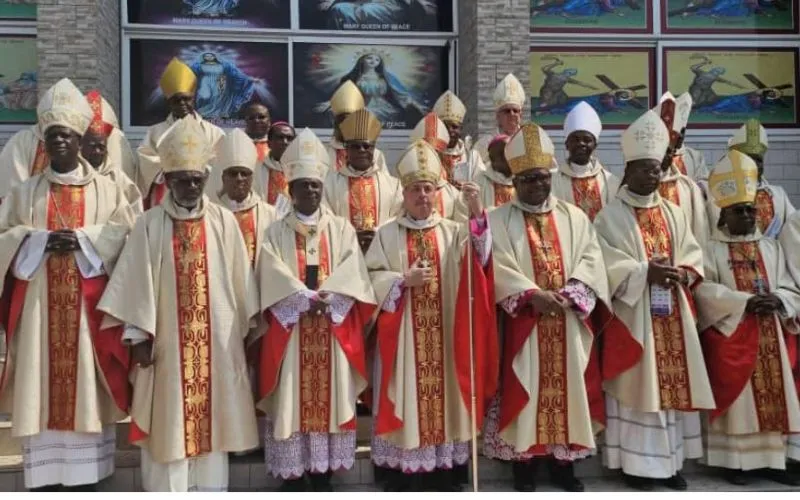
Members of the National Episcopal Conference of Cameroon (NECC). Credit: ACI Africa

Cameroon’s Catholic Bishops have commended the generally calm and orderly conduct of the October 12 presidential election in the Central African nation.

In a statement issued Monday, October 19, members of the National Episcopal Conference of Cameroon (NECC) express satisfaction with the peaceful atmosphere that marked Election Day but voice concern about several irregularities that, they say, “seriously hinder our progress towards democracy.”

“Based on what was observed on Election Day, the National Episcopal Conference would like to express its satisfaction with the efforts made by Elections Cameroon (ELECAM) to ensure that the voting took place in a serene atmosphere,” NECC members say, citing reports from 202 accredited observers deployed across 12,257 polling stations nationwide.

They note that polling sites were generally accessible, well secured by law enforcement officers, and that “outside the polling stations, the atmosphere was calm and peaceful.”

“In each polling station, the ballot box was sealed and transparent; it was sufficiently visible to the public; the voting booth was arranged in such a way as to ensure discretion and preserve the secrecy of the vote,” NECC members say.

Advertisement

They commend the example of “democratic civility shown by the assessors on duty in most polling stations. Still on Election Day, the public counting of the ballot papers in most polling stations was appreciated.”

While acknowledging these positive aspects, the Catholic Church leaders report several flaws observed by their monitors.

“Although the atmosphere throughout the country was calm on election day, the National Justice and Peace’s overall report on the observation of the 12th October presidential election also notes certain irregularities that seriously hinder our progress towards democracy,” NECC members say.

They note “high abstention rates, notably in Kribi 1 and 2, Lycée de Tsinga, and Matamfen Supérieur; relocation of certain polling stations; failure to update the electoral register, which still contained names of deceased persons; ballot bins positioned in a way that allowed voters to see previous ballots, potentially influencing their vote; voters leaving polling sites with unused ballot papers in Douala, Yaoundé, Maroua, Garoua, and Bertoua; polling stations existing on the ground but not listed on the official ELECAM register.”

NECC members also report isolated incidents of violence, including “an incident in the city of Garoua, where, following an intervention by the police on the convoy of the candidate Issa Tchiroma Bakary, clashes between the police and young people resulted in serious injuries to a police officer and the burning of a gendarmerie truck.”

More in Africa

“After the voting day, other scenes of violence in the towns of Dschang and Douala were observed,” they add.

Regarding the counting process, the Catholic Bihops observed that “these operations generally began at 6 p.m., in the presence of members of the Local Voting Commissions, scrutineers recruited from among voters registered on the polling station lists, and a few observers and voters.”

They report that results were publicly announced at the polling stations they monitored, saying, “The results of each candidate were made public in the 12,257 polling stations where we observed, and since the counting was public, the people recognized themselves in the votes that were counted and left generally satisfied.”

However, the NECC members note the population’s hope that “they will still recognize themselves in the results that will be published by the Constitutional Council and that nothing will be changed by any authority involved in this exercise.”

“It is our prayer that, with the help of God and the commitment of all, our country will experience peace and stability in truth, and will emerge stronger, thanks to the contributions of millions of Cameroonians through their daily work and love for the country,” the Catholic Bishops say.

Advertisement

Violence was reported in some cities in the central African nation following the October 12 poll.

In the country’s commercial capital, Douala, angry demonstrators accused authorities of electoral fraud in the October 12 vote. 

Clips shared by local outlets on various social media platforms depict demonstrators alleging that officials tampered with the ballot tally to secure an advantage for Cameroon’s long-serving president, Paul Biya.

Protests were equally reported in the city of Dschang, where the headquarters of the ruling party was burnt down.

In the October 12 poll, President Paul Biya, Africa’s second-longest serving Head of State after President Teodoro Obiang of Equatorial Guinea, sought his eighth term.

(Story continues below)

President since 1982 in the Central African nation, where Presidents have a seven-year mandate, the 92-year-old Cameroonian is the world’s oldest Head of State.

Constitutional amendments that President Biya’s party, Cameroon People's Democratic Movement (CPDM), spearheaded in 2008, abolishing the two-term presidential limit, occasioned his “extraordinarily long tenure”. 

After the presidential polls, the opposition contender, Issa Tchiroma Bakary, reportedly announced himself the winner.

His declaration was promptly dismissed by Minister of Territorial Administration Paul Atanga Nji, who denounced it as unlawful and “a matter of serious concern.”

The ruling CPDM also condemned Tchiroma’s claim as a “grotesque hoax,” maintaining that only the Constitutional Council is authorized to officially declare the winner.

Official announcement of results, once the electoral commission, Elections Cameroon (ELECAM), has compiled its reports, is expected by October 23, after validation by the Constitutional Council in the Central African nation.

However, there are reportedly widespread concerns about electoral transparency, fairness, and integrity. Opposition groups, civil society, and media have flagged possible irregularities.

ACI Africa was founded in 2019. We provide free, up-to-the-minute news affecting the Catholic Church in Africa, giving particular emphasis to the words of the Holy Father and happenings of the Holy See, to any person with access to the internet. ACI Africa is proud to offer free access to its news items to Catholic dioceses, parishes, and websites, in order to increase awareness of the activities of the universal Church and to foster a sense of Catholic thought and culture in the life of every Catholic.