Advertisement

Nigeria’s Insecurity Has Religious Dimensions, Catholic Bishop Says, Welcomes Calls for Accountability

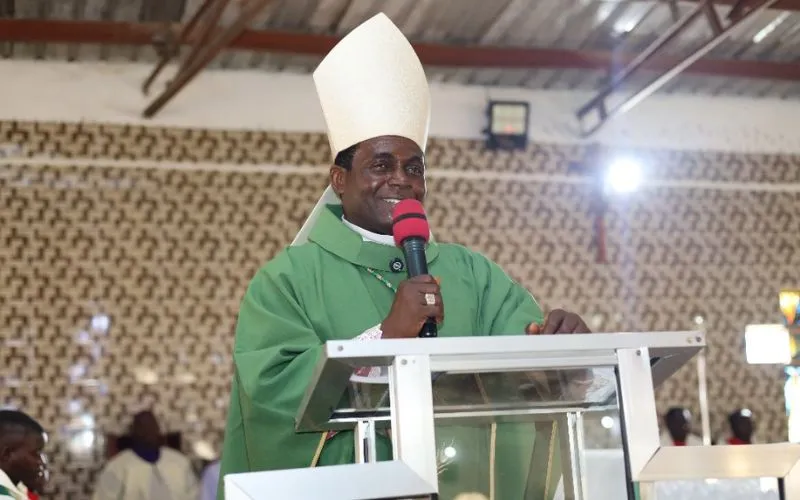
Bishop Gerald Mamman Musa of Nigeria’s Catholic Diocese of Katsina. Credit: ACI Africa

Bishop Gerald Mamman Musa of Nigeria’s Catholic Diocese of Katsina has acknowledged that the country’s worsening insecurity is multifaceted but maintains that it carries clear elements of religious persecution.

Speaking to ACI Africa on the sidelines of the 2025 World Mission Sunday, Bishop Musa weighed in on the recent remarks by U.S. Senator Ted Cruz, who called for Nigeria to be re-designated as a Country of Particular Concern (CPC) over ongoing attacks against Christians. 

The Nigerian Catholic Bishop said the American lawmaker’s comments “voice the anguish felt by many victims” and “capture a painful reality in many localities.”

“Many people have been victimized, attacked, kidnapped, and killed in Nigeria in recent years,” Bishop Musa said during the October 19 interview, and added, “These incidents can be interpreted in many ways, but we are aware that violence in Nigeria has multiple drivers.” 

He continued, “Some are driven by crime, banditry, or land disputes. But it would be wrong to deny that some of the killings are based on religious motives.”

Advertisement

The Catholic Church leader pointed to extremist groups such as Boko Haram and the Islamic State of West Africa Province (ISWAP) as examples of armed movements that continue to operate under religiously motivated ideologies.

“We have seen extremist religious ideologies that talk about establishing a mono-religious state. These groups go about their mission through a reign of terror. So, while not all violence is religious, the religious factor cannot be denied,” he said.

Bishop Musa emphasized that violence has affected both Christians and Muslims but acknowledged that credible data suggests Christians have often suffered disproportionately, particularly in the Middle Belt region.

“If we look at the figures, in many instances, there are more Christians who have been affected, particularly in the North Central Zone. But we must recognize that everyone, irrespective of faith, has suffered in one way or another,” he said.

On whether Nigeria should again be listed as a Country of Particular Concern, the Local Ordinary of Katsina said such designations carry political and diplomatic implications but can also push Nigerian authorities to act.

More in Africa

“Placing Nigeria among countries of particular concern has its implications. But sometimes such measures make our leaders sit up. I believe an internal solution is best — where our leaders look inward and take decisive actions. But if external pressure will make them act responsibly, so be it,” he said.

The Catholic Bishop faulted the Nigerian government’s handling of security, especially in rural communities that have suffered repeated attacks.

“There is much left to be desired; those who are worst hit are people in the villages. We are counting millions of internally displaced persons. Many villages are unprotected. Even when security personnel are present, there is often no prompt response when violence occurs,” Bishop Musa said.

He also lamented that despite the government’s claims of doing its best, much remains to be done.

“Ideas like community or state policing have been widely discussed as possible solutions but remain unresolved due to political considerations,” Bishop Musa said.

Advertisement

Sen. Ted Cruz (R-Texas) introduced legislation in September that would require the Trump administration to adopt the CPC designation in addition to imposing targeted sanctions against Nigerian government officials who facilitate or permit jihadist attacks against Christians and other religious minorities. 

He urged the international community to support Nigeria’s efforts toward justice and peace without politicizing the issue.

“When Ted Cruz raised the issue of genocide, many reacted based on sentiments. What we need is an independent and impartial investigation into the motives behind the violence and efforts to address them from the roots,” Bishop Musa said.

He emphasized that genuine peace will only come when truth, justice, and accountability are sincerely pursued, noting that political manipulation and economic interests often fuel ethnic and religious divisions.

“Sometimes religious and ethnic divisions are masterminded by politicians. There is also the economic dimension where herders and farmers clash. We must look at these issues holistically,” he said.

(Story continues below)

The Catholic Church leader also used the opportunity to encourage the people of God to remain steadfast in hope and compassion.

“We stand with all those who are suffering — Muslims, Christians, and every ethnic group. Our faith teaches that even in the darkest nights, the dawn comes. We are called to be that dawn for others,” he said.

Bishop Musa called on Catholics to support victims of violence, especially internally displaced persons, and to continue praying and advocating for peace.

“The fact that not everyone is directly affected does not mean we should be insensitive. We stand in prayer and service to all who are suffering, irrespective of religion. And we must continue to hold our leaders accountable for the security of the people,” he said.

He added, “Despite everything, we must not lose hope. We keep praying, we keep serving, and we believe that peace will return to our land.”

Abah Anthony John is a Nigerian Catholic journalist with passion for Church communication and media apostolate. He holds a bachelor’s degree in mass communication from Benue State University, Makurdi in Benue State Nigeria. He has a background in print, electronic and multi-media production.