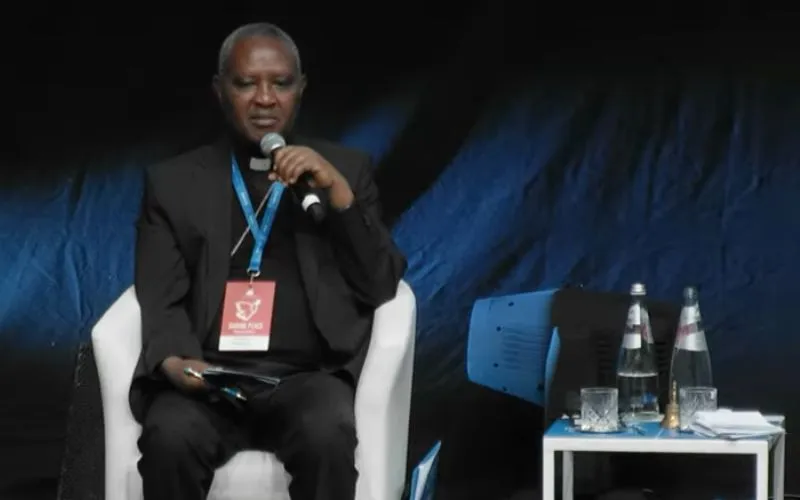
“Africa is not a young continent only because of its youthful population but also because its natural wealth is relatively untouched,” said the Rwandan Catholic Church leader, and added, “However, the abundance of natural resources also presents disadvantages.”
He noted that countries rich in natural resources in Africa “often suffer from corruption and weak governance, which hinder long-term development.”
“We see this in many parts of Africa,” said the Cardinal-Priest of Sansisto, who began his Episcopal Ministry in the Catholic Diocese of Kibungo in July 2013, noting that the natural resources have also led to violent conflict “due to illegal mining and competition over land and water, creating ethnic and community tensions.”
The Church in Africa has been raising concern over the growing crisis of illegal mining and mismanagement of natural resources across the continent.
During the conference to mark the 60th anniversary of the canonization of the Martyrs of Uganda in October 2025, the President of the Symposium of Episcopal Conferences of Africa and Madagascar (SECAM) called on the Church to take a firm stand against the illegal exploitation of Africa’s mineral wealth, saying the issue is both moral and developmental.
Fridolin Cardinal Ambongo, who is the Local Ordinary of the Democratic Republic of Congo’s (DRC) Catholic Archdiocese of Kinshasa, described the illegal exploration of natural resources in Africa as “a tragic human toll of the continent’s mineral wealth,” referring to those who suffer and die from the exploitation as “modern martyrs.”
“The Church cannot remain silent in the face of this illegal exploitation of mineral resources, which generates war and violence, which tears the social fabric of our countries and jeopardizes their future,” he said during the October 12 conference that was themed “Modern martyrs, victims of the exploitation of mineral resources in Africa: Realities and perspectives of the outgoing Church.”
Cardinal Ambongo further said, “The possible macroeconomic growth that this exploitation brings does not improve in most cases the standard of living of the communities concerned. Per capita income becomes significantly lower, while only a small group of people get rich.”
“The extraction and transport of these minerals dispossess and displace families from their lands. There is often violent demolition of homes, water contamination, air pollution with heavy metals, and the release of cyanide into nature, with serious damage to agricultural, livestock, or fishing yields,” he said.
Catholic Bishops in Ghana on October 3 decried illegal mining in the West African nation, describing it as a “public health and human rights emergency.”