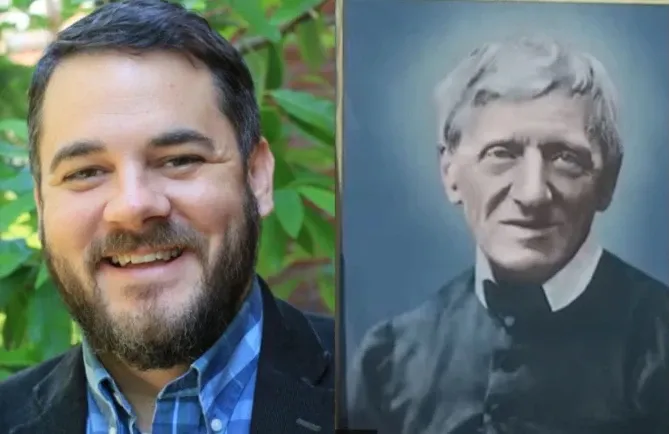
In his 1874 “Letter to the Duke of Norfolk,” one of his most celebrated essays, Newman cautioned against a “false notion of conscience,” identified with the right to one’s own will, an idea that, according to Marr, “reflects the modern mindset” that values subjective independence over objective truth.
He therefore pointed out that “as Catholics, we must work to restore the true vision of conscience, in line with the teaching of theological giants like Aquinas and Newman.”
The sensus fidei is not ‘a populist counterweight to the hierarchy’
This theme is intertwined with the concept of the sensus fidei, the supernatural sense of the faith bestowed upon the baptized: “Newman was ahead of his time in recognizing that the lay faithful have an essential role in the defense and transmission of tradition. The priesthood of all believers means, in part, that the baptized possess a special sense of the faith, a capacity that we must strengthen through devotion and study.”
Marr noted that, for Newman, this sense also had a communal dimension, the sensus fidelium, or sense of the faithful. “He did not understand it as a populist counterweight to the hierarchy,” he clarified. “He knew that the pope and the bishops exercise a divinely instituted authority, but he remembered that there have been times in history — such as during the Arian controversy — when the laity defended the faith, even when some pastors wavered.”
(Story continues below)
A prophet in the face of modern apostasy
With prophetic clarity, the expert noted, Newman “foresaw the growing irreligion of the modern world.” In his 1873 sermon “The Infidelity of the Future,” Newman warned that the trials of the future would be so great “that they would shake even hearts as valiant as those of St. Athanasius or St. Gregory the Great,” Marr said.
Newman, he explained, perceived that the greatest danger of modernity would be precisely the spread of unbelief, a society that is “simply irreligious.”
However, faced with this bleak outlook, “Newman neither called for retreat nor proposed authoritarian strategies.” He courageously confronted the philosophical ideas of his time and offered a compelling explanation of the “reasonableness of the Christian faith,” deeply rooted in Catholic tradition and in dialogue with modern philosophy, he noted.
Newman and the intellectual mission of the laity
Newman, the expert continued, understood the life of the Catholic Church as something “dynamic,” where “all members of the Body of Christ have an active role in the proclamation of the truth.”
The fathers of the Second Vatican Council took up this vision, presenting it as an urgent call to contemporary Catholics. The expert warned that it is important to understand this call well: “The laity do not fulfill their vocation by becoming more clerical, but by sanctifying the world according to their own specific mission, bringing the Gospel to education, law, medicine, and culture.”
This story was first published by ACI Prensa, CNA’s Spanish-language news partner. It has been translated and adapted by CNA.
As a journalist, Victoria Cardiel has specialized in social and religious news. Since 2013, she has covered the Vatican for various media outlets, including Europa Press and Alfa and Omega, the weekly newspaper of the Archdiocese of Madrid.