Advertisement

Nigerian Catholic Bishop Decries Dire Situation of Displaced Persons, Urges Government Support

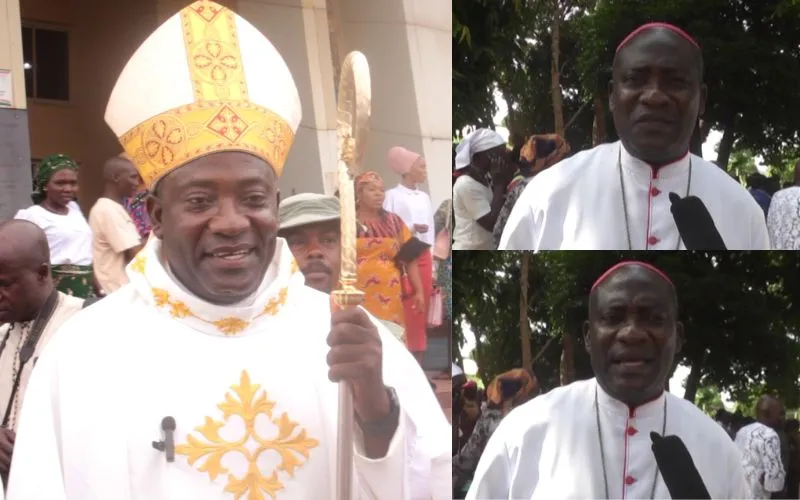
Bishop David Ajang of Nigeria’s Catholic Diocese of Lafia. Credit: ACI Africa

Bishop David Ajang of Nigeria’s Catholic Diocese of Lafia has decried the dire condition of internally displaced persons (IDPs) in his Episcopal See, warning that persistent insecurity and the neglect of victims threaten national stability and development.

In an interview with ACI Africa on the sidelines of the distribution of relief materials to victims of insecurity living in camps across in his Diocese, Bishop Ajang lamented that many victims of violent attacks in Nasarawa and surrounding regions have remained displaced for years without adequate government support.

“Most people have been displaced, and some of them have been away from their homes for a long time,” the Nigerian Catholic Bishop told ACI Africa on October 31.

He added, “Immediately after the attacks, there was an outpouring of generosity, but as time went on, people tended to forget. These are people whose means of livelihood have been affected, and they need support to survive.”

Bishop Ajang reminded the authorities that securing lives and property is the foundation of good governance.
Advertisement

 “If you go back to why governments are put in place, it is to secure lives and property. People give their rights to the government, and it becomes its duty to protect them,” he said.

The Catholic Church leader warned that the government's failure to fulfill this responsibility undermines its legitimacy. 

According to the Local Ordinary of Lafia Diocese, IDPs are not asking for much. 

“What these people are looking for is really not much. Allow them to settle in their places. Allow them to live their normal lives and prevent those who harass them from doing so,” he said. 

Bishop Ajang noted that the political will to tackle insecurity appears weak, saying, “It seems as if the will to prevent those troublemakers is not there.”

More in Africa

“If there is the will, there will always be a way. When you see the rate at which it happens, you realize there are many things the government should do but is unable to do at the moment,” he said.

Bishop Ajang noted that the Catholic Church continues to engage the government through dialogue and advocacy to promote justice and security. 

“We always engage the government, whenever we have occasions, we talk about it—the need for the government to do what it is supposed to do,” he said.

The Local Ordinary of Lafia Diocese, since his Episcopal Consecration in June 2021, explained that the Church’s humanitarian intervention was part of its mission to care for the needy.

“It’s just the Church being Church. We are doing what we are supposed to do, assisting our members who are in dire need,” he said.

Advertisement

Reflecting on the country’s 2027 General elections, Bishop Ajang, who chairs the Social Communications Commission of the Catholic Bishops’ Conference of Nigeria (CBCN), called on Nigerians to demand accountability from those in positions of power. 

He encouraged voters to keep records of campaign promises and use them to measure performance.

 “When we negotiate, we should not forget in a hurry. Keep notes, take notes, so that if promises are not fulfilled, you can remind them—you promised us this, but you did not deliver,” he said.

Bishop Ajang underscored the importance of civic responsibility in sustaining democracy, saying, “We must learn to hold our leaders to account. They must be accountable.”

Abah Anthony John is a Nigerian Catholic journalist with passion for Church communication and media apostolate. He holds a bachelor’s degree in mass communication from Benue State University, Makurdi in Benue State Nigeria. He has a background in print, electronic and multi-media production.