Advertisement

“True peace is born of justice”: Catholic Archbishop Ahead of National Reconciliation Congress in Angola

Credit: CEAST

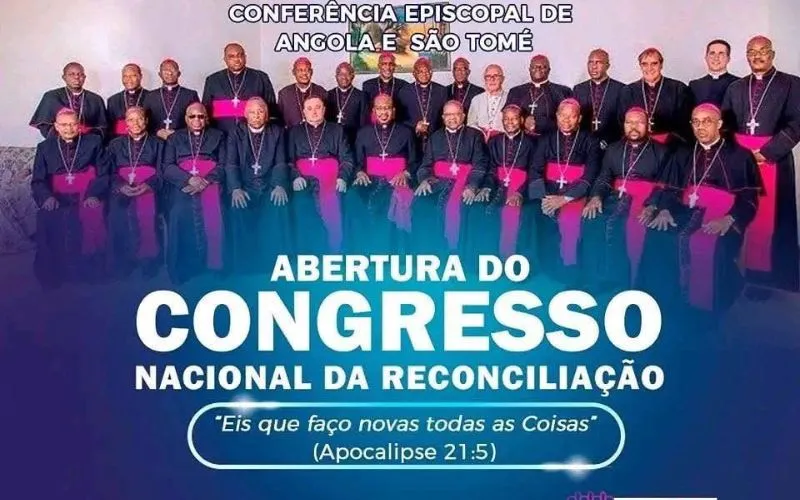
The President of the Commission for Justice, Peace, and Integrity of Creation of the Catholic Bishops’ Conference of Angola and São Tomé (CEAST) has said that genuine national reconciliation in Angola can only be achieved when grounded in justice and peace. 

Addressing journalists during a press conference at the CEAST headquarters ahead of the November 6–9 National Reconciliation Congress, Archbishop Zeferino Zeca Martins of Angola’s Catholic Archdiocese of Huambo noted that the event forms part of activities marking Angola’s 50th independence anniversary.

“Reconciliation is inseparable from peace, and true peace is born of justice. Peace is not merely the absence of war nor the silence of weapons, but the reunion of hearts and the meeting of brothers,” Archbishop Zeca said during the Wednesday, November 5 press conference.

He noted that the triad of justice, peace, and reconciliation remains at the heart of the Church’s mission. If the Church abandons this commitment, he warned, “it ceases to be faithful to the Gospel of Christ.”

The Angolan member of the Society of the Divine Word (SVD) decried persistent pockets of violence and political intolerance in the country, urging national leaders to condemn such acts. 
Advertisement

Political leaders, he suggested, should demonstrate unity publicly, even symbolically, to set a national example.

“All Angolans must participate in building a united Angola where no one is left behind. We inherited a free and independent nation; now we must lay solid foundations so future generations find an Angola worthy of life,” he said.

Describing reconciliation as “a never-ending task,” he insisted, “No one will do it for us if we Angolans do not do it ourselves.”

Organized by CEAST through its Commission for Justice, Peace and Integrity of Creation, the congress was originally slated for October 29–31. It was postponed to November 6–9 at the request of President João Lourenço, who expressed his desire to participate.

Also present at the press briefing were Fr. Eduardo Alexandre, spokesperson for the congress, and Fr. Celestino Epalanga, Secretary-General of the CEAST Commission for Justice, Peace, and Integrity of Creation.

More in Africa

Fr. Epalanga said reconciliation is rooted in forgiveness and social justice, citing Archbishop Desmond Tutu’s assertion that “there is no future without forgiveness.” 

Alongside promoting reconciliation, he added, the Church works to reduce inequality and combat injustice.

The Angolan member of the Society of Jesus (SJ/Jesuits) noted that reconciliation’s spiritual, social, and political dimensions are interconnected. 

“Speaking of politics is speaking of people. The Church must defend the dignity of every person,” he said.

Fr. Eduardo, on his part, underscored the urgency of reconciling Angolan society and building authentic unity among citizens, stating that “reconciliation is not simply being together, but being united in true communion.”

Advertisement

“The mission of this congress is to invite all Angolans to reflect on themselves, to recognize past errors, and to take concrete steps that promote justice and peace,” he said.

He added, “We must overcome the scars of past conflicts that continue to affect our economy and social life. Reconciliation depends on everyone—not only the government. Each citizen, community, and institution must assume responsibility and participate actively.”

Fr. Eduardo noted that the Church plays a central role in fostering reconciliation and social development, stressing that institutional renewal requires human cooperation with divine grace. 

“True change requires forgiveness, dialogue, and rebuilding trust,” he said.

João Vissesse is an Angolan Journalist with a passion and rich experience in Catholic Church Communication and Media Apostolate.