Advertisement

Designating Nigeria “Country of Particular Concern” Should Inspire Collaboration, Not Hostility: Catholic Official

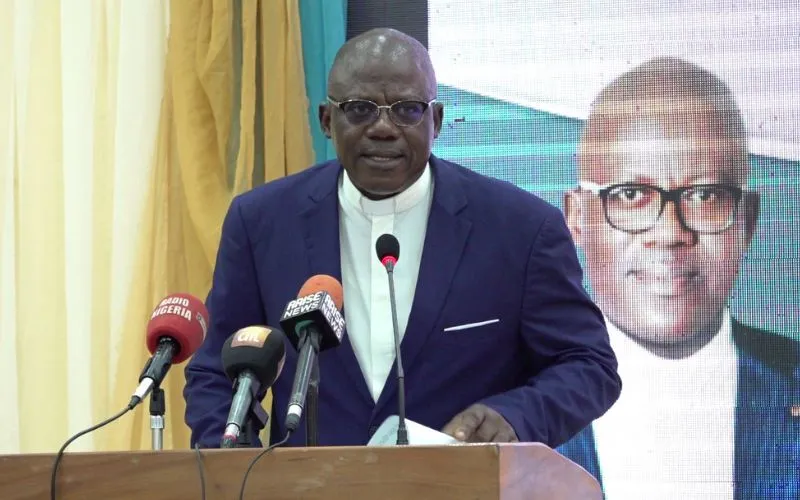
Fr. Hyacinth Ichoku. Credit: ACI Africa

Nigeria’s government officials need to view the West African nation’s designation as a Country of Particular Concern (CPC) as an opportunity for international collaboration rather than an act of hostility, the Vice-Chancellor of Veritas University, Abuja, has said. 

Speaking to ACI Africa on the sidelines of the university’s 14th convocation lecture on Friday, November 7, Fr. Hyacinth Ichoku said persistent insecurity continues to undermine national development, particularly in the education sector, which he described as being in urgent need of revival.

Designating Nigeria as a CPC is “not like a hostile move,” Fr. Ichoku said, and added, “I don’t see it from the perspective of conflict or takeover.”

He called for greater openness to international assistance, especially in addressing insecurity, which he noted has far-reaching implications for development and education.

“Anyone who can support us with equipment and help our soldiers in their war against bandits should be encouraged. That is what Trump wants for our country,” the Nigerian Catholic Priest said.
Advertisement

Fr. Ichoku emphasized that Nigeria’s security crisis is not an isolated problem but one with global dimensions.

“Insecurity is not just a local issue – it’s a global concern that affects education and development,” he said, adding, “We must work together, with openness and cooperation, to restore peace and ensure that education continues to thrive.”

He lamented that the violence, kidnappings, and banditry plaguing communities across the country have stalled progress. 

“This problem impedes development, impedes education, and affects every aspect of our lives. Our government should not live in denial. What Donald Trump said is what is happening in our country,” Fr. Ichoku said.

Since assuming office as Vice Chancellor in 2018, Fr. Ichoku said he has witnessed insecurity firsthand. 

More in Africa

“Bandits migrate from one side to another. The aspect of insecurity is everywhere—it is not just in Abuja; it is in every part of our country,” he recounted.

He emphasized that Nigeria’s priority should be ending the bloodshed, saying, “To stop the massacre happening in our country, to stop the bloodshed—nobody is happy about that. Any means of putting that to an end is welcome.”

Fr. Ichoku warned that the global perception of Nigeria as unsafe and intolerant toward religious freedom has consequences. 

“It affects foreign investment, diplomatic relations, and even the confidence of its citizens. Nigeria must prove through action that it values human life, justice, and equality,” he said.

The Catholic Priest argued that no nation is self-sufficient, urging the government to embrace foreign support. 

Advertisement

“If America or any country can give us support to tackle this matter, so be it. No country has everything,” he said.

According to the Catholic official, international designations reflect real concerns about governance and human rights—not mere symbolism. He linked the country’s deteriorating security to weak institutions, corruption, and economic hardship.

“Insecurity thrives where governance is weak and people lose trust in the system. The absence of effective governance structures has made it easier for criminality to spread,” Fr. Ichoku said.

Unless leaders strengthen institutions, promote justice, and create economic opportunities, Fr. Ichoku warns that insecurity will persist. 

“We cannot build a strong economy or a stable society when people live in fear or feel neglected by their leaders,” the Nigerian Catholic Priest said.

(Story continues below)

He noted that education is a national security tool, saying, “When young people are educated, engaged, and hopeful, they are less likely to be recruited by criminal or violent groups. Education remains the most effective antidote to insecurity.”

The Veritas University Vice-Chancellor urged policymakers to prioritize solutions targeting root causes such as unemployment, poverty, and inequality, arguing that improving welfare can reduce the desperation driving criminality and radicalization.

“We must invest in higher education, research, and innovation. Universities are the engines of national transformation, and when they are neglected, the entire system suffers,” Fr. Ichoku said.

Abah Anthony John is a Nigerian Catholic journalist with passion for Church communication and media apostolate. He holds a bachelor’s degree in mass communication from Benue State University, Makurdi in Benue State Nigeria. He has a background in print, electronic and multi-media production.