Advertisement

Catholic Bishop in Tanzania Calls for Respect for Human Life as Thousands Reportedly Killed in Post-Election Violence

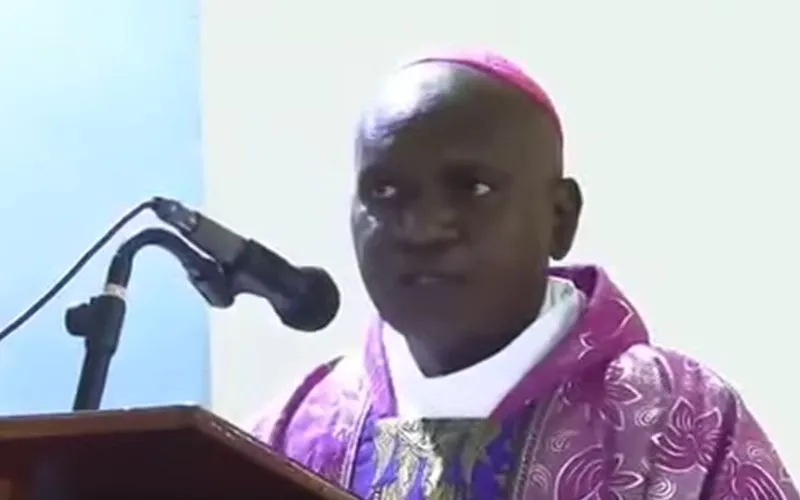
Bishop Stephano Lameck Musomba of the Catholic Diocese of Bagamoyo in Tanzania. Credit: Radio Maria Tanzania

The Local Ordinary of the Catholic Diocese of Bagamoyo in Tanzania has denounced the extrajudicial killings connected to the country’s disputed October 29 general elections, stressing that those suspected of breaking the law should be allowed to go through legal processes instead of being killed unlawfully.

In his homily during a Eucharistic Celebration that was held in honor of the victims of the election-related violence on Tuesday, November 11, Bishop Stephano Lameck Musomba underscored the need to uphold justice and due process when handling individuals suspected of any criminal wrongdoing.

“Some of those who were shot were participating in demonstrations, others were at home, on their way to work, or in their shops. They were struck by bullets and lost their lives,” said Bishop Musomba during the event that was held at the Immaculate Heart of the Blessed Virgin Mary Cathedral of his Episcopal See.

Demonstrations reportedly spread across Tanzania for several days following the October 29 vote, as citizens took to the streets to protest an election that, according to foreign observers, fell short of democratic standards after key opposition figures were barred from participating.

At least 240 people have reportedly been charged with treason in connection with the deadly protests, while human rights groups allege that thousands were killed in the post-election violence, and warn that some victims may have been buried in secret mass graves.
Advertisement

Bishop Musomba noted that “even those who took part in demonstrations” should not have been judged or condemned instantly, emphasizing that guilt must be determined by a court of law, and punishment should follow legal procedures.

“That is why, in matters of guilt, we speak of a suspect,” the Tanzanian-born member of the Order of St. Augustine (OSA) said, and added, “It is the court that determines whether a person is guilty. And if found guilty, the rightful consequence is imprisonment, not death.”

He emphasized that “justice for everyone is the foundation of true peace in any nation,” and called upon the people of God in the country to return to the founding principles of justice, peace, love, and solidarity that he said defined the country's early years as a nation.

“You cannot build a house in the air. The foundation of true peace in any nation is justice, justice for everyone. If we are not careful, we will go astray,” cautioned the 56-year-old Tanzanian Catholic Church.

He added, “Everyone is shocked. We are sad. We are crying. We don’t understand how this happened or why it has become this bad.”

More in Africa

“Now we are killing each other like animals, we hate each other, we are enemies, we do not help one another, we do not guide one another. It is a big problem,” said Bishop Musomba  who began his Episcopal Ministry as Auxiliary Bishop of Dar-es-Salaam in July 2021.

He went on to reflect on the sanctity of human life, stressing that those killed in the election-related violence “should be remembered not as political casualties but as children of God whose lives were sacred.”

“We were created in the image and likeness of God, whose nature is eternal. Whether you have sinned or not, your dignity remains,” said the OSA member, and added, " That is why we say a human being deserves respect from another human being, not to be treated or handled however one pleases.”

He continued, “A person has the right to live, the right to be heard, the right to medical care, and the right to express themselves freely, and where there is justice, there is joy, unity, understanding, and brotherhood. No one sees another as an enemy.”

The pioneer Bishop of Bagamoyo Diocese, which was erected on March 7 urged the people of God in the East African nation to continue praying for the souls of the departed, for healing among the injured, and for the nation to remain united.

Advertisement

“We pray that God may receive them in heaven and grant recovery to those who are still in pain. We place our country, Tanzania, in His hands. We pray for justice and peace, the foundation and strength of our nation, so that it may stand firm forever,” he implored.

Meanwhile, Archbishop Jude Thadeus Ruwa’ichi of the Catholic Archdiocese of Dar-es-Salaam on November 9 and Archbishop Gervas Nyaisonga of the Archdiocese of Mbeya on November 10 have also condemned the extra-judicial killings linked to the election-related violence, each also delivering a strong message of justice and peace.

In a separate memorial Holy Mass on November 9 for the victims of the post-election violence in Mbeya Archdiocese, Archbishop Nyaisonga condemned the excessive use of force against protesters, stating, “Most of the deceased were killed by firearms – guns that, by law, are meant to be used only by officers who have been entrusted and sworn to handle them according to safety regulations.”

 “Those killed included children, young people, and the elderly, as well as women and men, both civilians and security officers,” Archbishop Nyaisonga said in his November 9 homily recounting that on November 4, he had “witnessed” an “unusual number of people who were buying coffins.”

In his homily on Monday, November 10, while presiding over Mass for those killed and injured in the violence, Archbishop Ruwa’ichi decried the use of brutal force against protesters, lamenting the deaths and injuries that ensued.

(Story continues below)

“Our nation is wounded. Our nation has lost honour because of what happened during the week of the general election. It has not only lost honour, but it has lost people, citizens who have been killed unlawfully,” the Chairman of the Catholic Justice and Peace Commission (CJPC) of the Tanzania Episcopal Conference (TEC) said at St. Joseph Cathedral of his Metropolitan See.

He lamented that Tanzania had lost its understanding of justice and observed that, in many discussions, people often spoke about peace, either deliberately or out of ignorance, without addressing the issue of justice.

“There is no peace without justice. Let that be well settled in your minds; justice is the necessary foundation of peace,” Archbishop Ruwa’ichi said and added, “Wisdom is an attribute of God, and the righteous human being is expected to have wisdom; do we Tanzanians have wisdom?”

Nicholas Waigwa is a Kenyan multimedia journalist and broadcast technician with a professional background in creating engaging news stories and broadcasting content across multiple media platforms. He is passionate about the media apostolate and Catholic Church communication.