Advertisement

Catholic Bishop in Angola Urges Pastoral Agents to Deepen Commitment to Synodal Path

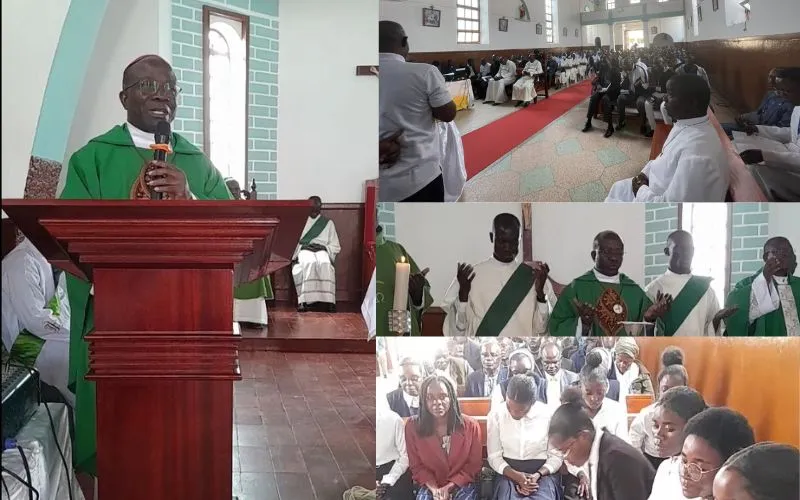
Bishop Estêvão Binga of the Catholic Diocese of Ganda in Angola. Credit: Ganda Diocese

Bishop  Estêvão Binga of the Catholic Diocese of Ganda in Angola has as called on pastoral agents to renew and strengthen their commitment to the multi-year Synod on Synodality that was concluded on 27 October 2024 in Rome, reminding communities not to neglect the orientations and promises already made.

In his homily during the opening Mass of the Diocesan Pastoral Assembly, Bishop Binga emphasized that the Synod is a continuous process requiring deeper study and reflection. 

“The Synod is not for forgetting what was proposed, nor for distracting ourselves from new guidelines,” the Angolan Catholic Bishop said during the Wednesday, November 19 event that was held at St. John the Baptist Cathedral of his Episcopal See.

He recalled that the study of the Synod’s final document had already begun and that each parish committed itself to living out its recommendations. 

This commitment, Bishop Binga insisted, “must not be abandoned, but deepened with fidelity and clarity of mission.”
Advertisement

Bishop Binga underscored the need for perseverance, openness to the Holy Spirit, and a sense of community. 

Mutual listening and active participation, he said, are essential for the Diocese to advance with spiritual maturity and pastoral coherence.

The Catholic Church leader also noted that the Synodal theme, “For a Synodal Church: Communion, Participation, and Mission”, requires further clarification and deeper reflection, warning that the process of pastoral conversion should not be considered secondary or temporary.

He underscored the importance of walking in communion with the Universal Magisterium and Pope Francis, calling this unity a key element of the Diocese’s identity.

The Bishop drew a connection between the Synodal process and Christian charity, stressing that Synodality must be lived through concrete acts of compassion. 

More in Africa

Reflecting on the social and spiritual challenges the Diocese faces, Bishop Binga reminded the people of God that Christ’s open heart inspires love for the sick, the poor, prisoners, and all whose dignity is wounded.

He emphasized that all efforts aimed at uplift­ing people from misery and indignity align with Christ’s mission entrusted to the Church. 

Bishop Binga said that pastoral mission and synodal commitment are inseparable and require dedication, closeness, and ongoing discernment. 

The assembly’s opening, he added, should renew pastoral agents' determination to move forward “with hope, dynamism, and growth.”

Bishop Binga also emphasized the importance of the Diocesan Pastoral Plan as a foundational guide for parish communities. 

Advertisement

He urged pastoral agents to remain steadfast in their commitments despite challenges, reminding them that while the pastoral triennium ends, “we must bear fruit at all times.”

The Local ordinary of Ganda encouraged communities to honestly evaluate their pastoral activities without losing hope, urging them not to give up in the face of human limitations or crises. 

True fidelity to the Synodal process, he said, depends more on spiritual conviction than on structures. 

“We must have trust in God so that our witness is worthy and our life becomes a daily transformation for the Kingdom of Heaven,” Bishop Binga said.

In 2021, Pope Francis officially inaugurated the XVI Ordinary General Assembly of the Synod of Bishops, the Synod on Synodality, as a multi-year journey to be realized under the theme, “For a synodal Church: Communion, participation and mission.”

(Story continues below)

The first session of the Synod on Synodality, which Pope Francis extended to 2024, took place from 4-29 October 2023, concluding with a 42-page summary report.

A 52-page Final Document of the XVI Assembly followed the 2-27 October 2024 second session of the Synod on Synodality. The Synod members approved the Final Document on 26 October 2024. On his part, Pope Francis approved its publication; he chose to directly implement it instead of the usual practice of issuing a Post-Synodal Apostolic Exhortation.

The Document that was approved by 355 Synod members in attendance outlines substantial proposals for Church renewal, including proposals to expand women’s leadership roles, greater lay participation in decision-making, and significant structural reforms such as a call to strengthen pastoral councils at Parish and Diocesan levels, and having regular ecclesiastical assemblies across all Church levels, and heightening ecumenical dialogue.

João Vissesse is an Angolan Journalist with a passion and rich experience in Catholic Church Communication and Media Apostolate.