Advertisement

Catholic Archbishop Says Nigeria could be “saddest nation in the world”, Reflects on Country’s Good Days

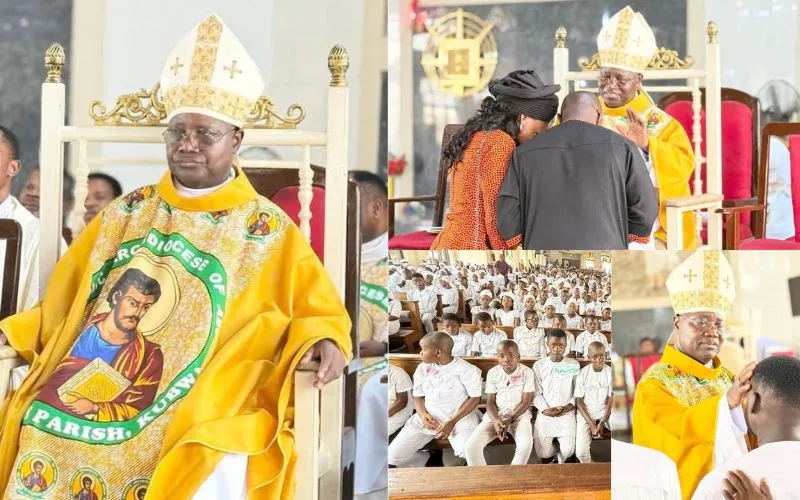
Archbishop Ignatius Ayau Kaigama of Abuja Archdiocese at St. Luke's Parish, Kubwa, during Confirmation Mass. Credit: Catholic Archdiocese of Abuja

Archbishop Ignatius Ayau Kaigama of Nigeria’s Catholic Archdiocese of Abuja has reminisced on the days when the West African country was ranked the happiest place on earth, and expressed sorrow that the situation is no longer the same today.

In fact, according to the Archbishop of Abuja, Nigeria’s could be the saddest people on earth today owing to poor governance, insecurity and corruption.

“Today, certainly, we should be the saddest nation in the world, considering all that has happened since the kidnapping of young, innocent Chibok girls,” Archbishop Kaigama said in his homily on Sunday, November 23 at St. Luke’s Parish, Kubwa.

“We seem to be so traumatized by how badly we are treated that we hardly ask tough questions,” he added.

The Catholic Archbishop observed that Nigerians are afraid to condemn crime in their country because of the protests by those supporting terrorism, including their chiefs, associations, and youths.
Advertisement

Archbishop Kaigama descried the “injustice happening in Nigeria”, despite the West African country being said to be the “most religious” nation on earth, with different denominations and a high number of worshippers.

“Is our religiosity only about filling up mosques and churches with numbers or indeed allowing ourselves to be led by the Spirit of God to act justly, to love one another tenderly, and to walk in humble fellowship with our God?” he posed, calling for “national introspection, confession, and perhaps, social dialysis.”

In his reflection at Mass during which he conferred the Sacrament of Confirmation to 500 candidates, Archbishop Kaigama called on the people of God in Nigeria to remain authentic to God through not only worship but also actions.

The Archbishop warned against treating God casually, urging Nigerians to demonstrate God’s presence in all aspects of their lives.

“We seem to approach God in a schizophrenic manner. We bow, kneel, clap, and call His name so loudly, while elegantly dressed on days of worship, but go on behaving as if He does not exist in our homes and places of work outside of our places of worship,” Archbishop Kaigama said on the Feast of the Solemnity of Christ the King.

More in Africa

“For some today, God is treated as if He is a policeman… who is approached only when there is trouble or crisis,” he added.

The Local Ordinary of Abuja said that a lot has been going astray in Nigeria since the country’s independence in 1960.

“Since 1960 to date, we have allowed tribal and religious sentiments to rule our politics, and even the distribution of power and wealth of the nation,” he said.

“Sacred cows have been bred that some people from certain ethnic or religious groups are untouchables,” he added.

Archbishop Kaigama decried favoritism, noting that the government only punishes those with a without a voice in society while leaving those in power to walk scot-free.

Advertisement

The Archbishop said justice and punishment should be served to all Nigerians regardless of their position or their social status, saying, “Being a leader does not mean you are beyond prosecution. Whether it is in the Churches and Mosques, the Judiciary, the National Assembly, the Presidency, or within the security agencies, the highest bidder seems to be the most respected. The law catches only the feeble.”

Archbishop Kaigama condemned the Nigerian government for ignorance in calling corrupt people to book. “Agencies set up to prosecute corruption are said to end up trapped in the complex webs of corruption that you can hardly recognize them’’ he said.

The Nigerian Archbishop expressed concern that major beneficiaries of the country’s exploitative system are “awarded”.

He encouraged Nigerians to identify corrupt leaders in society and to hold them accountable for their actions without fear.

Sabrine Amboka is a Kenyan journalist with a passion for Catholic church communication. She holds a bachelor’s degree in mass communication from St. Paul's University in Kenya.