Advertisement

Fifty Children Escape after Mass Kidnapping at Catholic Schools in Nigeria, 265 Still Held

Credit: Lina TV

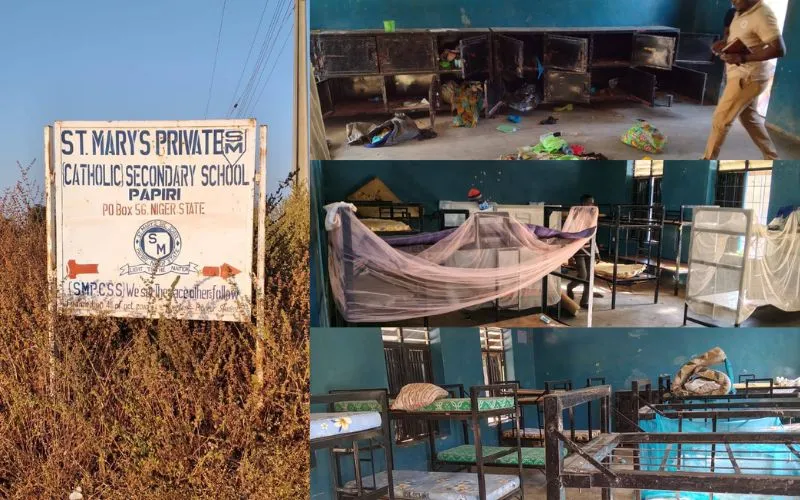
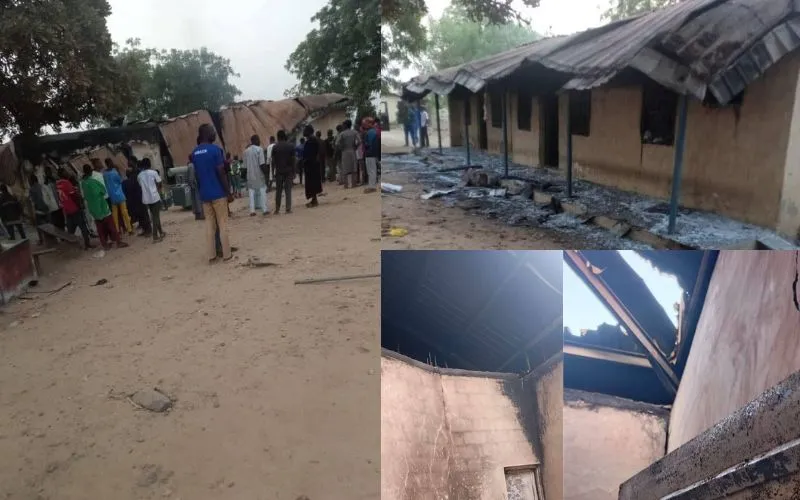
Nigeria’s Catholic Diocese of Kontagora has reported “encouraging developments” after 50 of the over 300 children who were abducted from St. Mary’s Catholic Primary and Secondary Schools on November 21 escaped and reunited with their families.

In a statement issued on November 23, Fr. Jatau Luka Joseph, the Diocese’s Secretary, provided details about those still in captivity.

“As of Sunday, 23rd November 2025, we wish to inform the public that fifty (50) pupils who were previously abducted have successfully escaped and reunited with their parents,” the Nigerian Catholic Priest said in the November 23 statement.

He added, “This encouraging development comes just days after bandits attacked our school and abducted a total of 315 individuals, comprising 289 pupils, 14 secondary school students, and 12 staff members.”

“The pupils who escaped did so between Friday and Saturday. They did not report back to the school. Instead, we were able to confirm their safe return home during follow-up visits and calls from their families,” Fr. Luka said.

Advertisement

The Catholic official emphasized that out of the 315 individuals initially reported abducted, 265 remain in captivity. He broke down the figure to 239 pupils, 14 students, and 12 staff members who are yet to return.

“We are providing these details to ensure complete transparency as we continue to work closely with parents, guardians, security agencies, and relevant authorities to verify and update all records,” Fr. Luka said.

St. Mary’s Catholic School complex hosts 430 primary pupils—377 boarders and 53 day students—and 199 secondary students, of whom 185 are boarders and 14 day students.

Fr. Luka said, “These details are important in helping the public understand the scale of the incident and the extensive efforts underway to account for every missing child and staff member.”

“We remain fully committed to the safe rescue of those still in captivity. We continue to collaborate with security agencies and relevant stakeholders, and we urge the public to remain calm, prayerful, and supportive as these efforts progress,” the Nigerian Catholic Priest said.

More in Africa

Nigeria has been battling with a surge of violence orchestrated by gangs, whose members carry out indiscriminate attacks, kidnapping for ransom, and in some cases, killing.

Boko Haram insurgency has been a major challenge in the country since 2009, a group that allegedly aims to turn Africa's most populous nation into an Islamic nation.

The insecurity situation in many other parts of the country has further been complicated by the involvement of the predominantly Muslim Fulani herdsmen, also referred to as the Fulani Militia.

Meanwhile, the Secretary General of Catholic Secretariat of Nigeria (CSN) has expressed concern about the resurgence of violent insecurity in Nigeria following the recent abductions.

In an interview with ACI Africa on the sidelines of the Investiture of the Order of Knights of St. John International (KSJI) Nigeria, which the Grand Commandery of Abuja Archdiocese organized, Fr. Michael Banjo, described the escalating wave of kidnappings as “heartbreaking” and “a direct assault on human life.”

Advertisement

“In just the last few days, we received tragic news of insecurity on multiple fronts. It is heartbreaking to see all these happen in our country. This is an assault on human life,” Fr. Banjo said on November 22.

The Nigerian Catholic official noted that the rising cases of abduction, religious violence, land denial, and killings reveal a disturbing pattern of hostility against Christians and vulnerable communities.

“Priests, Seminarians, women and men Religious, and lay faithful have been kidnapped; many have been murdered. Churches are attacked, destroyed, and burned. Entire communities are displaced, People forced to abandon their ancestral homes, forced to abandon their livelihoods and live as refugees within their own country,” he lamented.

Fr. Banjo warned against politicizing the crisis or minimizing the lived experiences of victims. He emphasized that the protection of human life is the foremost responsibility of any government.

“The government has a duty, a sacred responsibility to protect all citizens. It is not optional; Christians have suffered greatly, but we also acknowledge that many Muslims have also been victims. Terrorism does not check baptismal certificates before attacking,” the Nigerian Catholic official said during the November 22 Interview.

(Story continues below)

The Catholic Priest argued that Nigeria needs intelligence-driven responses rather than reactive condemnations.

“If the government cannot control the situation, there is no shame in asking for help from advanced nations, especially in intelligence gathering. Terrorists are not spirits. They live in specific locations. They move in large groups. They cross forests, villages, and towns. How is it that their movements are not tracked? These are honest questions the government must answer,” he said.

Despite the grim national mood, Fr. Banjo has a message of hope anchored in steadfast faith.

“Our hope is anchored in God, who is the God of the living, not the God of the dead,” he said.

Fr. Banjo invoked the intercession of St. Cecilia, saying, “She remained steadfast even in the face of death. Her courage should inspire us. Nigeria needs courageous Christians—laity, clergy, Knights—who will not be silent in the face of injustice and Christian persecution.”

Abah Anthony John contributed to the writing of this story.

ACI Africa was founded in 2019. We provide free, up-to-the-minute news affecting the Catholic Church in Africa, giving particular emphasis to the words of the Holy Father and happenings of the Holy See, to any person with access to the internet. ACI Africa is proud to offer free access to its news items to Catholic dioceses, parishes, and websites, in order to increase awareness of the activities of the universal Church and to foster a sense of Catholic thought and culture in the life of every Catholic.