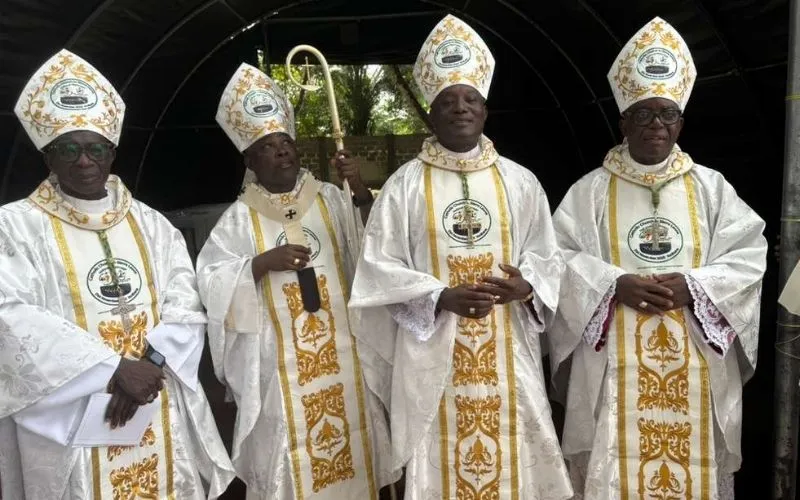
“To a youthful population seeking escape in the false paradise of hard drugs, notably kush, we must collectively be the hope that preserves. Our duty is not just condemnation but active preservation,” Bishop Koroma said.
He added, “We must devise ways to flavour the lives of our young people with real alternatives. With quality education. With viable skills training. With pastoral care that tirelessly reaffirms their God-given dignity.”
The Bishop reiterated the message of Pope Francis that the Church must be “a field hospital”, binding the Sierra Leonean youths’ wounded hearts with “the balm of mercy and the tangible hope of a future.”
He noted that for young people hooked on drugs, peace is the answer, “for young people at peace with themselves and their future would have no need for the false peace of narcotics.”
The Bishop also exhorted Sierra Leoneans to endure hardship amid “multi-dimensional poverty, saying, “To our people weighed down by dehumanizing poverty, we must be a hope that flavors.”
(Story continues below)
He called on development agencies in the country to be more innovative, focusing not only on immediate relief but on sustainable empowerment.
Calling on responsible politics in Sierra Leone, the Bishop of Makeni called on Sierra Leoneans to “shine a glaring, unflinching light on the political mindset that sees public office as a shortcut or fast lane to personal wealth, entitlement, brute power, and a platform to divide our people along tribal and regional lines, rather than advancing the collective wellbeing of all Sierra Leoneans.”
“A leader who sows tribalism is an enemy of peace and an arsonist of national unity,” he said, and added, “Peace is the answer that demands integrity, servant leadership, the rule of law, and a politics that unites rather than divides.”
“We should consider politics as a space where leadership meets responsibility and where the needs of the people dictate the direction of governance. This is the recipe for meaningful peace and stability,” the Catholic Church leader said.
Bishop Koroma also reflected on environmental degradation in Sierra Leone, and decried in particular the “reckless attitude” towards the environment.
He pointed out the country’s poor waste management which he said is “now choking drains in some towns.”
The Bishop condemned the dumping of rubbish along Sierra Leonean street corners, the indiscriminate deforestation, and the unchecked mining that he said is “disfiguring our land.”
“Peace is the answer that calls for ecological conversion, for living in harmony with God’s creation, ensuring a peaceful and sustainable home for our children now and those yet unborn,” he said.
The Bishop also condemned what he referred to as “the monster called tribalism” in Sierra Leone, saying, “Tribalism is a cancer that destroys the hope for a unified nation. It corrodes unity, breeds mediocrity and corrupt politicians use it as a shield against accountability.”
“Peace is the answer that embraces our diversity as strength, not as weakness – a diversity that spices our national life,” he said.
Agnes Aineah is a Kenyan journalist with a background in digital and newspaper reporting. She holds a Master of Arts in Digital Journalism from the Aga Khan University, Graduate School of Media and Communications and a Bachelor's Degree in Linguistics, Media and Communications from Kenya's Moi University. Agnes currently serves as a journalist for ACI Africa.