According to the Cardinal, some leaders who once appeared committed to the nation’s welfare “actually went astray because they were following the money.”
Cardinal Napier underscored the need for constant vigilance, insisting that Church leaders must actively monitor political developments and remain engaged.
“We have to be very conscious about keeping our eye on the ball, keeping our eyes very closely on what is happening in our country and where the politicians are taking us,” he said.
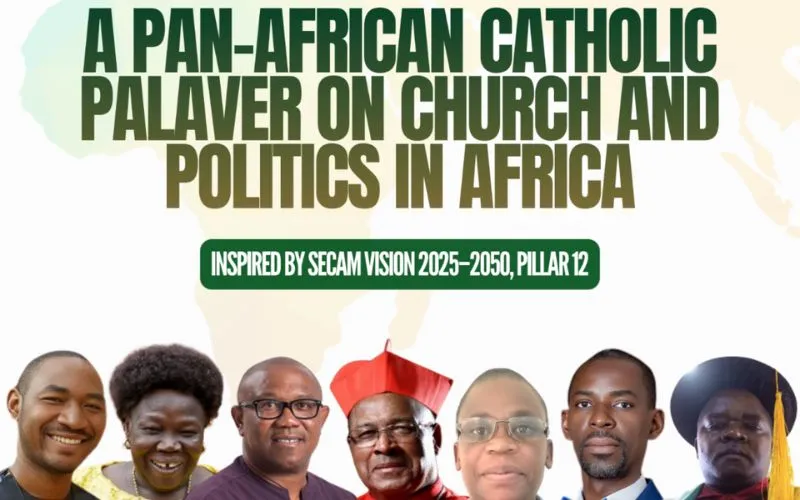
PACTPAN’s Coordinator, Fr. Stan Chu Ilo also shared his thoughts at the palaver, underscoring the Catholic Church’s vision for active engagement in politics and governance.
He emphasized the call of members of the Symposium of Episcopal Conferences of Africa and Madagascar (SECAM) for the Church to collaborate with governments to promote the common good, human rights, accountable governance, and constitutional democracy.
(Story continues below)
“A church that collaborates with governments can help ensure democracy, justice, and human dignity while infusing public life with Gospel values,” Fr. Stan said.
He emphasized that while Africa has made strides toward democracy, many nations remain trapped in cycles of poor governance, corruption, and inequality, with only eight countries considered truly democratic.
The Nigerian Research Professor at DePaul University in the U.S. also underlined the importance of translating the Church’s synodal and family-of-God principles into governance models that promote servant leadership, reconciliation, and restorative justice, especially in conflict-affected regions.
“Enhancing the Church’s prophetic witness through small Christian communities, media, and ecclesial groups is critical to holding leaders accountable while advancing peace, justice, and human development,” the Nigerian Catholic Priest who also serves as the producer and host of African Catholic Voices, a podcast service of PACTPAN, said.
Also speaking during the November 28 palaver, Guy Nko Ebobissé, civil engineer, entrepreneur, and national president of Cameroon’s Christian Democratic Party (ADP), challenged the Catholic Church to reconnect with African youth.
“Young people perceive the Catholic Church in Africa as a big NGO, yet the message of abundant life is difficult to perceive in the African context because the Church appears aligned with the powerful rather than the poor,” Mr. Ebobissé said.
He faulted practices such as Priests running schools and institutions without involving lay professionals, orphanages or hospitals closing due to financial considerations, and young people being excluded from decision-making processes.
“To rebuild trust, the Church must become a place of listening and accompaniment, transparent in its practices, denouncing social injustices even when they come from the powerful,” he said in his presentation titled “How the Church and Catholic public officials can work together to rebuild public trust, especially among disillusioned youth.”
Mr. Ebobissé added, “African youth do not demand moral or faith discourses alone; they demand coherence between words and actions, institutions that embody truth, justice, and equity.”
On his part, Tôognooma Wilfried Pierre Kaboré, humanitarian project manager and former National President of the Catholic Youth Council of Burkina Faso, urged the Church to play a more active role in guiding and empowering young people in politics.
Mr. Kaboré emphasized that the Church’s vocation goes beyond politics, serving as a moral pillar and educator for society.
“The Church is not a political party. Its role is to bring light to all dimensions of human life and support the search for the common good. Progress in politics comes by integrating Christian values, mentoring, and providing opportunities for youth to gain credibility and visibility,” he said.
He said that many young people hesitate to engage due to a lack of political skills, fear of compromise, and insufficient moral and ethical grounding.
Mr. Kaboré proposed four key approaches for fostering meaningful youth engagement in politics.
He mentioned the need to prepare young people to anticipate emerging political needs and develop leadership aligned with citizens’ aspirations; the need to strengthen the youth’s political and civic skills through better-resourced training initiatives; as well as the need to promote ethical young role models by giving them visibility in public forums, conferences, and media.
Kaboré also underlined the need to create parish-based mentorship programs and political fraternities that pair young aspirants with experienced leaders while ensuring spiritual guidance and preventing any form of clerical exploitation.
Jude Atemanke is a Cameroonian journalist with a passion for Catholic Church communication. He holds a Bachelor’s Degree in Journalism and Mass Communication from the University of Buea in Cameroon. Currently, Jude serves as a journalist for ACI Africa.