
Advertisement

Pope Leo XIV: Human Voices and Faces Are Sacred; AI Requires Education and Responsibility

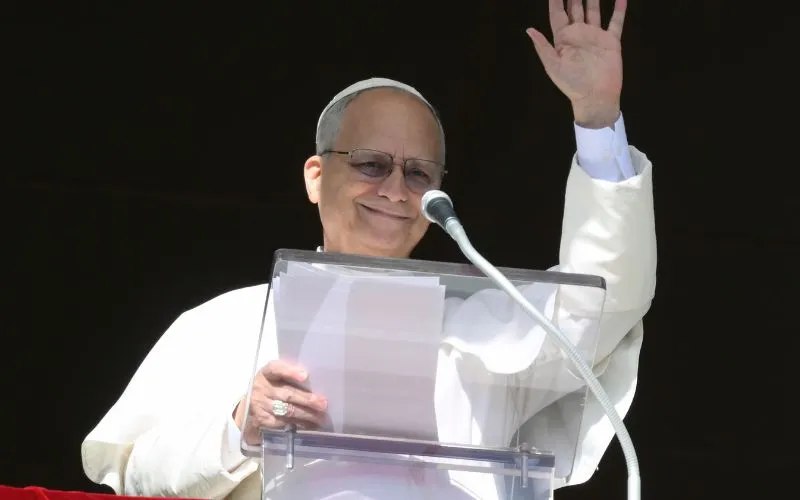
Pope Leo XIV greets pilgrims gathered in St. Peter's Square at the Vatican for the recitation of the Angelus on Jan. 25, 2026. | Credit: Vatican Media

In his first message for the 60th World Day of Social Communications, Pope Leo XIV warns that artificial intelligence and digital technologies can undermine human relationships and distort reality unless they are guided by responsibility and rooted in education.

The pope’s message, titled “Preserving Human Voices and Faces,” emphasizes the uniqueness of every person and the need to protect what he calls the “sacred” signs of human identity in an era increasingly shaped by AI-generated content.

“Our faces and voices are unique, distinctive features of every person,” Pope Leo XIV writes. “Faces and voices are sacred.” He states that safeguarding them ultimately means “safeguarding ourselves,” since the challenge posed by AI is “not technological, but anthropological.”

The pope cautions against surrendering human judgment to algorithms and automated systems, particularly those built to maximize engagement on social media. “Although AI can provide support and assistance in managing tasks related to communication, in the long run, choosing to evade the effort of thinking for ourselves and settling for artificial statistical compilations threatens to diminish our cognitive, emotional, and communication skills,” he writes.

The pope also highlights new risks in online interaction, noting how difficult it can be to tell whether one is engaging with a real person. “As we scroll through our feeds, it becomes increasingly difficult to determine whether we are interacting with other human beings or with ‘bots’ or ‘virtual influencers,’” he writes, warning that chatbots can be used for “covert persuasion” and may “become hidden architects of our emotional states.”
Advertisement

Pointing to the growing capacity of AI to fabricate content — including “parallel ‘realities’” — the pope underscores the dangers of misinformation and calls for renewed commitment to verification and field reporting. He warns that “failure to verify sources” can “fuel disinformation,” deepening “mistrust, confusion, and insecurity.”

Rather than calling for a halt to innovation, the pope urges discernment and governance, proposing what he describes as “a possible alliance” with digital technology — but only on clear foundations. “This alliance is possible but needs to be based on three pillars: responsibility, cooperation, and education,” he writes.

On responsibility, the pope addresses tech platforms, developers, lawmakers, and the media, urging them to prioritize the common good over profit and to ensure transparency and protections for human dignity. He also calls for clear labeling of AI-generated content: “Content generated or manipulated by AI are to be clearly marked and distinguished from content created by humans,” he writes.

The pope stresses the need to protect the work of journalists and creators: “The authorship and sovereign ownership of the work of journalists and other content creators must be protected. Information is a public good,” he writes.

Education, he adds, is essential for building critical thinking and digital citizenship, and it should reach every generation. “As Catholics, we can and must contribute to this effort, so that individuals — especially young people — can acquire critical thinking skills and grow in freedom of spirit,” Pope Leo XIV writes, adding that such literacy should also reach “older adults and marginalized members of society.”

More in Africa

The message is dated Jan. 24, the memorial of St. Francis de Sales, patron saint of writers and journalists.

This story was first published by ACI Stampa, the Italian-language sister service of EWTN News. It has been translated and adapted by EWTN News English.