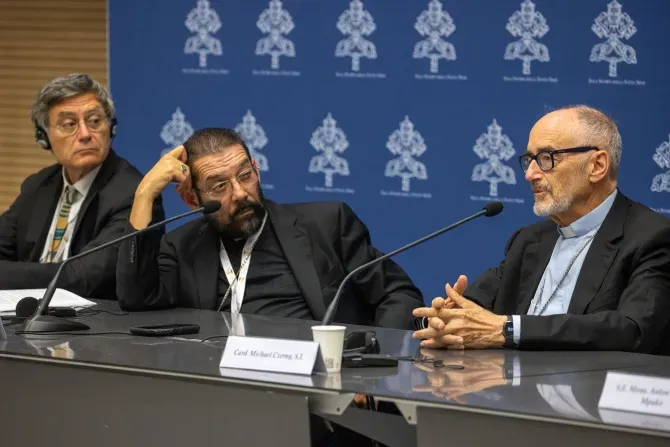
“There is no danger to the nature of the Church,” Czerny added, “because there are responsibilities which are already being — and in some cases are already — entrusted to non-cardinals, non-bishops, non-priests.”
Archbishop Dabula Anthony Mpako of Pretoria, South Africa, said at the same briefing that he believes it is commonly accepted that “synodality must coexist with the hierarchical structure of the Church.”
“I don’t think that is under any question,” he continued. “However, what we are probably wanting to see is how the two can work in such a way that synodality begins to infuse the way the hierarchical structure of the Church operates.”
Adding that he is “not at all worried about that,” the archbishop said, “in the Catholic Church, synodality has a unique character, [because] it is a synodality at the center of which there is the chair of Peter, the pope.”
“At the end of the day, hierarchy goes together with synodality,” he said.
In answer to a question about concerns expressed by some U.S. Catholics that the Synod on Synodality has a predetermined outcome with a liberal agenda, Bishop Daniel Flores of Brownsville, Texas, said he does “not see a conspiracy, I have simply heard honest, sincere, faithful, charitable conversations, under, shall I say, ‘sub tutela petri,’ ‘under the care of Peter.’ That is not a threat to the faith.”
“We live in a very suspicious age,” the bishop, who is a president-delegate to the synod, said. “I have no worry about that.”
Mpako also said a conspiracy “does not connect with reality as I know it.”
“I think the desire for a more synodal Church that encourages participation by all is something that many of us have been calling for,” he said. “We have already fertile ground for that [in Africa]; we have been practicing for that.”
Hannah Brockhaus is Catholic News Agency's senior Rome correspondent. She grew up in Omaha, Nebraska, and has a degree in English from Truman State University in Missouri.