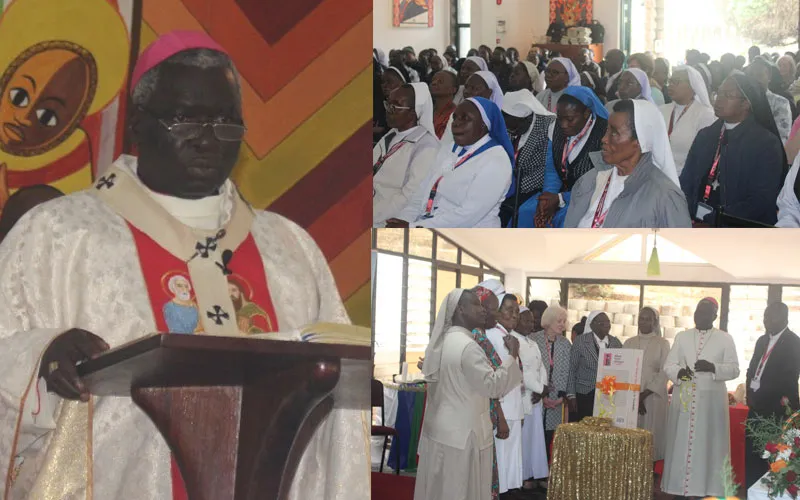
He said, “You know, more and more, we talk about the Church being patriarchal. It is very important, because God is also patriarchal. In His own image, the image of man, He made man and woman in His own image and likeness. The Church is like that. It cannot be one without the other.”
“The Church is matriarchal…because mothers are also there,” the Local Ordinary of the ADN said.
He underscored the central role women play in the Church saying, “We say Mary is the Mother of God. And indeed, she is. Who can talk about the Church, without Mary, Mother of God? Nobody can, especially in the Catholic Church.”
He pointed out that in most Parishes, women form the overwhelming majority, filling the churches, taking their children to Church, and praying faithfully for their husbands and relatives.
Archbishop Anyolo described women as “a very strong strong force” in the Church, saying, “The life of the Church is not only with the man, the life of the Church is with the woman also.”
He continued, “So do not be afraid to celebrate your life, in its simplicity, in its joy, in its heart, in its thought, in its work. Do not be scared because men are there serving.”
In his September 3 homily the 69-year-old Catholic Church leader also reflected on beauty as part of women’s theological contribution.
“In the world we live in, people search for two important things, even in our Church. They may think they are searching for riches and fulfillment. But in truth, in that search for fulfillment, the world is prone to seek beauty. To search for beauty,” he said.
Beauty culminates in what God created, he added, noting that “in our Church, we search for that beauty and holiness. Beauty and holiness.”
“I feel encouraged that the theology of a woman brings in the beauty of God. It brings the beauty of God. The theology of a woman brings in the virtuous life that we live. Your theology is very important. It is to recreate that beauty of God,” Archbishop Anyolo said in homily during the four-day event realized under the theme, “Synodality in Action: Emerging Ecclesiologies, Vitality of Women and Discerning Leadership For The 21st Century”.